

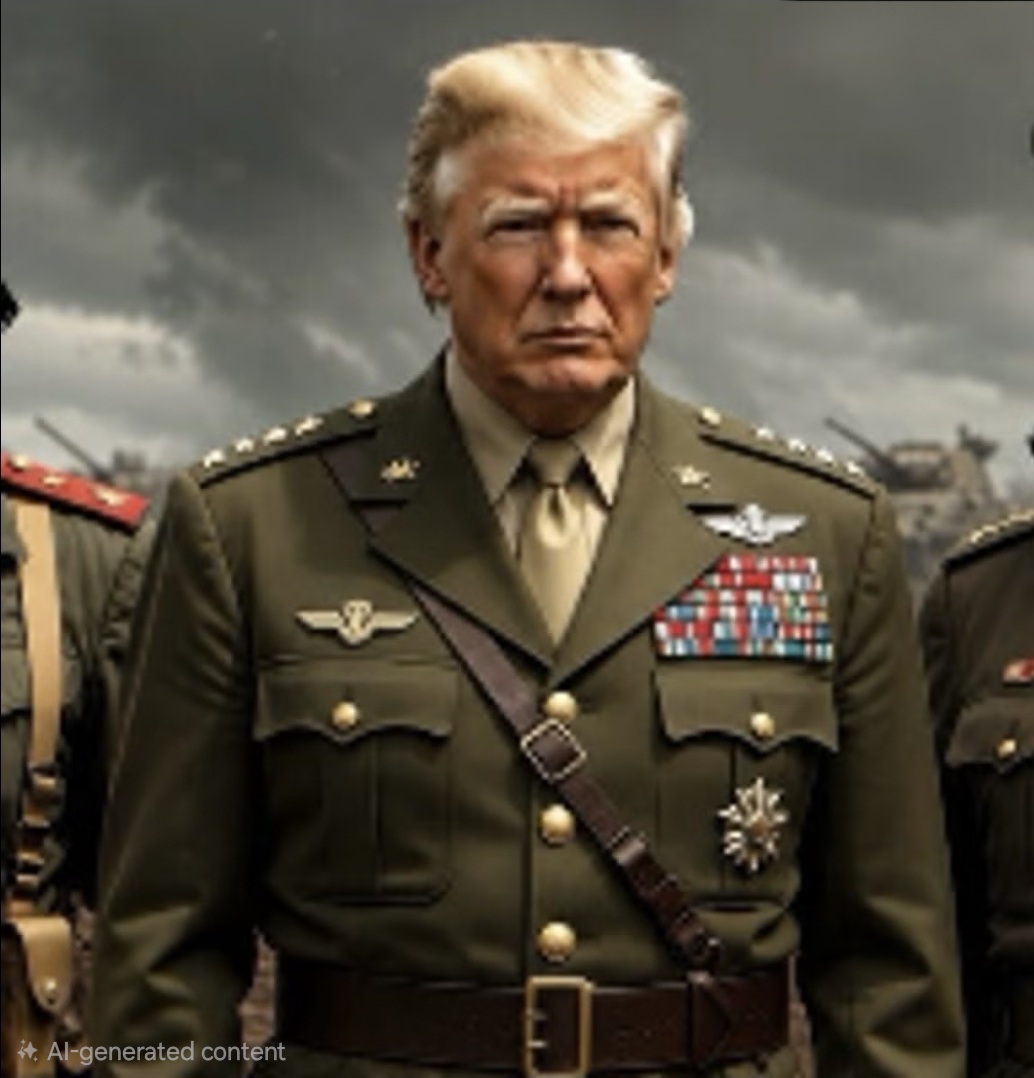
We ran the scenario. America loses the century.
Japan strikes Pearl Harbor. Germany declares war on the United States. And the president decides that none of it is his problem. This is a scenario wargame in which every historical fact is real, and the only fiction is the man at the top.
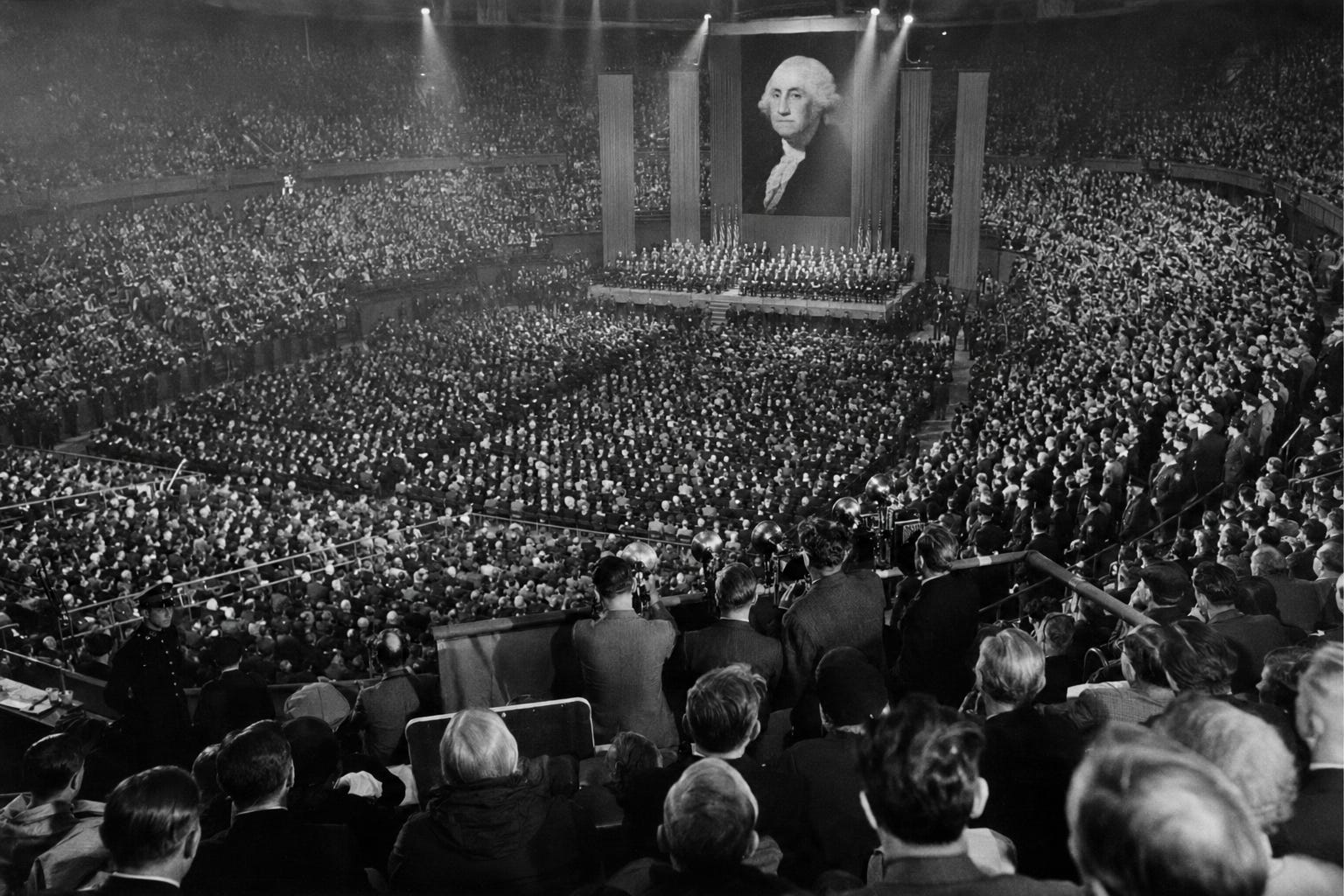
Madison Square Garden, New York City. The evening of February 20, 1939.
Twenty thousand people fill the hall. On the stage hangs a portrait of George Washington, ten meters tall. On either side of the first president hang swastikas.
This is not Nuremberg. This is Eighth Avenue.
The German American Bund has rented the most famous arena in America for what it calls a Pro-American Rally. Men in grey uniforms line the aisles. The crowd salutes, stiff-armed, the way crowds are saluting that same winter in Munich and Vienna. On the podium stands Fritz Kuhn, the Bund’s leader, a chemist from Detroit by way of Bavaria, and he is telling twenty thousand cheering Americans that their country is being stolen from them by the press and by the Jews, whom he names, one by one, to laughter.
A twenty-six-year-old plumber’s helper from Brooklyn named Isadore Greenbaum can take exactly as much of this as any of us could. He breaks from the crowd, rushes the stage, and reaches Kuhn’s podium before the uniformed men catch him. They beat him on stage, in front of twenty thousand people, while the crowd roars. The police escort Greenbaum out. He is fined ten dollars for disorderly conduct. Kuhn finishes his speech.
Outside, tens of thousands of New Yorkers are protesting in the winter cold. Inside, the hall is full.
Every detail above is real. It was photographed. It is on film. And the twenty thousand inside the hall were not a fringe. They were the visible edge of an America that did not want the coming war and did not much care who won it. The only thing this crowd was missing was a president on its side.
In our history, that president never came. Roosevelt held the line, and the crowd in the Garden ended up on the losing side of the American century.
In this article, the crowd gets its man.
The Simulation You Asked For
Our scenario work has found its audience. The Battle for Kharg Island, The Strait America Cannot Open and Sixty Hours in February: How Europe Fights Russia Without America became the most read and most shared pieces we have published, and if you have not read them, they are worth your time. But a number of you wrote to us with a different request. Take the method backwards, you said. Stop simulating the next war and simulate a war we already know, with one variable changed. The variable you proposed most often was this: take Franklin D. Roosevelt out of the White House, and put Donald Trump, with the character we have all now observed at length, in his chair in December 1941.
So we did. The rules are the ones we always use. Every historical fact in this piece is real and checkable, the isolationist crowds, the industrial numbers, the convoy routes, the declarations of war. The only fiction is the man at the top, and we do not even have to invent him. We know how he responds to an attack he did not expect. We know what he thinks of allies who cannot pay. We know which kind of leader he admires. We simply let that man make the calls at each of history’s hinges, and followed the logic wherever it went.
One housekeeping rule before we begin, because it matters: every quotation attributed to Trump, Vance, Rubio or Hegseth inside the scenario is invented by us. It is simulation dialogue, written to match documented patterns of speech and behavior, and it should be read the way you read dialogue in a wargame. Where we quote something a real person actually said or is reported to have said, we name the source. The two categories are kept strictly apart throughout.
It went somewhere we did not expect. This is not a story about America losing a war. America never fights one. It is a story about what gets built by everyone else while America watches, and who inherits the century when it is over.
The Audience Was Already in the Building
Begin with what requires no invention at all.
By 1941 the America First Committee had more than 800,000 paid members, the largest antiwar organization in American history. Charles Lindbergh, the most famous man in the country, filled arenas telling Americans the war was a British and Jewish project. Henry Ford, the most famous industrialist on earth, had spent the 1920s publishing antisemitic conspiracy material in his newspaper, The Dearborn Independent, and in July 1938 he accepted the Grand Cross of the German Eagle, Nazi Germany’s highest decoration for foreigners. He never gave it back.
If the pattern feels oddly current, it should. The most famous industrialist of our own era also owns his own media platform, and has spent recent years using it to amplify conspiracy material aimed at a religious minority, anti-Muslim this time rather than anti-Jewish, while endorsing Germany’s far right and promoting Britain’s. The parallel is not something we constructed. History arranged it, and we merely note it: the richest man of the age, a mass media machine of his own, and a minority to point it at. Ford would have recognized the business model.
This was the environment. Isolationism was not a fringe. It was a mass movement with celebrity leadership, industrial money and a plausible claim to speak for half the country. What it lacked was a president.
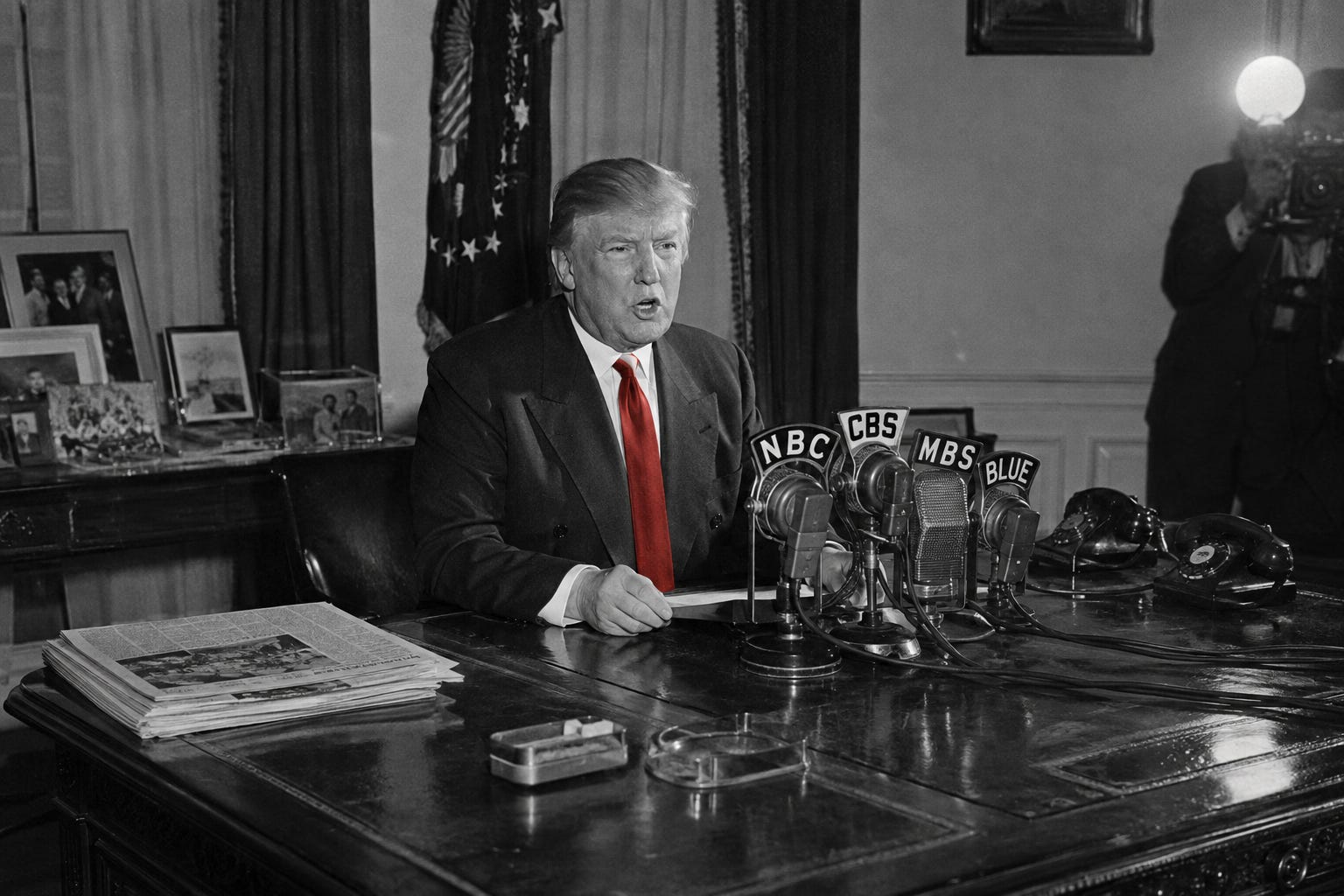
Now the man we place at the top. His characteristics are a matter of record, not speculation. He received five draft deferments during Vietnam, one of them medical, for bone spurs. In 2026 we all watched the Iran pattern play out in real time: escalate, boast, retreat, and rename the retreat a victory. His family history is German, not Swedish, although the family claimed Swedish origins for decades, a cover story that survives in print in The Art of the Deal; his grandfather Friedrich emigrated from Kallstadt in the Pfalz in 1885. And his admirations are documented by the people who worked closest to him. His own White House chief of staff told The Atlantic what the president had said to him:
“I need the kind of generals that Hitler had.”
John Kelly, White House chief of staff, to The Atlantic
Kelly also recalled the remark that Hitler “did some good things.” Ivana Trump claimed in Vanity Fair in 1990 that he kept a book of Hitler’s speeches by the bed. These are reported statements, attributed here to the people who made them, and the reader can weigh them. For a wargame, they are more than enough to set the character’s parameters.
Around him, the simulation places the team we know. Pete Hegseth at the War Department, a man who mistakes force protection for strategy. J.D. Vance as the ideologist, whose documented indifference to a European ally under attack we transpose faithfully to 1941:
“I don’t really care what happens to Ukraine one way or the other.”
J.D. Vance, February 2022, days before the invasion
Marco Rubio as the smoother of edges, the man sent to explain that surrender is actually leverage.
The pieces are on the board. History now proceeds to move them.
Lend-Lease Dies in the Senate
The first hinge comes before America is even attacked.
In our timeline, Roosevelt spent 1940 and 1941 dragging a reluctant country toward the fight. The destroyers-for-bases deal in September 1940. Lend-Lease in March 1941, the program that would eventually move 50 billion dollars of war material to the Allies and that Churchill called the most unsordid act in history.
In the scenario, none of it survives contact with the president. Britain in 1940 is a bankrupt customer asking for credit, and our simulated Trump treats it exactly the way the real one treats allies in arrears. Churchill, in our scenario, is dismissed at a press availability as “a failing leader, everybody says it,” and the terms are cash up front, “like NATO should have paid.” Vance delivers the Senate speech that kills the bill, and he does not need new material; the argument that Europe’s democracies are decadent and unworthy of American blood is the same speech he gives today, moved eighty-five years earlier. Lend-Lease dies in committee.
Britain stands alone, and its one remaining industrial lifeline runs not from New York but from a cold grey harbor in Nova Scotia. Remember Halifax. It will matter more than any city in this story.
December 7, 1941: The Speech That Never Comes
The Japanese carrier force strikes Pearl Harbor at 7:55 on a Sunday morning. 2,403 Americans die. The battleship Arizona burns for two days.
In our timeline, what follows is the most consequential single day of presidential leadership in the century. Roosevelt before Congress: a date which will live in infamy. War declared within twenty-four hours, with one dissenting vote.
In the scenario, the president addresses the nation from Mar-a-Lago that evening, and our simulation writes his statement from a template we have all heard many times. The attack is somebody else’s fault, “I inherited these admirals, the worst admirals, everybody says it.” Hawaii was “poorly defended for years, not my fault, I just got here.” And the closer, the line that in our wargame ends the American century before it begins: the announcement that Secretary Rubio will travel to explore “a framework, a beautiful framework” with Tokyo.
No declaration of war is requested. Congress, in which the president’s party holds the majority and the president holds the party, does not act on its own. A handful of senators demand war. They are primaried in absentia by the president’s social operation, 1941’s version of it, the radio men and the pamphlet networks that America First has kept warm.
The fleet burns in the harbor, and the United States government asks Japan whether it is willing to talk.
The War That Asked Permission
Four days later comes the fact that makes this scenario genuinely disturbing, because at this hinge the real history is so clean.
On December 11, 1941, Adolf Hitler declared war on the United States. Unprovoked, unforced, to the lasting bafflement of historians. America never had to choose to fight Germany. Germany chose for it. All Washington had to do was say yes to a war that had already been declared against it.
In the scenario, the White House says no. The declaration is dismissed from the podium as “a fake declaration, probably fake, Germany has been very nice to us.” Berlin, which has spent years studying how to flatter useful men, understands immediately what it is dealing with. Ribbentrop’s cables, in our simulation, drip with respect for the president’s strength, and quiet intermediaries begin mentioning what the Trump Organization might build in the new Europe once the unpleasantness is over. The president, in our scenario, calls Germany “our natural partner, great genes, my father’s people,” and describes occupied Paris as “a beautiful takeover, honestly, very efficient.”
Note what the scenario does not need him to do. He declares no war on Britain. He signs no pact with Berlin. He simply declines a war that history had hand-delivered to his desk, and the declining is enough. Cowardice does not require collaboration. It only requires an excuse, and Berlin is delighted to keep supplying them.
Stalin is the one dictator our simulated president cannot embrace, because Stalin is a communist and the base will not have it. So the Eastern Front becomes the one war he permits himself to enjoy, from the sidelines, cheering the Wehrmacht the way a man cheers a team he has bet on.
The Tankers Burn Off Miami Beach
Now the part of the story where the price of all this stops being abstract, because it is paid in American lives, in sight of American beaches, and still nothing happens.
The real history first, because most readers have never been told it. In the first six months of 1942, German U-boats conducted Operation Paukenschlag, Drumbeat, against shipping along the American East Coast, and it was the most one-sided campaign of the entire Atlantic war. Nearly 400 ships went down in and around American waters in half a year. Coastal cities refused to enforce blackouts, Miami’s hotels kept their lights burning, and the glow silhouetted the tankers perfectly for the U-boat commanders offshore, who called it the Second Happy Time. Americans stood on beaches and watched torpedoed tankers burn on the horizon. That happened in our timeline, with America fully at war and mobilizing.
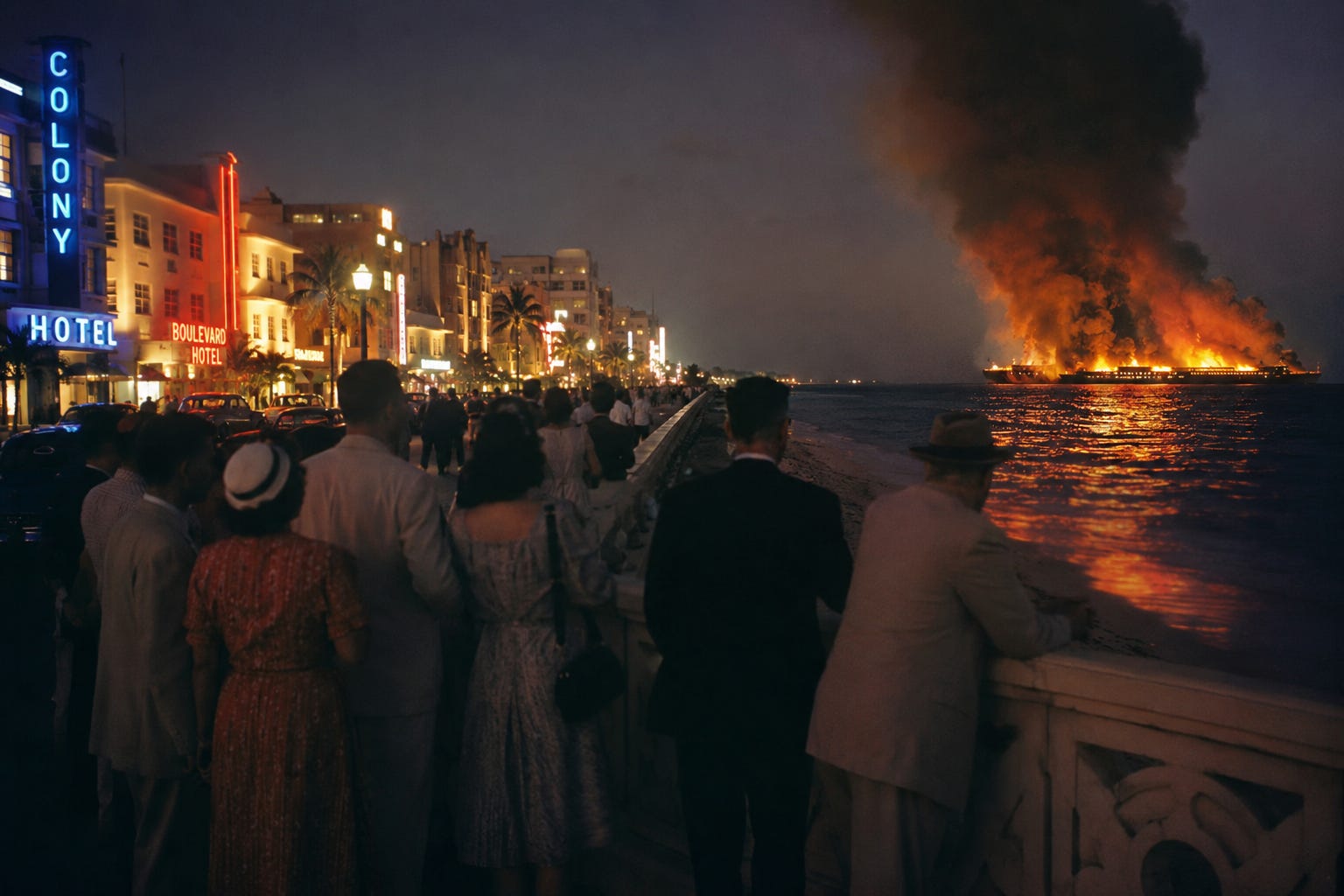
Now run it without the mobilization.
In the scenario, the U-boats come anyway, because the tankers are carrying oil to Britain and Germany is at war whether Washington admits it or not. Hegseth, at the War Department, orders the Atlantic Fleet to remain in port, “force protection,” the phrase that means the navy’s first mission is to avoid losses rather than inflict them. The president’s position, delivered in our simulation from a podium in Florida while smoke is visible offshore, is that the shipping companies “should have paid for their own escorts, these are very rich companies.”
American merchant sailors burn to death in American waters, week after week, and the United States Navy watches from its moorings.
Here is the sentence this entire first half has been building toward, and we ask you to sit with it, because everything that follows grows from it. The United States is attacked, on its own coast, for six months, and does not respond. Not because it cannot. The fleet exists, the shipyards exist, the men exist. It does not respond because the man at the top has spent his whole life avoiding exactly one thing, and that thing is a fight with someone who hits back.
What happens to the world when the strongest country in it simply declines to show up? Read on, because we run the answer to the end. Who actually wins this longer, darker war, and why it is not the country you think. Which nation quietly inherits the American century, and what it builds with it. Why the Iron Curtain hangs on a different river, and falls forty years early. And why, in this timeline, Honolulu is today a Japanese prefecture.

