

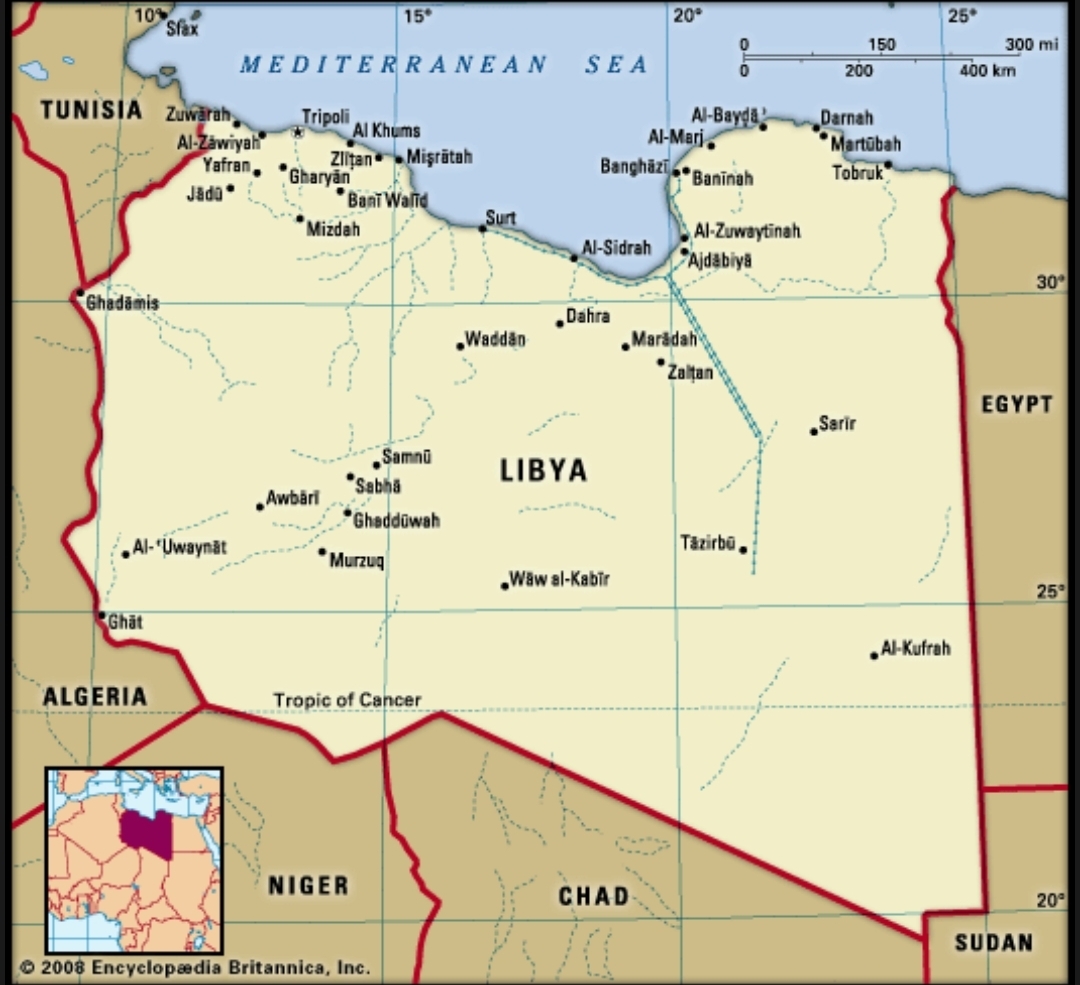
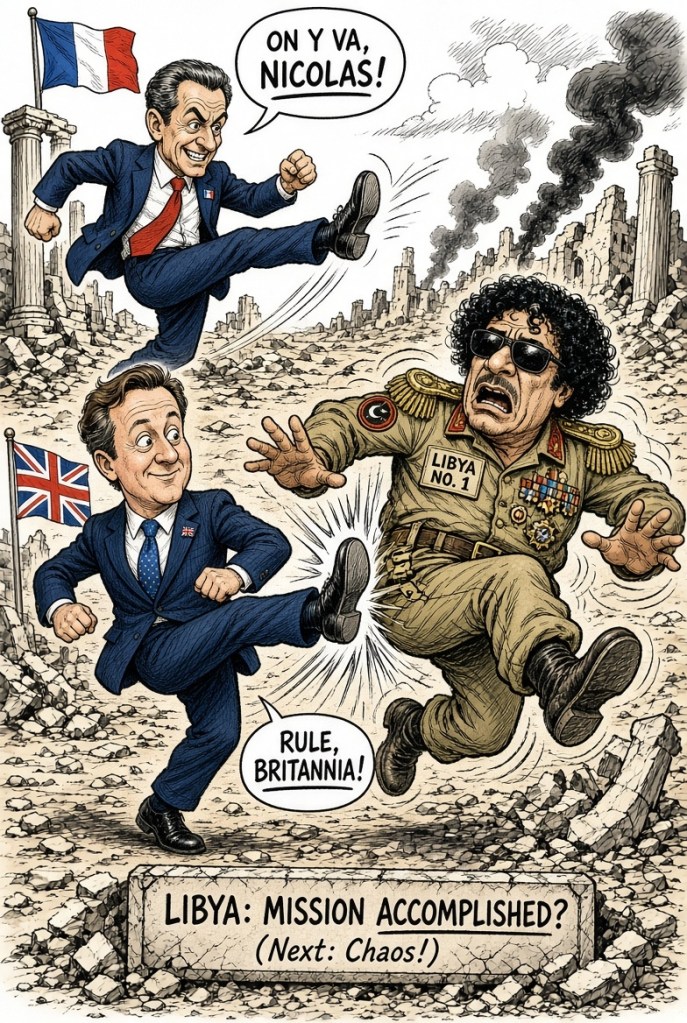
Nicolas Sarkozy did not invent the idea of intervening in Libya, but few leaders embraced it with quite the same theatrical urgency. In early 2011, as Muammar Gaddafi’s forces advanced on Benghazi, the French president positioned himself at the front of the charge. France recognised the rebel National Transitional Council early, lobbied aggressively for UN Security Council Resolution 1973, and sent its aircraft into action on 19 March — among the first to strike. Sarkozy cast the operation as both moral necessity and European leadership moment: history would not forgive inaction, and France would not stand aside.
The military phase succeeded in its narrow objective. Gaddafi’s forces were degraded, the dictator was eventually killed, and France, alongside Britain, claimed a share of the credit. Sarkozy and David Cameron even made a joint victory-lap visit to Tripoli and Benghazi in September 2011, promising continued support for the new Libya. What followed was less flattering. The rapid collapse of the old regime produced no coherent successor order. Militias proliferated, institutions disintegrated, and the country slid into years of civil conflict, economic predation, and regional proxy competition. France, like its partners, had prioritised the removal of one man over the construction of anything durable in his place. Subsequent French governments continued to meddle — at times tilting toward Khalifa Haftar in the east — while officially backing UN-led processes that never quite delivered stability. The result was not French influence restored, but a fragmented Libya that remains a source of migration pressure, arms flows, and strategic frustration for Europe.
That is the foreign-policy ledger. The personal one has proved even more costly for Sarkozy.
In September 2025 a Paris criminal court found the former president guilty of criminal conspiracy in connection with alleged Libyan financing of his successful 2007 presidential campaign. The court sentenced him to five years in prison, a €100,000 fine, and a five-year ban from holding public office. Critically, the judges ruled that the sentence would begin regardless of appeal — an unusually harsh procedural decision that made Sarkozy the first former French president of the modern era to face actual incarceration. He was acquitted of the more direct charges of passive corruption, illegal campaign financing, and concealing the embezzlement of public funds. The court concluded there was insufficient proof that Libyan money actually reached or was spent on the campaign. What it did find was that Sarkozy, while interior minister and presidential candidate, had allowed close aides to pursue contacts with Libyan officials — including meetings involving Abdullah al-Senussi, Gaddafi’s intelligence chief and brother-in-law — with a view to obtaining financial support in exchange for diplomatic favours aimed at rehabilitating the Gaddafi regime’s international standing.
The sums alleged over the years ranged as high as €50 million. Intermediaries, suitcases of cash, and opaque financial routes featured heavily in the decade-long investigation that began after Saif al-Islam Gaddafi publicly accused Sarkozy of taking Libyan money once the 2011 war had turned against his family. Sarkozy has always denied the core allegations, describing the case as politically motivated and the verdict as a scandal against the rule of law. He has appealed. The legal process continues, but the political damage is already irreversible: a former head of state associated with the very regime he later helped destroy has been convicted of conspiring to take its money.
The irony writes itself. The leader who presented the 2011 intervention as a clean break with a pariah dictator had, according to the court, earlier been prepared to do business with that same dictator’s money when it suited electoral needs. France’s energetic role in toppling Gaddafi cannot be reduced to personal corruption — the decision involved multiple capitals, genuine humanitarian concerns, and real-time intelligence assessments. Yet the conviction adds a layer of retrospective cynicism to an already discredited enterprise. Removing a dictator while entangled, even at one remove, in the murky financing of one’s own rise does not burnish the image of principled interventionism.
Libya’s chaos has many authors. Sarkozy’s France was among the most vocal and earliest. The military success was real; the strategic follow-through was not. And the personal legal reckoning, years later, has left the former president with a prison sentence and a reputation permanently tethered to the regime he once courted and then helped to destroy. History, as he once claimed, does keep score. It just does not always keep the score Sarkozy preferred.

