

There is a curious magic trick at the heart of modern politics.
Politicians promise to cut taxes. The wealthy cheer. Businesses applaud. The public is told that investment will surge, prosperity will spread and, eventually, the benefits will “trickle down” to everyone else.
Then the government discovers that it still has to pay for hospitals, schools, roads, policing, defence, pensions, social security and all the other inconvenient things citizens expect government to provide.
The money has not trickled down.
But the bill has.
That, in essence, is the political durability of trickle-down economics.
It is not merely an economic proposition anymore. In parts of the political world it has become a dogma, a statement of faith which survives the inconvenient evidence that occasionally wanders into the room.
And Britain, having watched the American experiment for decades, now has politicians looking across the Atlantic and saying, in effect: perhaps we need a little bit of that.
Perhaps we do not.
When tax became a dirty word
The cleverest achievement of the tax-cutting revolution was not necessarily cutting taxes.
It was making tax itself sound immoral.
The word became politically toxic.
Governments began talking about “burdens”, “charges”, “contributions”, “levies” and “fiscal drag”. Politicians learned that almost anything could be sold to the electorate provided nobody called it what it actually was.
Britain became particularly adept at this linguistic gymnastics.
VAT is a tax.
National Insurance is a tax-like compulsory contribution that finances public expenditure and social security.
Congestion charges are not technically taxes in the same legal sense, but they are certainly compulsory payments imposed through public policy.
Yet politicians discovered that voters react differently when the word tax disappears from the sentence.
The result is an extraordinary political paradox.
Everyone wants Scandinavian-quality public services.
Everyone wants better hospitals, better schools, safer streets, functioning infrastructure, decent pensions and an effective welfare state.
But nobody wants to pay for them.
We have somehow arrived at the political equivalent of ordering champagne and insisting that the waiter should simply find somebody else to pay the bill.
Enter Ronald Reagan
The modern political mythology of supply-side economics reached its great American political moment with Ronald Reagan.
The argument was seductive.
Reduce tax rates, particularly on high earners and investment.
The wealthy will invest more.
Businesses will expand.
The economy will grow.
Jobs will multiply.
Tax revenues will eventually recover because there will be a much larger economy from which to collect them.
It was an elegant theory.
The problem with elegant theories is that reality occasionally has the bad manners to interfere.
Reagan’s administration combined substantial tax reductions with increased defence spending. The result was a dramatic deterioration in the federal fiscal position. Historical analysis has specifically identified the sharp tax-rate reductions and increased defence expenditure as contributors to the Reagan-era deficit. (RCNi Company Limited)
And that should have been the point at which the great experiment was subjected to a rather serious post-mortem.
Instead, the political lesson drawn by much of the American right was remarkably different.
The answer to deficits was apparently not necessarily raise revenue.
It was to reduce government.
This became associated with what later came to be described as “starve the beast” economics: cut government revenue and eventually government will be forced to shrink.
There was one small problem.
Government did not disappear.
The Pentagon did not disappear.
Social Security did not disappear.
Medicare did not disappear.
The federal government continued spending.
So the difference went onto the national credit card.
And America has been carrying the card ever since.
The Bushes and the return of the tax-cutting faith
The George W. Bush administration repeated the formula.
Tax cuts were presented as economic stimulus and a route to greater prosperity. But tax reductions, combined with spending commitments and wars, contributed to large deficits.
The lesson should have been obvious:
Tax cuts do not abolish the cost of government. They merely reduce the revenue available to pay for it.
There are circumstances in which tax cuts can stimulate economic activity.
There are also circumstances in which high taxation can distort incentives.
Neither proposition is controversial among serious economists.
The problem begins when either proposition becomes a religious commandment.
The United States now provides a spectacular warning.
The Congressional Budget Office projects a federal deficit of approximately $1.9 trillion in 2026, with debt held by the public at about 101 per cent of GDP. Under current law, the deficit is projected to rise to $3.1 trillion by 2036 and debt held by the public to reach 120 per cent of GDP.
And the Trump era has doubled down on the same instinct.
The 2025 reconciliation legislation alone was estimated by the CBO to increase projected deficits by $4.7 trillion over the relevant budget window, after accounting for economic and debt-service effects.
This is not an argument that every American deficit was caused by tax cuts. It plainly was not.
Wars cost money.
Recessions cost money.
Pandemics cost money.
Ageing populations cost money.
Interest on accumulated debt costs money.
But that is precisely the point.
If politicians promise citizens an ever-expanding catalogue of public benefits while simultaneously promising ever-lower taxes, somebody eventually has to explain the arithmetic.
Economics is not impressed by campaign slogans.
Two plus two continues to equal four even when delivered from a podium.
The British version: tax by any other name
Britain has taken a somewhat more sophisticated route.
British politicians generally know that the British public expects government to provide considerably more than the American model traditionally does.
So outright tax abolition is difficult.
Instead, governments have developed a vocabulary of fiscal camouflage.
Tony Blair’s Labour government did it.
Gordon Brown did it.
Governments since then have continued the tradition.
National Insurance became a “contribution”.
VAT became an “indirect tax”.
Congestion charging became a mechanism for managing traffic.
The language changes.
The underlying reality does not.
The government requires revenue.
And there is nothing inherently shameful about saying so.
The real political dishonesty is pretending that public services can be maintained without either taxation or borrowing.
The Office for Budget Responsibility currently forecasts UK National Accounts taxes rising from 34.5 per cent of GDP in 2024-25 to 38.5 per cent by 2030-31, with personal taxes, including income tax and National Insurance, accounting for a significant part of that increase. VAT alone is forecast to raise around £181 billion in 2025-26.
Meanwhile, Britain continues to wrestle with deficits and a public debt burden approaching the size of annual economic output.
The latest figures underline the problem. Government borrowing in July 2026 unexpectedly reached £1.8 billion, while borrowing for the first four months of the financial year reached £56.7 billion.
So we are left with an uncomfortable question:
What exactly is the alternative to taxation?
The Buffett paradox
Perhaps the clearest illustration comes from Warren Buffett.
Buffett famously pointed out that his effective tax rate was lower than that of many people working in his office.
His 2010 figures showed federal income tax equivalent to about 17.4 per cent of taxable income, while he said the effective tax burdens of the other 20 people in his office ranged from 33 to 41 per cent.
The precise comparison requires some care because different definitions of income and tax can produce different percentages.
But the underlying phenomenon is real and important.
The tax system does not necessarily treat £1 of wages in the same way that it treats £1 of investment income.
That is where the trick becomes particularly interesting.
Suppose a billionaire owns shares worth £10 billion.
The shares rise in value by £1 billion.
The billionaire is now £1 billion wealthier.
But if those shares have not been sold, the increase may not be treated as ordinary taxable income.
Meanwhile, the nurse receives £40,000 in salary.
Tax is deducted.
National Insurance is deducted.
VAT is subsequently charged when the nurse spends some of what remains.
The billionaire can therefore become dramatically richer without generating anything remotely equivalent in taxable income.
The nurse cannot.
That is not necessarily a conspiracy.
It is the consequence of how modern tax systems distinguish between income, consumption, capital gains and accumulated wealth.
And it creates a remarkable political illusion.
We say we tax income.
But wealth can grow much faster than income.
The great warehouse of wealth
This is the part of the debate politicians tend to avoid.
Imagine two people.
Person A earns £1 million a year from employment.
Person B owns assets worth £100 million and receives relatively little conventional taxable income.
Both may become considerably richer.
But the tax system can treat them very differently.
The wealthy individual may have companies, trusts, investment portfolios, property, pensions, capital gains, borrowing arrangements and other mechanisms through which wealth can be held, transferred and managed.
The ordinary employee has a payslip.
There is nowhere to hide a payslip.
The taxman knows precisely what the employee earned before the employee does.
This is why the political debate about taxation needs to move beyond the simplistic question:
“How much tax do you pay?”
The more important question is:
“Tax on what?”
Income?
Consumption?
Capital?
Property?
Inheritance?
Corporate profits?
Land?
Unrealised gains?
The answer can transform the apparent fairness of the system.
The political genius of blaming tax
This is where trickle-down economics performs its most impressive trick.
It convinces ordinary people that the enemy is taxation, rather than asking the more fundamental question:
Who is being taxed, on what, and at what effective rate?
The consequence is politically extraordinary.
A worker can be persuaded to oppose higher taxation on billionaires because the word tax has become synonymous with government taking money from them.
But the worker is already paying tax.
The billionaire is already paying tax.
The question is whether the distribution of that tax burden is compatible with the society we claim to want.
And this is where the political debate becomes intellectually dishonest.
Politicians promise lower taxes while simultaneously promising better services.
They denounce taxation while complaining about failing hospitals.
They demand lower public spending while promising voters more police officers.
They want cheaper government but more infrastructure.
They want balanced budgets but lower taxes.
Eventually somebody has to introduce the accountant.
There is no Commonwealth without a common purse
The uncomfortable truth is that a functioning society requires a commonwealth.
Not merely wealth.
A common pool of resources from which society collectively pays for things individuals cannot efficiently provide for themselves.
The NHS is a commonwealth institution.
The courts are a commonwealth institution.
The roads are a commonwealth institution.
National defence is a commonwealth institution.
Schools, policing, public health, environmental protection and basic social security all require collective financing.
We can argue endlessly about the appropriate size of government.
We should.
We can argue about whether taxes are too high.
We should.
We can argue about whether government wastes money.
Absolutely.
But the argument cannot honestly be:
“We want all the benefits of the commonwealth but none of the taxation required to sustain it.”
That is not economics.
It is wishful accounting.
And now Britain is watching America again
The extraordinary thing is that Britain has the American experiment sitting in front of it like a giant fiscal warning sign.
America has enormous economic strengths.
It remains one of the world’s most innovative economies.
It has extraordinary capital markets, universities, technology companies and entrepreneurial capacity.
None of this proves that tax cuts cause deficits.
But neither does American economic dynamism prove that governments can indefinitely cut revenue without consequences.
The current CBO numbers should therefore be read as more than an American problem. They illustrate the arithmetic consequences of a political system in which spending commitments, tax preferences and accumulated debt collide.
Britain should be paying attention.
Instead, sections of British politics appear to be rediscovering the old religion.
Cut taxes.
Cut regulation.
Cut government.
Cut welfare.
Cut, cut, cut.
But nobody quite explains what happens when the cutting reaches the bone.
The French lesson
There is another historical warning worth remembering.
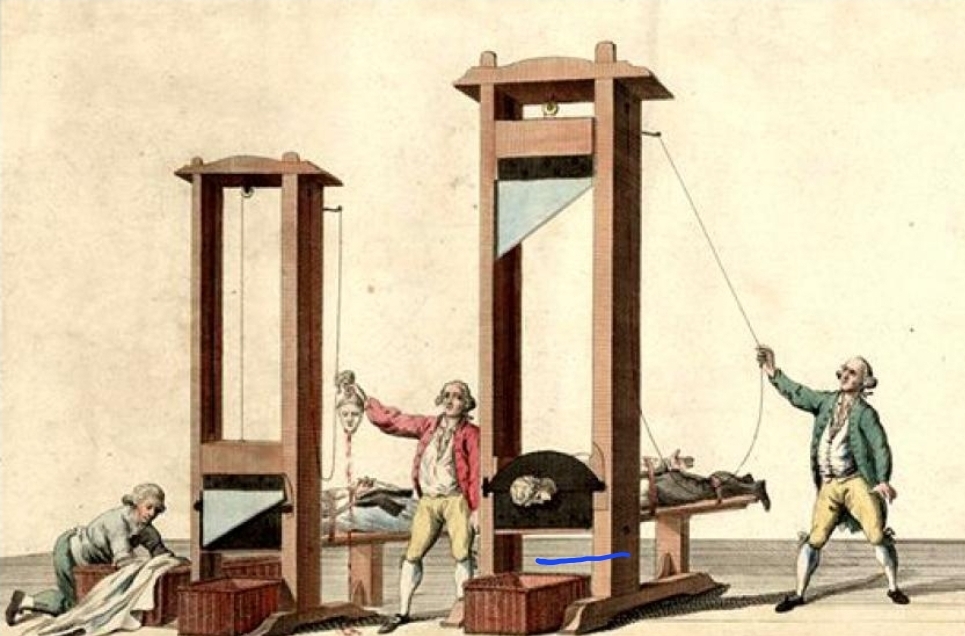
Pre-revolutionary France did not collapse simply because people suddenly became interested in guillotines.
The fiscal system of the ancien régime was deeply unequal. The clergy and nobility enjoyed substantial exemptions while the Third Estate bore much of the tax burden. Recent economic research has found a strong relationship between local tax burdens and unrest in the years preceding the French Revolution.
The famous phrase about “let them eat cake” is almost certainly apocryphal.
The underlying political lesson is not.
People can tolerate inequality for surprisingly long periods.
What they find much harder to tolerate is a system in which they believe the rules are different for those at the top.
That is the danger.
Not taxation itself.
Not even inequality itself.
Perceived unfairness.
A society can survive high taxes if citizens believe the system is broadly fair and that their money produces something collectively valuable.
It becomes much more fragile when ordinary people are told that they must pay more for diminishing services while those with the greatest capacity to contribute are invited to warehouse wealth and optimise their tax position.
We are sleepwalking towards the politics of resentment
This is the great danger in today’s politics.
If mainstream politicians refuse to defend taxation, somebody else will eventually define taxation for them.
And populists are very good at this.
They will tell voters that their problems are caused by immigrants.
Or welfare recipients.
Or bureaucrats.
Or Brussels.
Or Washington.
Or bankers.
Or foreigners.
Or the poor.
Or the rich.
Or whoever happens to be standing conveniently close to the political microphone.
But the real question remains stubbornly arithmetic:
How do we finance the society we want?
There are only so many possibilities.
Tax it.
Borrow for it.
Cut something else.
Grow the economy sufficiently to generate additional revenue.
Or pretend the problem does not exist.
The last option is politically attractive because it requires no courage.
Unfortunately, the bill eventually arrives.
Tax is not the enemy
Perhaps the time has come for politicians to stop being frightened of the word.
Tax.
There.
Nothing exploded.
Tax is not inherently good.
Tax is not inherently bad.
It is an instrument.
The real questions are whether it is fair, efficient, transparent and sufficient to finance the society citizens have chosen.
If politicians believe taxes are too high, tell us which services they intend to remove.
If they want higher spending, tell us how they will finance it.
If they want lower taxes for investment, demonstrate the economic return.
If they want to tax labour more lightly, explain where the replacement revenue will come from.
If they want to tax wealth rather than income, explain how it will work.
But please stop pretending that government can provide a first-class commonwealth with a second-class tax base.
That is the real trick of trickle-down economics.
It did not merely promise that wealth would trickle down.
It persuaded politics to look down at the tax bill instead of looking up at the distribution of wealth.
And now, after decades of cutting taxes and discovering that governments still cost money, we are left with enormous deficits, strained public services and politicians still promising that another round of tax cuts will somehow make the arithmetic behave.
At some point, we should stop calling that economics.
We should call it what it is:
faith in the fiscal resurrection of money that was never collected.
Britain should be careful.
History has a rather nasty habit of reminding societies that when people believe the economic rules have been written for someone else, political stability becomes a much more expensive commodity.
The guillotine is a terrible tax collector.
Better to build a tax system people regard as fair before somebody decides that the entire system deserves to be chopped down.
Further reading: The wider argument fits naturally alongside my earlier commentary on the political economics of governments and taxation at Lawakhigbe.com, including The IMF’s Two Languages of Pain and Political Side Effects May Include Severe Disappointment. (lawakhigbe.com)

