

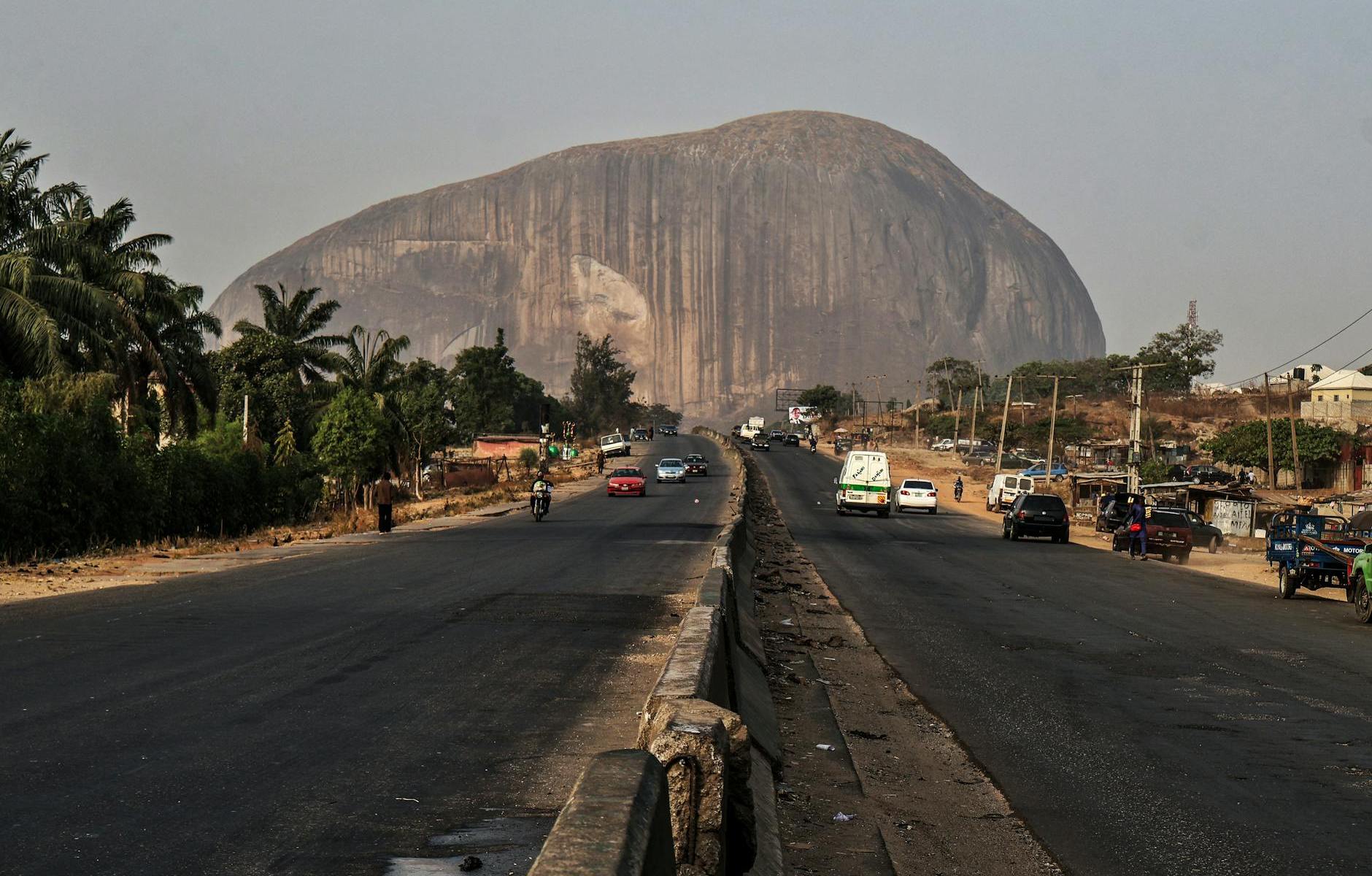

If you have ever found yourself in Abuja, Nigeria, you have likely noticed a peculiar architectural phenomenon.
On one side of the Federal Capital Territory, millions of civil servants, teachers, and entrepreneurs are packed into satellite towns like Nyanya, Kubwa, and Lugbe, battling soul-crushing traffic and rent prices that require sacrificing an organ just to renew a lease.
On the other side, in elite enclaves like Maitama, Asokoro, and Guzape, stand sprawling neoclassical fortresses complete with Greek columns, manicured perimeter walls, and gold-trimmed gates.
There is just one tiny detail missing: people.
Hundreds of multi-billion-naira palaces sit in eerie, pin-drop silence. Driveways sprout weeds through interlocking tiles, curtains never twitch, and the sole sign of human life is usually a lone, exhausted security guard paid ₦30,000 a month to guard ₦25 billion worth of empty concrete.
How does a country with a national housing deficit of over 15 million units end up with entire ghost neighborhoods of luxury mansions?
As documented in an eye-opening investigation by Historic Capital, the market did not fail. It was deliberately engineered.
1. The “Virgin Land” Myth (Or: How to Erase History with a Pen)
Every good magic trick starts with misdirection. When the federal military government decided to move the capital from crowded Lagos into the geographic center of Nigeria via Decree No. 6 of 1976, they pitched Abuja as an egalitarian paradise, a neutral and pristine “virgin land” belonging to no single ethnic group and open to all.
Except it was not virgin land at all. It was the ancestral home of the indigenous Gbagyi people.
Under the decree, the Gbagyi were systematically displaced with promises of fair compensation and resettlement that, in typical bureaucratic fashion, materialized mostly as fractions of pennies or vapor. The land was seized first, and the paperwork was drafted later to legitimize the grab.
That 1976 playbook became the foundational DNA of Abuja real estate: law by decree, wealth by extraction.
2. Concrete as a “Shadow Currency”
If you think real estate in Maitama is designed for traditional landlords hoping for reliable rental yields, you are playing the wrong sport.
In Abuja, luxury mansions do not function as homes. They function as untraceable Swiss bank vaults with marble countertops.
When a politically connected figure accumulates billions of naira in illicit funds, keeping it in a bank account flags compliance alarms, and stashing it in cash risks mattress-induced rot. Converting that loot into prime real estate solves every problem:
- It acts as an ultra-stable store of value against a volatile currency.
- It is significantly harder for anti-graft agencies to seize without a decade of court filings.
- You never need tenants. In fact, tenants are an inconvenience because they cause wear and tear on your money laundry.
By locking up prime land as private wealth repositories, the political class creates artificial scarcity. The supply of livable land drops, prices skyrocket, and the dream of owning a home in the city center becomes pure science fiction for ordinary citizens.
3. The “Zoning Flip” (The Easiest 1,000% Return on Earth)
Why bother building a profitable business or investing in tech when you can simply know the right director at the Federal Capital Development Authority (FCDA)?
Insiders perfected a maneuver known as the Zoning Flip:
- Use a proxy or shell company to acquire cheap, legally protected agricultural land or ecological green zones on the city outskirts.
- Meet with the right officials over tea.
- Watch as the city master plan is quietly redrawn.
Suddenly, your swamp or carrot farm is legally redesignated as high-density luxury residential zoning. Overnight, its value multiplies by 1,000%. To sweeten the pot, public money is often deployed to pave a brand-new, six-lane expressway straight to the front gate.
When developers paved over natural floodplains in Maitama Extension for luxury estates, parts of the district ended up submerged underwater during rainy seasons. But the plots were already sold for millions of dollars, privatizing the profit and socializing the disaster.
4. The Weaponized Bureaucracy: Bulldozers vs. Ghost Castles
Under FCT land allocation laws, the “use it or lose it” clause is unequivocal: if you fail to develop your allocated plot within a stipulated timeframe, the minister has the legal mandate to revoke it.
Here is how that rule works in practice:
- For the poor: If working-class families erect informal settlements along Airport Road or in Lugbe to survive, the FCDA arrives with armed task forces and roaring yellow excavators, reducing homes to rubble in the name of “strictly restoring the Abuja Master Plan.”
- For the elite: If an oligarch leaves a 5,000-square-meter plot behind razor wire in Asokoro to rot for 20 years, the bulldozers are nowhere to be found.
The law serves as a sledgehammer against the vulnerable and a velvet rope for the powerful.
5. The Illusion of Digital Transparency
In recent years, the FCT rolled out the Abuja Geographic Information Systems (AGIS), digitizing land registries and issuing tens of thousands of Certificates of Occupancy (C of Os). Officials hailed this as a triumph for modern transparency.
Do not be fooled. Digitizing a broken system does not cure corruption; it just automates it.
If a multi-billion-naira estate in Wuse 2 is registered to “Blue Horizon Holdings Ltd.,” but AGIS refuses to publish the Ultimate Beneficial Owner (UBO) behind that corporate veil, the database is simply a high-speed digital vault. The public can see the plot numbers, but the actual puppet masters remain completely invisible.
6. The 2026 Ghost House Tax and the Offshore Shuffle
The crisis has become too blatant to ignore. Economic reformers pushed forward a radical measure: the Ghost House Tax, a proposed 1.5% annual luxury levy on vacant, prime residential assets.
The economic logic is straightforward: make sitting on empty mansions financially painful so owners are forced to either lease them, build on them, or sell them off.
The elite counter-offensive was instantaneous. Rather than renting out their properties, owners have mobilized top-tier legal defense teams to claim the tax violates their constitutional property rights, all while restructuring titles into complex offshore trusts. The battlefield for Abuja has simply shifted from the streets to the tax tribunals and server rooms.
Abuja was envisioned as the great Nigerian equalizer, a modern, planned capital where every citizen had a stake in the commonwealth. Instead, it has been carved up into an exclusive, gated Monopoly board where the politically connected hoard the properties and everyone else pays just to pass Go.
Watch the full investigation on YouTube: The Secret Land Machine Behind Abuja (Historic Capital)

