

The Mambilla Arbitration, Malami, Sunrise Power and the Curious Business of Representing the Republic
There are moments in Nigerian public life when one is tempted to stop asking, “How did this happen?” and begin asking the more dangerous question:
“Who exactly was this being done for?”
The latest revelations from the International Chamber of Commerce arbitration over the Mambilla Hydroelectric Power Project provide precisely such a moment.
The ICC tribunal has rejected Sunrise Power and Transmission Company Limited’s claims against Nigeria, including a demand that could have exposed the Federal Government to hundreds of millions of dollars under a settlement negotiated in 2020.
But that is not the most extraordinary part.
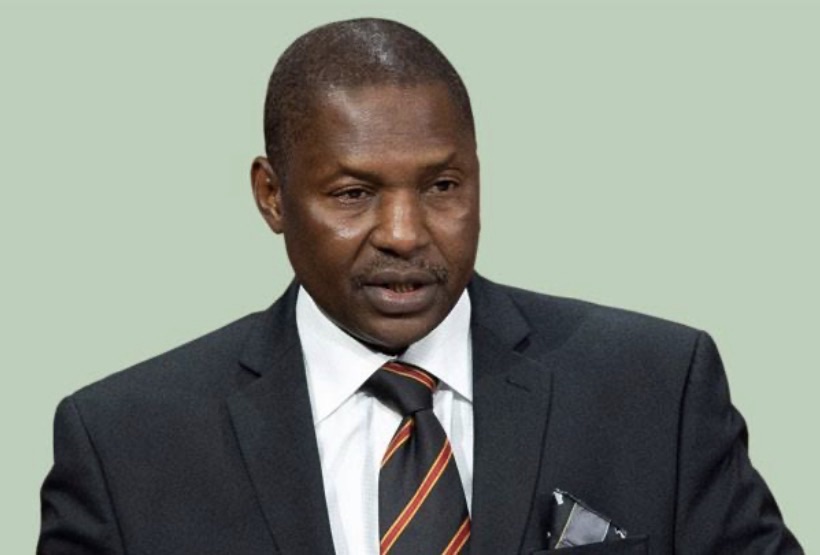
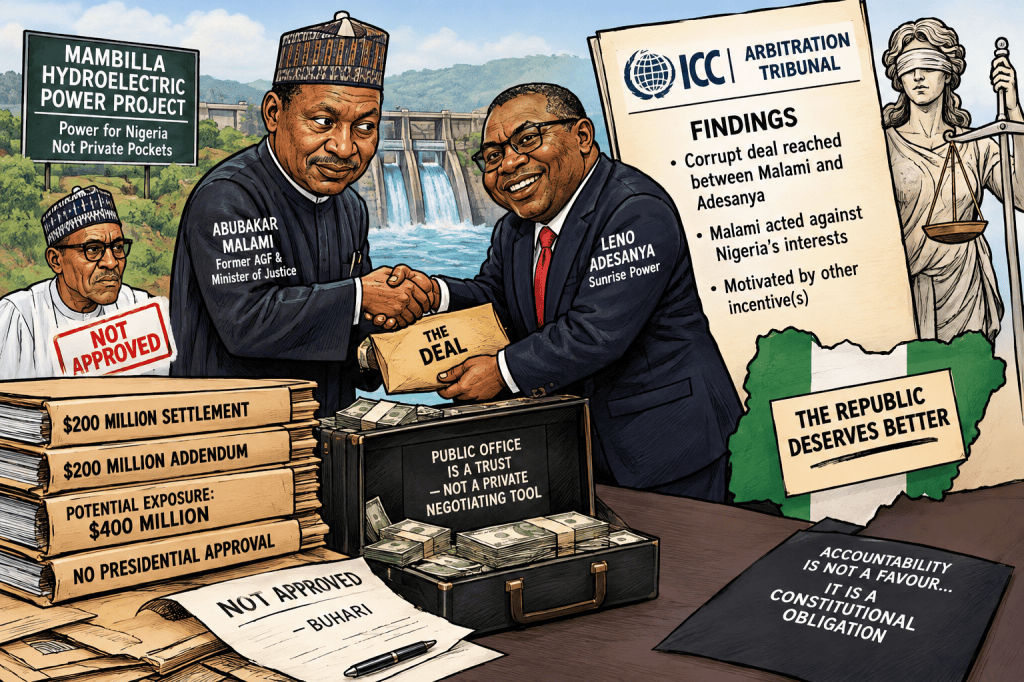
The tribunal found that a corrupt deal was reached between former Attorney-General of the Federation and Minister of Justice, Abubakar Malami, and Leno Adesanya, the promoter of Sunrise Power.
It further found that Malami acted against Nigeria’s interests in handling the settlement and was “motivated by other incentive(s).”
Those are not words that normally appear in the obituary of an ordinary commercial negotiation.
They are words that go to the heart of public office.
The Attorney-General and the Republic
The Attorney-General of the Federation is not a private solicitor instructed by a businessman to maximise his client’s commercial return.
He is the chief legal officer of the Federal Republic of Nigeria.
That distinction matters.
The Constitution does not create the office so that the Attorney-General can become a negotiator whose conduct is indistinguishable from that of the opposing party.
Yet that is precisely the extraordinary picture painted by the ICC award.
The tribunal examined a January 2020 Settlement Agreement under which Nigeria was to pay Sunrise $200 million.
Nine weeks later, an Addendum introduced another $200 million default provision, potentially increasing Nigeria’s exposure to $400 million, before interest.
The tribunal found that the revised arrangement worsened Nigeria’s position without a corresponding benefit to the country. It also examined communications and interactions between Malami and Adesanya while Nigeria and Sunrise were, formally at least, opposing parties.
And then came the sentence that should make every student of Nigerian constitutional government sit upright:
The tribunal concluded that a corrupt deal had been reached between Malami and Adesanya.
Consequently, it found the settlement and its addendum to be products of corruption and contrary to Nigerian public policy.
There is a certain Nigerian genius for making the conflict of interest look like an administrative procedure.
From $200 million to $400 million
The arithmetic alone deserves attention.
Nigeria had agreed, under the settlement, to pay $200 million.
Then came the addendum.
Suddenly, a further $200 million could become payable as a consequence of default.
The potential exposure therefore became $400 million, with interest also forming part of Sunrise’s claim.
The tribunal ultimately rejected Sunrise’s attempt to enforce that arrangement.
Why?
For two separate reasons.
First, the agreements lacked the necessary presidential approval and therefore did not bind the Federal Government.
Second, the tribunal found that the agreements were products of corruption and therefore unenforceable because they violated Nigerian public policy.
In other words, Nigeria was spared a potentially enormous bill partly because the agreement intended to produce the bill could not lawfully bind Nigeria in the first place.
Nigeria’s constitutional machinery had apparently remembered the Constitution just in time.
Buhari said no. Apparently, no did not mean no.
The tribunal also examined the relationship between Malami and then-President Muhammadu Buhari.
According to the findings reported from the award, Buhari rejected the proposed settlement in April 2020 and again in January 2021, recording his decision as:
“Not approved.”
Yet the tribunal found that Malami continued to seek presidential approval and had provided Buhari with incorrect information concerning the financial consequences of the arrangement.
This raises a question far more important than the personalities involved.
What does “Not approved” mean in Nigerian government?
Apparently, in some quarters, it means:
Please try again.
But constitutional government cannot operate on the principle that a presidential refusal is merely the opening bid in a negotiation.
If an official lacks authority to bind the Republic, the solution is not to keep rearranging the furniture until the refusal becomes an approval.
The most uncomfortable finding
Perhaps the most devastating aspect of the award is not even the money.
It is the tribunal’s conclusion concerning whose interests Malami was actually advancing.
The tribunal found that he acted against Nigeria’s interests and was “motivated by other incentive(s).”
That is an extraordinarily serious finding.
But there is an important legal distinction.
An ICC arbitral tribunal is not a Nigerian criminal court. Its finding that a corrupt deal existed in the context of the arbitration is not, by itself, a criminal conviction for corruption.
That distinction should not be blurred.
Neither should the tribunal’s findings be casually dismissed.
An international arbitral tribunal has examined the evidence, heard the parties and reached findings that resulted in Sunrise’s claims being rejected.
It also found that the settlement agreements were products of corruption and contrary to Nigerian public policy.
That is a matter of public record and a matter of considerable constitutional significance.
The strange journey of Leno Adesanya
There is another curious feature of the story.
According to reporting on the award, Malami’s position towards Adesanya and Sunrise changed dramatically.
The former Attorney-General had previously taken a strongly adversarial position towards the company’s claims. Yet he later became involved in a settlement that potentially exposed Nigeria to $400 million.
The ICC tribunal found an “inappropriate relationship” between Malami and Adesanya and concluded that their interactions were sufficient to establish the corrupt arrangement concerning the settlement.
This is where the Nigerian political imagination is forced to confront an uncomfortable phenomenon.
The person appointed to defend the Republic appears, according to the tribunal’s findings, to have developed a relationship with the very person whose financial claim the Republic was resisting.
At that point the question ceases to be merely:
“Was the settlement good or bad?”
The question becomes:
“For whom was the Attorney-General negotiating?”
And then there is the older Mambilla mystery
The Malami episode did not occur in a vacuum.
The ICC tribunal also examined allegations surrounding the original Mambilla project.
Among the evidence was a $500,000 payment made in January 2003 by Adesanya through his offshore company, China Castle Investments Limited, to the US bank account of Jennifer Douglas Abubakar, then the wife of Vice-President Atiku Abubakar.
Adesanya acknowledged making the payment but maintained that it was a foreign-exchange transaction unrelated to Mambilla.
The tribunal said that explanation was unsupported by documentary or independent witness evidence and described the circumstances surrounding the payment as raising “significant red flags.”
But here again, precision matters.
The tribunal did not find that Atiku Abubakar actually used his official position to secure the Mambilla contract for Sunrise.
It expressly noted the absence of evidence establishing that causal link.
That distinction is important.
Nigeria does not need additional facts invented to make the existing facts sufficiently scandalous.
The facts, as found and reported, are already remarkable enough.
Nigeria wins, but Nigeria must still ask why
The immediate result is favourable to Nigeria.
The ICC tribunal rejected Sunrise’s claims, including the claim for enforcement of the $400 million settlement.
It also ordered Sunrise and Adesanya to reimburse Nigeria approximately $11.8 million in legal fees and a further $414,125 in arbitration costs.
The wider Mambilla claims reportedly amounted to approximately $3.38 billion.
Nigeria therefore avoided a potentially enormous financial liability.
But there is a danger in celebrating the result and moving on.
A Republic should not measure the success of its legal system merely by asking whether it eventually avoided paying the money.
It should also ask why its own institutions came within touching distance of paying it.
If the tribunal is correct, Nigeria was not merely confronted by an aggressive private claimant.
It was confronted with something more disturbing:
the possibility that the Republic’s own legal machinery had been compromised from within.
The constitutional question
The Mambilla affair therefore deserves to be examined beyond the personalities of Malami, Adesanya, Buhari or any other individual.
The fundamental issue is institutional.
Public officials exercise public power on behalf of the Republic.
They do not own that power.
The Attorney-General does not own Nigeria’s legal claims.
A minister does not own the government’s contracts.
A civil servant does not own the public purse.
And no government official should be able to convert public authority into a private negotiating instrument.
That is why the ICC findings matter.
They are not merely about an old power project in Taraba.
They concern the ancient constitutional principle that public office is a trust.
Once that principle disappears, government becomes a marketplace in which the Republic is merely another customer.
And when the Republic itself becomes the customer, somebody eventually sends the bill.
Mambilla and Nigeria’s long-running national joke
There is a particularly Nigerian irony here.
The Mambilla project has been discussed for decades as the great promise of Nigerian hydroelectric power.
Billions of dollars.
Thousands of megawatts.
Chinese partnerships.
Government agreements.
Private investors.
Arbitrations.
Counter-arbitrations.
Settlement agreements.
Addenda.
And now an ICC finding that a settlement intended to resolve part of the dispute was itself tainted by corruption.
Nigeria has managed to turn a hydroelectric project into a legal hydra.
Cut off one claim and another appears.
Negotiate one settlement and another addendum grows behind it.
Reject one liability and another emerges from an arbitration file thick enough to require its own table.
The country has spent decades trying to generate electricity from the Mambilla waters.
Instead, the project has generated something else in abundance:
litigation.
What should happen now?
The ICC award should not simply be placed on a shelf labelled “Nigeria Wins Arbitration” and forgotten.
The findings concerning public officials deserve careful examination by the appropriate Nigerian institutions.
The relevant questions include:
– What exactly did the tribunal find concerning Malami’s conduct?
– What Nigerian laws and constitutional provisions may be engaged by those findings?
– Were any Nigerian public officials involved in conduct that warrants further investigation?
– What happened to the settlement negotiations after Buhari’s refusal?
– What safeguards existed within the Ministry of Justice to prevent conflicts of interest?
– Why was a settlement potentially increasing Nigeria’s exposure from $200 million to $400 million pursued after presidential rejection?
– What institutional reforms are required to ensure that no future Attorney-General, minister or official can negotiate away public assets or liabilities without the required constitutional authority?
These questions should be answered through evidence, due process and the law.
Not through political theatre.
Not through selective outrage.
And certainly not through the Nigerian governmental tradition of discovering accountability only after an international tribunal has done the investigative work for us.
The Republic must learn the lesson
The real victory in the Mambilla arbitration is not simply that Nigeria did not have to pay $400 million.
The real victory would be if Nigeria learns why such a liability was ever placed on the negotiating table in the first place.
A government can survive a bad contract.
It can survive an unsuccessful project.
It can survive an arbitration loss.
What becomes dangerous is when the institutions created to protect the Republic begin, according to an international tribunal’s findings, to operate against the Republic’s own interests.
That is the line that must never become blurred.
The Attorney-General is the lawyer for the Federal Republic.
The minister is a servant of the state.
The public purse belongs to the people.
And the Constitution is not an inconvenient footnote to a settlement agreement.
The Mambilla arbitration has therefore left Nigeria with a curious gift.
It has saved the country billions in potential liabilities while presenting the country with a bill of another kind.
A bill for institutional accountability.
And unlike the $400 million settlement, this one cannot be settled by an addendum.
Nigeria must pay it by rebuilding public trust in the institutions that are supposed to protect Nigeria from itself.
 Centre for Nigeria Progress