

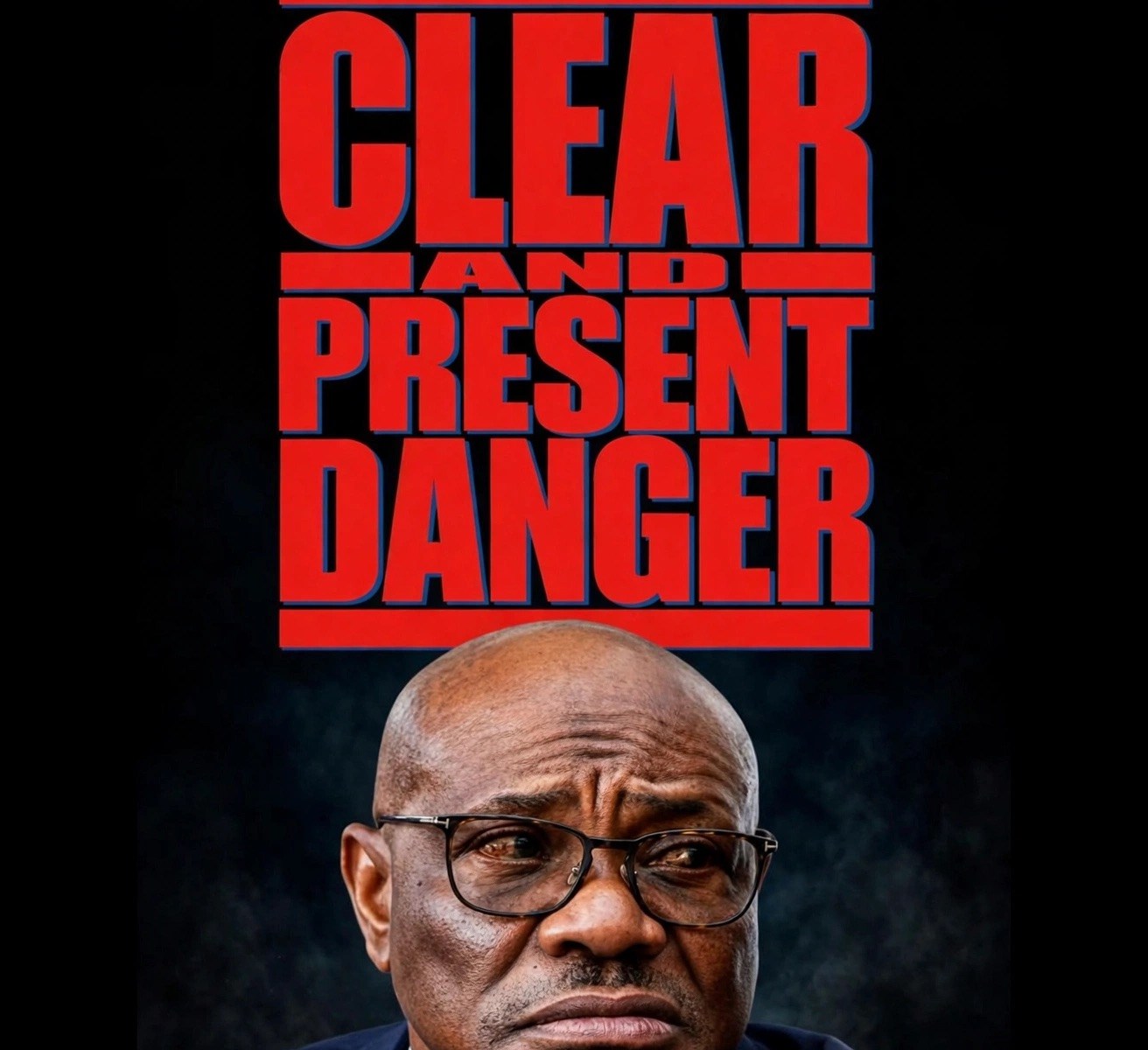
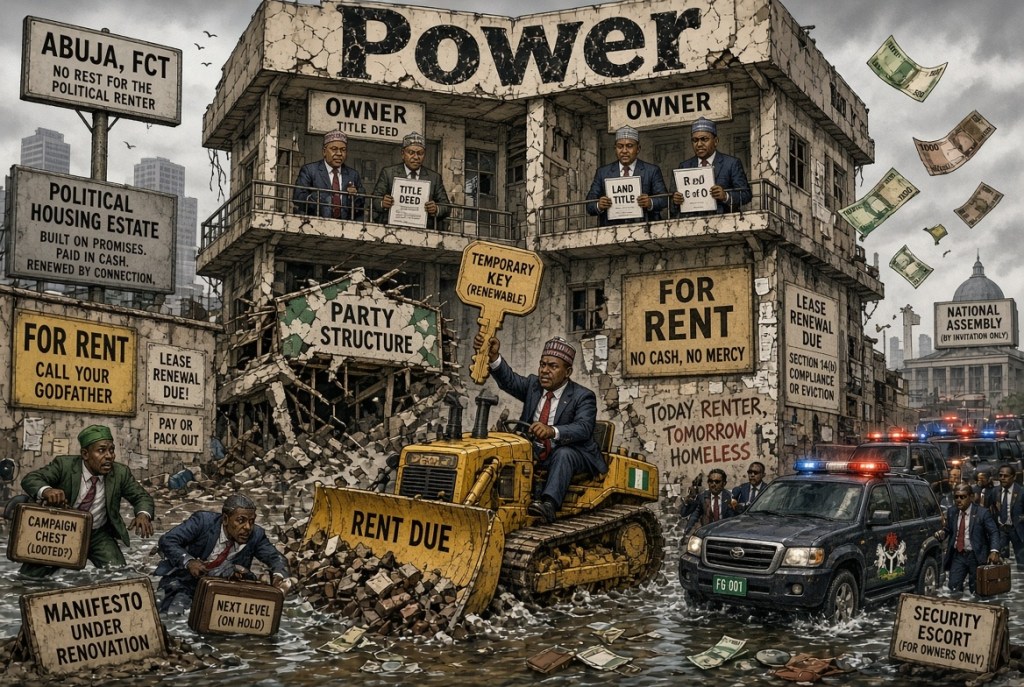
Afolabi Adekaiyaoja has done the Lord’s work. He has finally given us the proper vocabulary for the peculiar Nigerian political condition: the landlord, the owner, the renter, and the tenant. In one elegant real-estate metaphor, he has explained why our politicians never seem to retire, why they fight harder the longer they stay, and why Nyesom Wike, that perpetual bulldozer of hotels and political careers, cannot sit still.
The diagnosis is sharp. Owners build houses. Renters lease rooms from the state. Tenants sublet from the renters and occasionally try to change the locks. Tinubu is an owner. Ibori is an owner. Wike is the model renter: forever paying his dues, forever renovating other people’s property, forever terrified that the landlord might notice the arrears.
It is a beautiful frame. Almost too beautiful. Because once you accept it, the entire Fourth Republic starts to look like a badly managed housing estate where nobody has a proper title deed and everyone is arguing over who paid the last NEPA bill.
Wike, we are told, had a chance to become an owner. He funded the PDP when it was homeless, hosted its conventions, removed its chairmen, and nearly seized the presidential nomination. Then he set fire to the building, handed the keys to Tinubu, and moved into a ministerial flat in the FCT. The moral of the story is clear: when given the choice between ownership and proximity to power, the skilled renter will always choose the latter. Ownership requires patience, networks, and the willingness to be irrelevant for a season. Renting only requires the ability to keep paying, loudly and publicly, while the cameras are rolling.
There is something almost tragic in this portrait. The man who has held office almost continuously since 1999 is presented as the ultimate product of a system that punishes rest. Stop moving and you are evicted. Lose the convoy and the relevance evaporates. The tragedy is not that Wike fights; it is that the system has made fighting the only form of existence available to people of his class. Retirement is not rest. It is exile.
Yet the metaphor, for all its elegance, has a blind spot the size of a demolished Abuja waterway. If power is rented from the state, and the state is the landlord, then who exactly is the landlord’s landlord? The people? The constitution? The oil money that keeps the entire estate solvent? The essay treats the state as a neutral landlord with an infinite supply of apartments. In reality, the landlord is itself a collection of previous renters who got lucky with the allocation list. The “state” that Wike rents from is simply the temporary alliance of other men who also cannot afford to miss a payment.
This is why the scarcity of owners is not merely a generational shift or the result of more money flowing to governors. It is the logical outcome of a system that has made ownership almost impossible without first becoming a successful renter. Tinubu owned Lagos after governing it. Ibori kept Delta after leaving it. Both men first used the state as a platform and then converted the platform into something that outlived the office. Wike tried the same conversion with the PDP and discovered that the building was already structurally unsound. He then did the rational thing: he found a better landlord.
The essay is at its strongest when it observes that today’s politics is dominance without permanence. Defections bring offices, not movements. A one-party state of tenants is a temporary arrangement that lasts exactly as long as the current leases. The moment the landlord changes the terms, the tenants will scatter looking for new accommodation. This is not a bug. It is the entire business model.
But there is a quieter implication that the piece only glances at. If almost everyone is now a renter, then the few remaining owners become disproportionately powerful not because they are wiser or more virtuous, but because scarcity itself is a form of leverage. Tinubu’s ownership of Lagos is more valuable precisely because so few others can claim anything similar. The same applies to Kwankwaso’s residual hold on Kano, even after his protégé walked. In a market flooded with renters, the man with a certificate of occupancy can charge almost any price.
Wike understands this market better than most. He does not pretend to own anything he cannot take with him. He ties his survival to delivering Rivers and the FCT in 2027, and he says so publicly. That is not ideology. It is the renter’s version of a security deposit. Fail to deliver and the lease is terminated. Succeed and you might get an extension, or at least a better flat.
The deeper question the essay raises, and then politely steps around, is whether any form of ownership is still possible in a politics so thoroughly financialised by oil and federal allocations. When state resources grow large enough, the incentive to build anything that outlasts your tenure shrinks. Why construct a political house when the landlord is handing out fully furnished apartments every four years? Why cultivate voters when the security vote and the FAAC allocation can buy enough temporary loyalty to get you through the next election?
Wike is not the disease. He is the most accomplished symptom. He has simply mastered the only game that still pays. There is no rest for the wicked, the old saying goes. In Nigerian politics, there is also no rest for the merely competent. The moment you stop renovating, someone else starts measuring the curtains.
And that, more than any personal restlessness, is why the bulldozers never sleep.

