


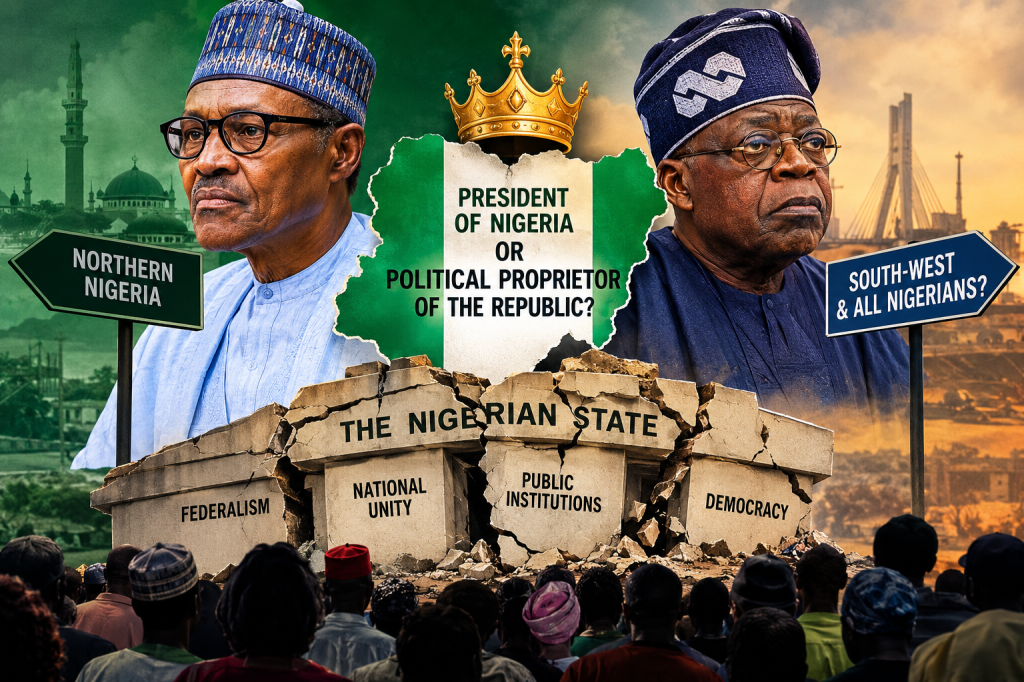
The body blows to Nigeria’s federal structure, national cohesion and constitutional democracy
There was a time when the question confronting Nigerians was whether Muhammadu Buhari was President of Nigeria or King in the North. Today, under Bola Ahmed Tinubu, the question has acquired a wider and potentially more dangerous dimension: is the President governing a federation of equal citizens, or presiding over a political establishment increasingly organised around the interests of the ruling party and its principal beneficiaries?
The difference matters. Buhari’s critics accused him of regional favouritism, particularly in appointments, infrastructure and the distribution of national resources. Tinubu faces similar allegations of regional and ethnic bias. But the present concern extends beyond the distribution of government benefits. It encompasses the concentration of political power, the weakening of opposition, the use of state institutions in partisan contests and the apparent transformation of political loyalty into a currency of access to government.
These are allegations that deserve rigorous scrutiny, not automatic acceptance. Yet their cumulative implications raise a fundamental question about the Nigerian state: what happens when the institutions designed to serve the entire federation increasingly appear to operate for the advantage of a particular political establishment?
Buhari: When the President appeared to have a regional constituency
My original article, written during Buhari’s presidency, was prompted by a revelation from Jim Yong Kim, then president of the World Bank. Kim said that during his first meeting with Buhari, the Nigerian President had specifically requested that the Bank shift its development focus towards Northern Nigeria, and that it had done so.
The revelation provoked an understandable debate. Why would a President elected to govern the entire federation single out one region as the preferred destination for an international development institution’s attention?
There was nothing inherently wrong with directing development resources towards the North. The region has substantial development needs, including poverty, educational deprivation and insecurity. A government committed to national equity must be prepared to direct additional resources towards disadvantaged communities.
The constitutional and political problem was different: was the preference based on an objectively defensible national development strategy, or was it an expression of sectional political allegiance?
That distinction is the dividing line between equitable governance and regional patronage.
Buhari’s critics also pointed to appointments they considered lopsided, the deployment of security forces in the South-East, his perceived reluctance to condemn certain killings, and infrastructure decisions they believed favoured his political and regional base.
The controversy was not simply about whether Northern Nigeria deserved development. It was about whether the President understood that his electoral victory did not confer ownership of the Nigerian state.
A President is not the representative of the region that supplied most of his votes. He is the constitutional head of a federation whose citizens, including those who voted against him, possess equal civic standing.
The ballot box determines who occupies the presidency. It does not determine which Nigerians deserve the protection, attention and resources of the state.
Tinubu: The allegations return, but the political landscape has changed
Under President Tinubu, the regionalism argument has returned from a different direction, although the underlying constitutional concern remains familiar.
Critics have alleged that important appointments and strategic positions disproportionately favour the South-West, particularly Yoruba political associates. In November 2024, the Human Rights Writers Association of Nigeria raised concerns about the ethnic composition of appointments in important economic, security and administrative institutions. Northern political voices have also complained about what they regard as inadequate representation and an unfair distribution of federal projects.
The Council on Foreign Relations examined the resulting northern discontent in its analysis, Tinubu’s Northern Trap, published in April 2026. It observed that accusations of South-West favouritism had become a political problem for an administration that had also relied on substantial Northern electoral support.
These are allegations, not judicial findings that the administration has breached the Constitution. The Federal Government has rejected claims of regional discrimination, maintaining that its projects and appointments reflect a commitment to balanced development. It has cited major infrastructure projects in the North and the establishment of regional development commissions as evidence of its national outlook.
The appropriate response is neither to accept the accusations merely because they are politically convenient nor to dismiss them because the government denies them. The evidence must be examined.
How many appointments went to each state and geopolitical zone? Who occupies the most influential positions? What sums have actually been released for capital projects in each region? Which projects have been completed, which remain on paper, and what objective criteria explain the differences?
A government cannot establish equitable distribution simply by announcing projects. Nor can its critics establish discrimination by compiling an unverified list of appointments.
The relevant test is evidence, not political arithmetic.
There is, however, a more troubling development in the current debate. The controversy is no longer confined to the question of which region receives what. It increasingly concerns who controls the institutions through which power is exercised and whether political competition can survive that concentration.
From regional favouritism to the capture of the state
Regionalism and state capture are related, but they are not synonymous.
Regional favouritism occurs when government decisions systematically privilege one geographical or ethnic constituency over others without adequate public justification. State capture is a broader phenomenon in which public institutions and the exercise of state power become excessively subordinated to the interests of a political faction, a network of beneficiaries or a small circle of powerful individuals.
The first can contribute to the second, but one does not automatically prove the other.
The danger emerges when the distribution of public resources, the composition of institutions, the conduct of political parties and the exercise of executive power begin to reinforce one another in ways that weaken accountability.
Under Buhari, the argument centred substantially on whether the President privileged his regional constituency. Under Tinubu, the allegations of regional favouritism coexist with a wider concern about political consolidation.
The Associated Press reported in September 2026 that Tinubu had consolidated considerable political strength through defections to the All Progressives Congress, with the ruling party controlling 31 of Nigeria’s 36 state governorships. The report also described the fragmentation of the opposition ahead of the 2027 presidential election.
The number of governors aligned with a President is not, by itself, proof of state capture. Governors are entitled to change political parties, and the Constitution does not require opposition parties to remain electorally competitive.
But the scale of political consolidation deserves attention when considered alongside the institutional conditions under which opposition parties organise, challenge government policies and prepare for elections.
Why are elected representatives defecting? Are they persuaded by policy, ideology and performance, or are political calculations shaped by access to federal power, the prospect of patronage and the perceived risks of remaining in opposition?
What happens when governors, legislators and other political actors conclude that their best prospect of political survival lies in joining the ruling party rather than offering voters an alternative?
And what becomes of federalism when the President’s party commands such an overwhelming proportion of the political machinery of the constituent states?
These questions are not accusations against every defector. They are questions about the incentives and institutional safeguards of a democratic federation.
A multiparty democracy is not merely a system in which several parties remain legally registered. It is a system in which political competition is meaningful, public institutions remain impartial, and citizens can remove their rulers without the machinery of the state being mobilised to frustrate the process.
When political alignment becomes the principal route to influence, the distinction between governing in the national interest and maintaining a political empire begins to blur.
The constitutional injury
Nigeria’s Constitution does not leave the responsibilities of government entirely to presidential discretion.
Section 13 imposes a duty on all organs of government and all authorities exercising legislative, executive or judicial powers to conform to, observe and apply the constitutional provisions governing the fundamental objectives of the state.
Section 14(1) declares Nigeria to be a state founded on democracy and social justice. Section 14(2) establishes the people as the source of governmental authority and identifies their security and welfare as the primary purpose of government.
Most significantly for the question of regionalism, section 14(3) requires the composition of the Federal Government and its agencies, and the conduct of their affairs, to reflect Nigeria’s federal character and promote national unity. It seeks to prevent the predominance of persons from a few states or ethnic or sectional groups in government.
Section 147(3) reinforces that principle in relation to ministerial appointments, requiring compliance with section 14(3) and providing for at least one minister from each state.
There is an important legal qualification. Section 14 falls within Chapter II, the Fundamental Objectives and Directive Principles of State Policy. By virtue of section 6(6)(c), those objectives are generally not independently enforceable by the courts except to the extent provided by the Constitution or applicable legislation. Section 147(3), however, expressly incorporates the federal character requirement into the rules governing ministerial appointments.
Consequently, every allegation of regional bias cannot simply be translated into a successful constitutional lawsuit. The particular decision, the relevant constitutional provision and any applicable legislation must be examined.
Nevertheless, constitutional enforceability is not the only measure of constitutional importance. A principle can impose a compelling political and institutional obligation even where a court cannot directly enforce every aspect of it.
Federal character is not an instruction to divide every public appointment into ethnic quotas or to award every state an identical number of roads. It is an attempt to ensure that the federal state belongs to all Nigerians and that no sectional group can reasonably regard government as the exclusive property of another.
The President has discretion in making many appointments and determining national priorities. But discretion is not ownership. Executive authority must be exercised for public purposes and within constitutional boundaries.
A President may legitimately prioritise a region suffering from exceptional deprivation. What he cannot reasonably demand is that Nigerians treat his political or regional preferences as a substitute for an objectively defensible national policy.
The body blows to the structure of the state
The most serious consequence of perceived regional and partisan capture is not necessarily the immediate loss of a contract, appointment or infrastructure project. It is the gradual erosion of the shared political compact that makes a federation governable.
A federation depends upon citizens believing that, despite their differences, they have a stake in the same state.
When a citizen begins to believe that government belongs to another ethnic group, that public appointments depend on regional identity, or that political access is determined by allegiance to the ruling party, the psychological foundations of citizenship begin to fracture.
The consequences are cumulative.
First, national loyalty weakens. Citizens who perceive the state as an instrument of sectional power may increasingly identify with their ethnic, regional or religious communities rather than the federation. Politicians can exploit that alienation, converting legitimate grievances into competing narratives of exclusion.
Second, public institutions lose credibility. A police force, security agency, regulatory authority or public service that is perceived to act selectively risks losing the confidence necessary for effective governance. Even an institution that acts impartially can suffer when its composition or conduct creates a reasonable appearance of political subordination.
Third, federalism becomes a bargaining arrangement among political elites. Instead of functioning as a constitutional structure for sharing authority and accommodating diversity, the federation risks becoming a marketplace in which political actors negotiate access to central power. The citizen’s welfare becomes secondary to the politician’s place at the table.
Fourth, opposition becomes vulnerable to institutional pressure. If political actors believe that the ruling party offers the safest route to public resources and political survival, defections may gradually weaken meaningful competition. The problem is not that one party wins elections or attracts supporters. It is whether the institutions responsible for maintaining fair competition remain credible and independent.
Fifth, national development loses coherence. Infrastructure, education, security and economic policy should follow defensible assessments of public need and national priorities. If projects are selected principally for electoral advantage, regional prestige or the enrichment of political allies, the result may be a collection of political trophies rather than a national development strategy.
Each of these developments strikes at a different part of the state. Together, they can undermine the institutional trust upon which constitutional government depends.
The damage is not confined to the region that feels neglected. Even the region perceived to be favoured ultimately suffers when the federation becomes less stable, public institutions become less credible and political competition becomes less meaningful.
A road built for political prestige cannot substitute for a functioning state. Neither can a ministerial appointment, a party defection or a presidential promise purchase the loyalty of a population indefinitely.
The irony of electoral victory
There is a recurring mistake in Nigerian politics: the assumption that winning an election entitles the victorious party to treat the state as its property.
It does not.
A President wins a mandate to exercise constitutional powers. The mandate is not a conveyance of title to the republic.
The ruling party may determine its manifesto, select its candidates and pursue its legislative programme. It may also seek to win every state and every election through lawful political organisation. But public institutions do not become party assets simply because the party controls the executive branch.
Nor does an electoral majority extinguish the rights of the minority.
This is why the distinction between the party and the state matters so profoundly. The party exists to compete for power. The state exists to serve the people, including those who oppose the party in government.
When the two become indistinguishable in practice, the citizen risks becoming a political client rather than a rights-bearing participant in a constitutional democracy.
That is the deeper danger in the transition from allegations of Buhari’s regionalism to allegations of Tinubu’s regional and partisan favouritism.
Buhari’s critics asked whether the President had placed Northern interests above the federation. Tinubu’s critics are asking whether regional preferences and the concentration of partisan power are similarly undermining the principle that the state belongs to all.
The circumstances differ. The constitutional test remains.
The road from Abuja to the regions
The answer cannot be found in competing lists of appointments or in the President’s assurances that all regions are being treated fairly. Nor can it be found in opposition rhetoric that treats every government project as evidence of sectional conspiracy.
Nigeria needs transparent, independently verifiable information about the distribution of federal appointments, budgetary allocations, actual capital expenditure, project completion and public-service representation.
The Federal Character Commission must be able to perform its responsibilities credibly. The National Assembly must scrutinise executive decisions rather than merely endorse them. The judiciary must remain capable of resolving genuine constitutional disputes without political interference. Electoral institutions must preserve confidence in the possibility of meaningful political competition.
Political parties, for their part, must develop identities and programmes that go beyond access to the presidency. A party that survives principally through the attraction of political officeholders may command an impressive number of governors while contributing little to the development of a durable national political culture.
Above all, the President must recognise that national unity is not achieved by assembling political elites around the presidency. It is achieved when citizens have reasonable grounds to believe that the state is fair, public resources are allocated for defensible purposes, and political disagreement does not make them second-class members of the republic.
The ultimate test is not whether Tinubu appoints more people from the North or the South-West, or whether Buhari directed the World Bank to focus on Northern development. It is whether the decisions of either administration can be justified by reference to the needs of the federation rather than the presumed entitlement of a political constituency.
Regional equity is not a competition in which one part of Nigeria must lose for another to win. It is a constitutional obligation to ensure that the federation’s diversity does not become a permanent hierarchy of political privilege.
President of Nigeria, or proprietor of the republic?
The question that animated my original article remains relevant, but it must now be asked more broadly.
Is the President governing a country whose institutions belong to its citizens, or is the country increasingly being organised around the political survival of those who control its government?
The danger is not simply that one President may favour one region. It is that successive administrations may normalise the idea that public power is a reward for political loyalty, that appointments are instruments of sectional balancing or patronage, and that the principal objective of governance is to secure the ruling establishment’s continued dominance.
Such a system can weaken the republic without abolishing a single constitutional provision. It can retain the outward forms of democracy while gradually diminishing the impartiality, accountability and institutional independence that give those forms substance.
This is how the structure of a state can sustain body blows without immediately collapsing. Each individual decision may appear manageable. Each appointment may have an explanation. Each defection may be lawful. Each infrastructure project may be defended as development.
But the cumulative effect must still be examined.
The Nigerian state is not the inheritance of the North, the South-West, the South-East or any other region. It is not the private estate of the President, the ruling party or the network of politicians who surround them.
It belongs to the Nigerian people.
Buhari’s regionalism controversy asked whether a President could distinguish his constituency from his country. Tinubu’s political circumstances compel us to ask whether a President can distinguish his party from the state itself.
The presidency is a temporary constitutional trust, not a deed of ownership. And when the institutions of the republic are bent towards sectional privilege or partisan survival, the injury is not merely to those excluded from power. It is to the structure of the state, the credibility of the Constitution and the future of Nigerian democracy.
The republic must remain larger than the men who occupy its highest office.

