

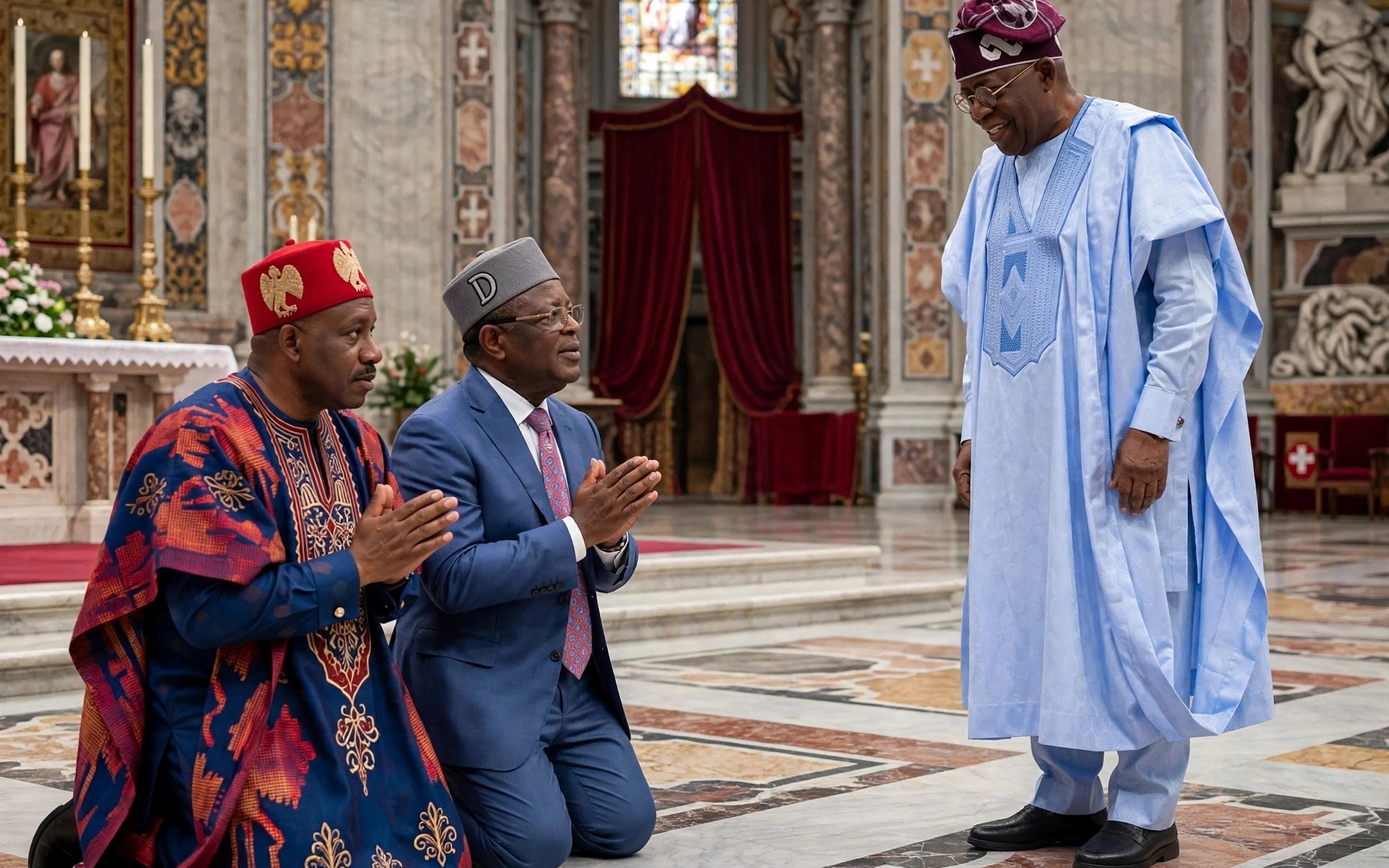
Dave Umahi has perfected the Nigerian politician’s favourite magic trick: the disappearing principle. One day he is a regional champion, the South-East’s own man demanding blanket support for his presidential ambition. The next, he is the Minister of Works in a Tinubu led administration, solemnly informing the same South-East that it is not their turn, that ambition must wait, and that anyone who dares dream without first genuflecting before him has committed a political sin.
In 2023, Umahi sought the APC presidential ticket with the quiet confidence of a man who believed the South-East owed him a block vote. He had defected from the PDP with the usual sermon about marginalisation and the need for equity. He positioned himself as the regional standard-bearer. The South-East, he implied, should rally behind one of its own.
Fast-forward a few years and the same man now lectures the zone that the presidency is not yet available for Igbo aspiration. Tinubu, being from the West, has already collected the regional IOU on behalf of everyone south of the Niger. The eight years belong to the South as a whole. The South-East must wait its turn—preferably until after 2031, by which time Umahi may have reinvented himself yet again.
This is not statesmanship. This is the political equivalent of a man who queues for the last plate of jollof, eats it, then turns to the people behind him and announces that the kitchen is closed for the day.
Umahi’s demand that aspirants must consult “people like us” is particularly rich. Who exactly constitutes this exalted circle of consultants? A politician whose organic following is so thin that observers struggle to locate it in his household? Umahi has never been a man of the streets in the sense that true regional heavyweights command automatic loyalty. He has governed Ebonyi, built roads, and cultivated the image of a technocrat-engineer in politics.
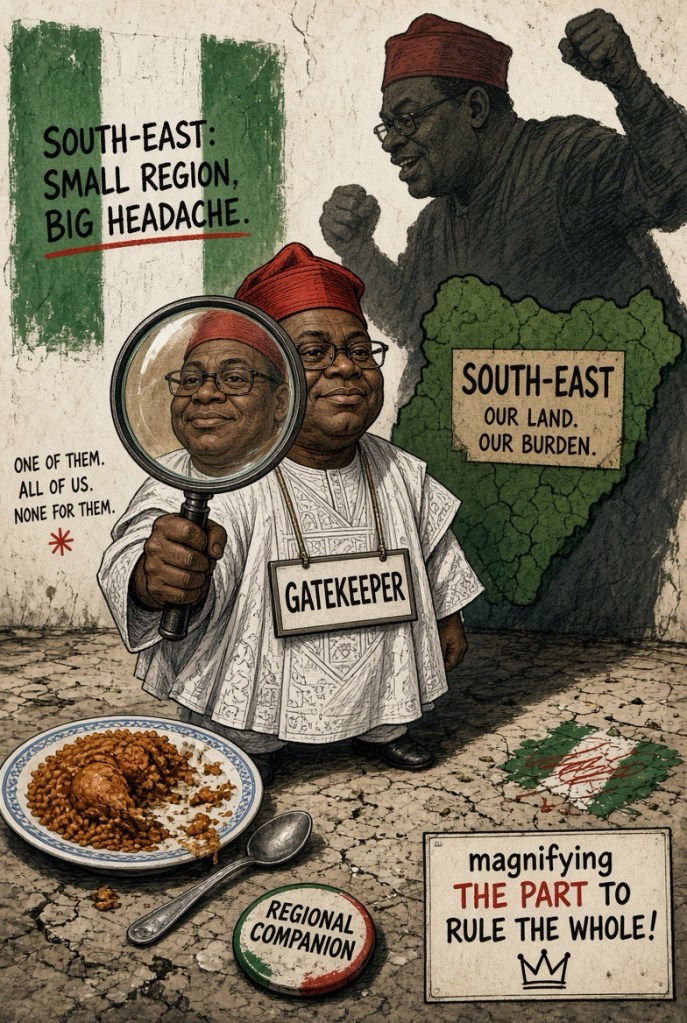
What he has not cultivated is a genuine hinterland. No mass movement follows him. No youth wing chants his name without payment. No deep ethnic or ideological base anchors him. He is a political pygmy who discovered a magnifying glass and decided the enlarged shadow on the wall was the real thing.
The irony is almost artistic. The man who once needed the South-East’s collective endorsement now requires the South-East to seek his personal endorsement before it may even consider its own presidential prospects. He has transitioned from regional champion to regional gatekeeper without ever acquiring the political capital that usually accompanies such authority. It is rather like a man who borrowed a megaphone for one afternoon and now insists no one else may speak without first clearing their script with him.
Nigerian politics is full of such characters: men who mistake proximity to power for actual power, who confuse the temporary glow of office with permanent relevance. Umahi currently occupies a consequential ministry. He awards contracts, inspects projects, and speaks with the authority that comes from sitting close to the centre. But authority borrowed from the centre is not the same as authority rooted in a people. When the music stops, the chairs will be counted, and those without hinterlands tend to find themselves standing.
The South-East has every right to pursue the presidency whenever it judges the moment ripe. It does not require a certificate of permission from a man whose own presidential bid was less a popular uprising than a personal calculation. Umahi’s current posture, that the zone must defer, that it must wait, that it must consult him, reveals more about his self-image than about political reality. He sees a giant in the mirror. The rest of us see a carefully polished pygmy holding a magnifying glass and daring anyone to look away.
In the end, the tragedy is not that Umahi changed his mind. Politicians do that for a living. The tragedy is that he changed his mind so completely that he now campaigns against the very regional aspiration he once claimed to embody, while still demanding to be treated as its indispensable referee. That is not evolution. That is performance art performed with a straight face.
And in Nigerian politics, the straight face is often the funniest part of the show.

