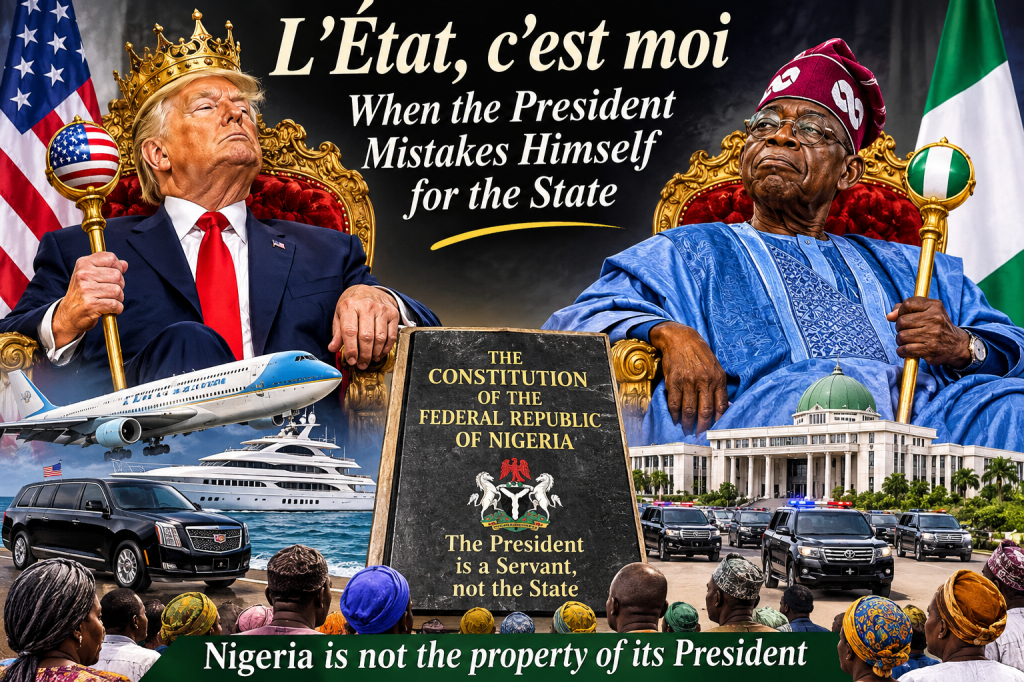
There is a famous French expression, L’État, c’est moi, translated as “I am the state.” It is attributed to Louis XIV, the Sun King, whose reign became synonymous with absolute monarchy and the concentration of political authority in the person of the sovereign.
There is, incidentally, some historical doubt about whether Louis XIV actually uttered those words. But their historical significance is not diminished. They represent a political philosophy in which the state is identified with the person of the ruler, its institutions become extensions of his authority, and the interests of the country are subordinated to the interests of the palace.
The state exists to serve the monarch. The monarch does not exist to serve the state.
Centuries later, one would have thought that constitutional democracy had buried this philosophy. Unfortunately, it appears to have survived, acquired a modern wardrobe and found enthusiastic practitioners on both sides of the Atlantic.
Donald Trump is perhaps its most conspicuous contemporary representative. And closer to home, Bola Ahmed Tinubu increasingly exhibits the same political disposition.
Trump and the personalisation of the American state
Trump’s understanding of the American presidency is difficult to separate from his understanding of himself. Institutions are useful when they serve his purposes, disloyal when they question him and expendable when they stand in his way.
The presidency, in his imagination, is not primarily an institution established by the American Constitution. It is an instrument of personal authority.
His contempt for independent institutions, his attacks on judges, the media, political opponents and civil servants, and his tendency to treat public office as an extension of his personal political interests illustrate the dangers of this philosophy.
His foreign policy provides an even more troubling illustration. Military action can become a personal presidential decision, announced with the confidence of someone ordering dinner rather than contemplating the consequences of war.
The American constitutional system was designed precisely to prevent the country from becoming the personal property of its president. Yet its institutions are repeatedly tested by a president who appears to regard constitutional restraint as an inconvenience.
Nigeria has its own version of this political philosophy.
Tinubu and the presidential palace
When Bola Ahmed Tinubu assumed office in May 2023, Nigerians were presented with the familiar language of sacrifice, economic reform and national reconstruction.
The administration announced the removal of the petroleum subsidy and embarked on sweeping economic adjustments. Nigerians were told that the country had to endure hardship today to secure prosperity tomorrow.
But the first major conversations about government priorities were not necessarily about the sacrifices of the political class.
The 2023 supplementary budget contained provisions for presidential luxury vehicles, the presidential air fleet, renovations of presidential residences and a presidential yacht.
The yacht allocation of approximately ₦5.09 billion attracted such public criticism that the National Assembly subsequently removed the provision and redirected the money towards student loans. The Presidency maintained that the proposed vessel was an operational naval asset rather than a private pleasure yacht.
The controversy, however, was revealing.
The same supplementary budget made substantial provisions for presidential accommodation and other State House requirements. Subsequent budget proposals continued to contain significant allocations for the maintenance and renovation of presidential residences.
Then came the acquisition of a presidential Airbus A330, reported to have cost approximately $100 million. The Presidency defended the purchase on the grounds that it was a refurbished aircraft which would reduce the cost of maintaining the existing presidential fleet.
There is a legitimate argument for maintaining functional presidential transport and official accommodation. No serious person expects a head of state to travel in a rickety aircraft or conduct international diplomacy from a leaking roof.
But the issue is one of priorities, proportionality and political sensitivity.
A government asking citizens to absorb the consequences of economic restructuring must demonstrate that the political class is also prepared to make sacrifices.
The question is not whether the President deserves an aircraft. It is whether the scale of presidential comfort has become disconnected from the economic circumstances of the people financing it.
The Nigerian presidency increasingly resembles a palace whose maintenance is treated as a national priority while the citizens outside its gates are instructed to exercise patience.
The President’s relationship with France
Another curious feature of the Tinubu presidency has been its repeated attraction to France.
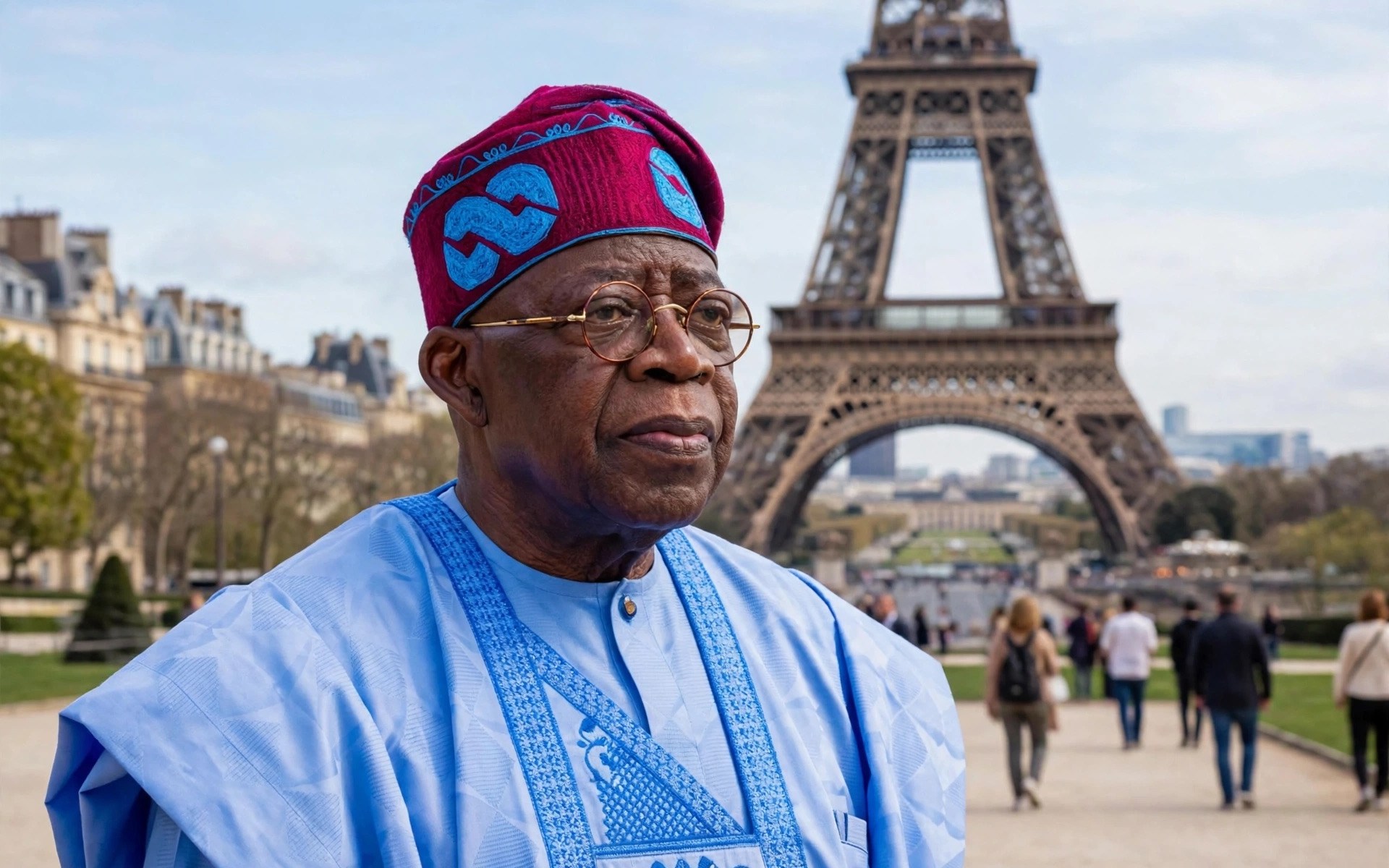
France has become something of a second presidential destination. Private visits, working visits and diplomatic engagements have repeatedly taken the President to Paris.
The International Centre for Investigative Reporting documented eight visits to France by April 2025. Subsequent reporting has continued to draw attention to the frequency of these journeys.
There is nothing inherently wrong with a Nigerian president visiting France. France is an important international partner, and diplomacy requires personal engagement.
But the frequency and apparent preference invite legitimate questions about the President’s priorities, particularly when Nigeria is experiencing serious domestic difficulties.
What exactly is the strategic relationship being developed? What measurable national interests are being advanced? What has Nigeria secured from this extraordinary diplomatic familiarity?
The problem is not France. The problem is the absence of sufficient public explanation of the national benefits.
ECOWAS, Niger and the French question
Tinubu’s conduct as Chairman of ECOWAS during the 2023 military coup in the Republic of Niger deserves particular examination.
Following the overthrow of President Mohamed Bazoum, Tinubu adopted a remarkably hard line. ECOWAS imposed sanctions, closed borders and authorised the deployment of a standby force to restore constitutional order.
Military intervention was seriously contemplated.
The question was whether the proposed intervention was sufficiently grounded in the collective interests of West Africa, or whether Nigeria was allowing itself to become an instrument of external strategic calculations.
France had substantial political, military and economic interests in Niger. The country was a former French colony and hosted French military forces. The coup threatened those interests and fundamentally altered France’s position in the Sahel.
It was therefore reasonable to ask whether ECOWAS’s response was sufficiently independent of French strategic interests.
That question should not be confused with an established finding that Tinubu was acting on French instructions. There is no demonstrated evidence of that.
Indeed, defending constitutional order in Niger was a legitimate ECOWAS objective. Military coups cannot simply be normalised because the consequences of resisting them are inconvenient.
Nevertheless, a regional organisation must act in the interests of its member states and their populations, not become an extension of the foreign policy objectives of an external power.
The irony was that Nigeria, which should have been concentrating on its own extraordinary security challenges, was contemplating military intervention in a neighbouring country.
The eventual diplomatic retreat demonstrated the limitations of the initial approach.
The American bombing of Nigeria: Who owns the decision?
Perhaps the most disturbing illustration of the personalisation of the Nigerian state is the relationship between Tinubu’s government and Donald Trump over American military action in Nigeria.
On Christmas Day 2025, the United States conducted airstrikes against Islamic State targets in Sokoto State.
President Trump publicly announced that he had ordered the operation. US Africa Command confirmed that the strikes were conducted in coordination with Nigerian authorities.
The Nigerian government subsequently described the operation as a joint security exercise directed against terrorist elements, rather than an operation targeting any particular religious community.
Nigeria’s Foreign Minister also explained that the operation followed intelligence cooperation and had been planned over a period of time.
That distinction matters.
Nigeria is a sovereign country. Its security problems are Nigerian problems, even when international cooperation is necessary to address them.
The United States has legitimate security interests in combating international terrorism. Nigeria also has legitimate interests in obtaining intelligence, military technology and operational assistance.
But cooperation must not become the surrender of national strategic independence.
Trump’s subsequent public comments, including his January 2026 warning that further American strikes could follow if Christians continued to be killed, demonstrated the danger of allowing another country’s president to frame Nigeria’s internal security crisis according to his own political narrative.
At the February 2026 National Prayer Breakfast, Trump publicly recognised First Lady Remi Tinubu and referred to her Christian religious background.
There is nothing wrong with religious diplomacy. But Nigeria’s security policy cannot be reduced to the religious identity of its victims or the political preferences of an American president.
Muslims and Christians are victims of terrorism in Nigeria. The Nigerian state has a constitutional obligation to protect both, irrespective of religion.
The real question is whether Tinubu has established a coherent national security strategy that addresses terrorism, banditry, kidnapping, intelligence failures, arms proliferation and the institutional weaknesses of the security services.
American airstrikes may destroy terrorist camps. They cannot, by themselves, rebuild Nigeria’s security architecture.
Nor can a presidential photograph, a diplomatic handshake or a religious breakfast meeting substitute for a comprehensive national security policy.
A country does not outsource its sovereignty simply because it requires assistance.
The economics of a presidential state
Tinubu’s economic reforms have been presented as necessary corrections to structural weaknesses in the Nigerian economy.
Subsidy removal, foreign exchange reforms and fiscal adjustments were defended as measures that would eventually create a stronger and more productive economy.
There are arguments in favour of these reforms. Nigeria could not indefinitely sustain a system of economic distortions, opaque subsidies and an exchange-rate regime that encouraged arbitrage.
But economic reform is not an end in itself. Its legitimacy must ultimately be measured by its consequences for the population.
Who bears the cost? Who receives the benefits? Who is protected from the consequences? Who is becoming wealthier?
A government cannot simply point to macroeconomic indicators and declare victory while households struggle with food prices, transportation, electricity costs and declining purchasing power.
Nor should the political class be insulated from the consequences of policies imposed on everybody else.
The concern is that the benefits of economic restructuring appear disproportionately concentrated among those who already possess political access, economic influence and privileged relationships with government.
The perception that the sacrifices flow downwards while the opportunities flow upwards is politically dangerous.
It becomes even more dangerous when the President appears more concerned with the comfort and privileges of the presidency than with the material circumstances of the people.
The constitutional position: The President is not the state
This is where the argument moves beyond political criticism into constitutional principle.
Section 14(2)(a) of the Constitution of the Federal Republic of Nigeria 1999 provides that sovereignty belongs to the people of Nigeria, from whom government derives all its powers and authority.
Section 14(2)(b) further provides that the security and welfare of the people shall be the primary purpose of government.
These provisions are not decorative constitutional language. They establish the philosophical foundation of the Nigerian state.
The President does not own Nigeria. He exercises powers entrusted to him under the Constitution.
Section 5 defines the executive powers of the Federation and vests their exercise in the President, subject to the Constitution and the laws of the Federation.
Section 308 provides certain protections against civil and criminal proceedings while a person occupies the office of President. It does not confer personal ownership of the state or immunity from constitutional accountability.
The President is an officeholder, not a sovereign monarch.
He is a trustee of public authority, not its proprietor.
The distinction is fundamental.
A president may enjoy the privileges attached to his office, but those privileges exist because the office belongs to the constitutional order. They do not exist because the individual occupying it has acquired some personal entitlement to national resources.
The state must outlive its president. Its institutions must remain independent of his personal preferences. Its resources must be administered for the public good.
The danger of the presidential personality cult
There is a worrying similarity between the political instincts of Trump and Tinubu.
Both appear comfortable with a style of government in which the personality of the leader becomes more important than the institutions of the state.
The leader’s preferences become national priorities. His political allies become indispensable. His critics become enemies. Public resources become instruments of political management, while constitutional institutions are expected to accommodate the demands of the presidency.
But the greatest danger is not necessarily the individual leader. It is the political culture that develops around him.
A presidency surrounded by people who cannot disagree with the President is a presidency deprived of honest advice.
A government that measures loyalty by personal allegiance rather than constitutional responsibility eventually becomes incapable of distinguishing the national interest from the President’s interest.
This is how institutions are weakened without necessarily being formally abolished.
The legislature becomes an extension of the executive. Political appointments become rewards for loyalty. Public expenditure becomes a demonstration of presidential power. National security becomes a matter of presidential announcement rather than institutional planning.
And citizens are expected to applaud.
Conclusion: Nigeria is not the property of Bola Ahmed Tinubu
The greatest misconception of an imperial presidency is that the country belongs to the person who occupies the highest office.
It does not.
Nigeria belongs to its people. The Constitution is the instrument through which they have agreed to be governed. The President is merely the temporary custodian of an office created by that constitutional arrangement.
Louis XIV, whether or not he actually uttered the famous words, became the historical symbol of a political philosophy in which the monarch and the state were indistinguishable.
Donald Trump has demonstrated the modern dangers of that philosophy in America.
Bola Ahmed Tinubu appears increasingly comfortable with its Nigerian equivalent.
The presidential aircraft, the presidential residences, the political motorcades, the international travels, the economic sacrifices demanded of citizens and the increasingly personalised conduct of national affairs all contribute to a disturbing impression.
The President appears to be governing as though the state exists to accommodate him, rather than understanding that he exists to serve the state.
But there is a constitutional answer to this imperial instinct.
Section 14 does not say that the welfare of the President is the primary purpose of government. It says the welfare and security of the people.
The President is not Nigeria. Aso Rock is not Nigeria. The presidential aircraft is not Nigeria. The political party is not Nigeria.
And the people are not tenants in their own country, waiting for the President’s generosity.
L’État, c’est moi may be the philosophy of an absolute monarch. It cannot be the philosophy of a constitutional president.
Nigeria needs a President who understands that the state is greater than the presidency, that the Constitution is greater than the President, and that the people are greater than the political class.
The President is a servant of the Nigerian state.
He should stop behaving like its owner.

