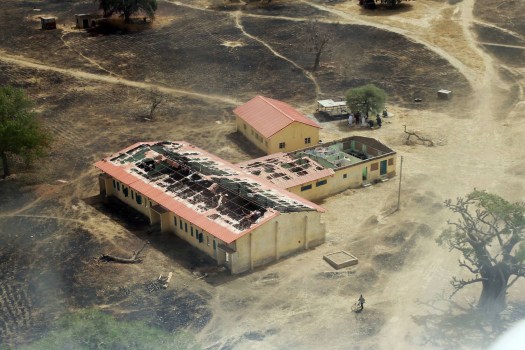
In April 2014, more than 200
girls were kidnapped from a
school in Nigeria. The world
responded: #BringBackOurGirls.
Boko Haram dressed them in dark gowns and head coverings, broadcasting the images to the world the following month.
Four years later, more
than a hundred of
them have been freed.
The New York Times met and photographed dozens of the students.

Asabe Goni

Comfort Bulus

Rifkatu Solomon

Magret Yama

Tabitha Pogu

Fatima Tabji

Rebecca Ibrahim

Pinda Nuhu

Rahila Bitrus

Mary Usman

Maimuna Usman
Asabe Lawan
Yanke Shettima
Amina Paul
Grace Hamman
Aisha Ezekiel
Esther Usman
Naomi Philemon
Maryamu Bulama
Christiana Ali
Comfort Amos
Deborah Peter
Maryam Ali
Maryamu Yakubu
Hannatu Stephen
Jummai John
Saratu Markus
Luggwa Samuel
Rhoda Peter
Ruth Ishaku
Asabe Manu
Mary Ali
Rebecca Joseph
Maryamu Lawan Yamta
Ladi Ibrahim
Fibi Haruna
Hauwa Ntakai
Ramatu Yaga
Yola, Nigeria — The list had more than 200 names.
Martha James. Grace Paul. Rebecca Joseph. Mary Ali. Ruth Kolo. And so many others.
It took Nigerian officials agonizing weeks to publish the names of all the students Boko Haram kidnapped from a boarding school in the village of Chibok four years ago, on the night of April 14. Once they did, the numbers were staggering.
The list quickly circulated among the grieving parents searching for their daughters, some setting out on motorbikes to confront the Islamist militants who had stormed the school, loaded the girls into trucks and hauled them away at gunpoint.
Soldiers used the list, too, as they combed the countryside for the missing students, marching through the forest, dispatching jets and enlisting the help of foreign militaries.
Negotiators checked the names as they bartered with militants for the girls’ release. And the list became an inspiration for protesters hundreds of miles away in the capital, who kept marching for the girls’ return, day after day.
“As I began to read each name, my resolve strengthened,” said Oby Ezekwesili, a former education minister who led protests. “They were not just statistics. These were real human beings.”
Far away in America, France, South Korea and elsewhere, public figures and celebrities joined the cause.
Bring back our girls, they all demanded.
For years, the teenagers remained missing, changing from girls into women, lost to a band of extremists known for beating, raping and enslaving its captives.
And then, many of their names were joyfully crossed off the list.
“I’m ‘back,’ as they say,” said Hauwa Ntakai, one of the Chibok students.
Nearly four years after they were abducted and dragged off to a forest hide-out, more than 100 of the students from Chibok now live on a pristine university campus four hours from their homes here in northeastern Nigeria, their days filled with math and English classes, karaoke and selfies, and movie nights with popcorn.
The government negotiated for the release of many of the Chibok students, who were set free in groups over the last year and a half. A few others were found roaming the countryside, having escaped their captors.
But more than 100 of their former classmates are still missing, held by Boko Haram. About a dozen are thought to be dead.
“I’m happy,” said Ms. Ntakai, who was No. 169 on the list. Now, she is a 20-year-old student who rises at dawn for Saturday yoga class and argues about the benefits and dangers of social media during debate night at the university.
“But I’m thinking about my sisters who are still in the back,” in Boko Haram’s clutches, she said.
Martha James Bello
Rachel Nkeki
Mary Yakubu
Maryam Bashir
Salomi Titus
Hauwa Abuga
Helen Musa
Rakiya Gali
Mwa Daniel
Tabitha Silas
Liyatu Kwanta Simon
Ruth Amos
Martha James
Maryamu Lawan
Palmata Musa
Comfort Habila
Ruth Kolo
Rebecca Mallum
Liyatu Habila
Glory Dama
Victoria William
Naomi Luka
Juliana Yakubu
Nigeria is in its ninth year of war with Boko Haram, a group that has killed and kidnapped thousands of civilians across northern Nigeria. In many respects, the Chibok students, as extraordinary as their plight has been, were just another set of its victims. Many of the young women now consider themselves the lucky ones.
Weeks before the Chibok kidnapping, a group of young boys were burned alive in their own school, a tragedy that failed to resonate around the world in the same way as the mass abduction of the schoolgirls.
The vast majority of Boko Haram’s victims will remain anonymous and unaccounted for, their names never broadcast across the globe. Many of their families will never even know what happened to them. The crimes committed against them occur in remote areas, far from the reach of cellphone networks, and often while the world’s attention is elsewhere.
But the Chibok girls had names. Saratu Ayuba. Ruth Amos. Comfort Habila. Esther Usman.
And from a few weeks after they were taken — when Boko Haram broadcast images of its somber-looking captives, covered from head to toe in long, dark gowns — they had faces.
Rahab Ibrahim
After negotiating with the government, Boko Haram released 21 Chibok students in 2016. Ms. Ibrahim was one of them.
Teenage students from a village school suddenly became the unwitting representatives of all the dead and missing victims of a crisis that has upended a poor, remote corner of the globe.
They became the daughters of Nigeria, and more broadly daughters of the whole world, embraced and fretted over as though they belonged to everyone.
“When the Chibok abduction happened, it was the articulation of this whole saga,” said Saudatu Mahdi, a co-founder of the Bring Back Our Girls movement. “They became a rallying point.”
But the freed students from Chibok also bear the heavy burden of the celebrity that led to their release.
They are fortunate enough to attend a private university that educates the children of Nigerian politicians, businesspeople and other members of the elite.
But security restrictions on the Chibok students are especially tight. They are not allowed to leave campus without an escort. They can’t have visitors without special permission. And though some of the women gave birth during their captivity, their children are not allowed to stay with them at the university. Administrators say that would distract from their studies.
In fact, the young women have rarely seen their families since they were freed from Boko Haram. The longest period they have spent with their parents, siblings and other relatives since their abduction in 2014 was over Christmas break last year, when they went home for a couple of weeks. Other than that, they have been under close supervision by officials and educators.
As soon as they were released from Boko Haram, the women were whisked to Abuja, the capital, where they spent weeks in the government’s custody, questioned for information that could help find their still-missing classmates — and to satisfy officials that they had not grown loyal to Boko Haram.
Security agents warned the young women not to talk about their time with militants, arguing that it might jeopardize the safety of the students still held captive. Forget about the past and move forward, they were told.
Saratu Ayuba
Last May, an additional 82 hostages were released. Ms. Ayuba was in that group.
For months, their access to their parents was severely restricted. They weren’t allowed to leave the bland government building that was their dormitory. Even today, their only regular connection to their families is by phone.
Last summer, officials at the American University of Nigeria traveled to Abuja to meet with the government. Back in 2014, the university, in the city of Yola, had taken in about 20 students from Chibok who had been kidnapped by Boko Haram but had managed to escape within hours.
Administrators pitched the government on a plan to take the newly freed women, too. The idea was to incorporate them into a program designed to help them catch up on their studies, reunite them with their former classmates who were already at the university and prepare them for college life.
Now the Chibok students’ lives are highly structured. With militants still at large in the country, they are considered high-profile targets. And as public figures, officials fear, they are vulnerable to exploitation.
“They will not be the normal people they were before they were abducted,” said Ms. Mahdi, secretary general of the Women’s Rights Advancement and Protection Alternative, an advocacy group for women and girls in Nigeria. “A lot of restrictions will come with their lifestyle.”
Officials at the university had no experience educating a large group of former hostages from a village school. But neither did anyone else.
“We’ll take them all and figure it out,” the university’s president, Dawn Dekle, an American, recalled thinking at the time. “They were traumatized as a group. Their healing has to be in a group.”
All but one of the newly freed students agreed to attend. She had already been married at the time she was kidnapped, so she went back to live on her farm near Chibok with her husband.
At the university, officials scrambled to prepare for the students, renovating a dormitory so they all could be housed together and finding classrooms to accommodate the extra pupils.
The assistant dean of student affairs became the women’s de facto principal. A therapist in the United States, who had counseled some of the early escapees from the kidnapping, was recruited to work as the students’ psychologist. A conference room was designated as a prayer room for the few women who are Muslim. And for the Christian students, the person in charge of the university’s recycling program, who also serves as a local pastor, leads Sunday services.
Deborah Andrawus
While the women now live on a university campus, studying English and preparing for college, they are “free, but not really free.”
Last September, more than 100 of the students arrived at the tidy campus, with its trimmed hedges, three-story library and solar-powered buildings. Not everyone was happy to welcome such a large group of women who had spent the past few years living with militants.
Some of the other students were scared that Boko Haram would come for the Chibok women again, especially at a university representing the sort of Western education that Boko Haram has long condemned.
Others worried that the women had grown attached to their captors and could be terrorists themselves. One student told officials that she feared waking up at night to discover one of the women holding a knife to her neck.
After arriving on campus, the women were escorted to the university cafeteria for their first meal. The group drew stares from the other students.
“I could tell they were not feeling comfortable,” said Reginald Braggs, a former United States Navy R.O.T.C. instructor who is in charge of the program for the Chibok students.
Rather than force integration, administrators decided to let the new arrivals eat most meals in their dorm.
All in their 20s now, the women are housed at the university, but in a program that sometimes seems designed for elementary students. Classrooms are decorated with pictures of Spider-Man and basic multiplication tables.
“Remember to flush the toilet and wash your hands,” reads a poster on the bulletin board.
For months, their tablets, all donated, were ordered turned off at night. Messages of positive thinking are plastered on every wall: Never give up. Believe in yourself. Shine like stars.
When some of the women were upset at messing up during spelling bees, administrators gave them the words to study ahead of time. Even their church service, during which the women seemed relaxed and joyful as they sang and danced on a recent Sunday morning, is watered down. Raymond Obindu, a charismatic speaker who bounces beside the pulpit and uses an equally ebullient interpreter, keeps his sermons for the women more uplifting than the ones he delivers to his local congregation.
“The Bible says you are fearfully and wonderfully made,” Mr. Obindu said during the service. “Everyone say, ‘I’m beautiful.’ ”
“I’m beautiful,” the room of women chanted.
He asked if anyone wanted to give thanks.
“I thank God for leaving me alive,” said Magret Yama, who was released by Boko Haram last May.
Yana Joshua
Hauwa Ishaya
Luggwa Mutah
Hauwa Musa
Filo Dauda
Naomi Zakariya
Blessing Abana
Kauna Lalai
Saraya Yanga
Abigail Bukar
Awa Yirma
Grace Paul
Luggwa Sanda
Yana Bukar
Glory Maintah
Maryamu Musa
Amina Bulama
Grace Dauda
University officials have the women adhere to a busy schedule — including classes on Saturdays — to keep their minds off the past.
“They’ve seen hell together,” said Somiari Demm, the psychologist, who counsels the women, teaches them yoga and attends church services alongside them. “They share the extensive narrative that no one else does.”
The women told their parents that they had endured periods of hunger while with Boko Haram. They were made to cook and clean for fighters. Some were raped. Some have shrapnel lodged under their skin. One is missing part of a leg from injuries suffered with Boko Haram.
Ntakai Keki, 60, said his daughter Hauwa had told him that the militants beat girls who disagreed with them or refused to follow orders. She was once lashed 30 times with a cane, he said.
Hauwa had told him that she saw the dead bodies of children who were being held hostage and witnessed fighters die of wounds from aerial bombings by the military.
“That has all ended now,” Mr. Keki said.
Psychologically, Mr. Braggs said more than half of the women were in what he called the red zone. “They’re just sad or down,” he said.
University officials do not let journalists ask the women about their experiences with the militants, arguing that it could traumatize them further.
“They’re grown women by American standards,” Mr. Braggs said. “Even physically they are grown women. But look at their social development. They’re still very vulnerable.”
“I’m very, very cautious about people thinking I’m overprotective,” he added. “I don’t think they’re children. But there’s a certain responsibility I’ve been given.”
At the university, the women are instructed to speak only English, a language most of them struggle with (they grew up speaking Hausa and local languages). Other than a few staff members posted to their dorm, most of the people in charge of the women can’t communicate with them in their own languages — including the women’s psychologist, their teachers and the director, Mr. Braggs.
A handful of the women speak English well. Some are using kindergarten-level phonics books. Yet most of the women’s counseling sessions are carried out in English, raising questions about the depth of their therapy.
Ms. Demm contended that some of the Chibok students who had initially escaped the kidnapping had traveled to the United States, only to be exploited by people there. She said they were made to repeatedly recount the night Boko Haram came to their school, with their testimonies used to solicit donations for churches or other organizations.
Ms. Demm argued that she wanted to empower the students in her care to tell their own stories, in their own time.
For now, she said, the hardest adjustment for the women is “being free, but not really free.”
Recently, one of the women, Glory Dama, learned that her father was being treated for an illness at a hospital not far from campus. She wanted to see him, so the university prepared to organize an escort for her. Before it happened, though, he was discharged and relatives drove him back to Chibok, without waiting for Ms. Dama to arrive. He died on the way.
Ms. Dama was devastated, and as the news traveled through the group so were the other women. Activities were canceled for the rest of the day.
The women, who spend their days in air-conditioned classrooms equipped with Wi-Fi, know that their current circumstances are vastly better than those of most people who have escaped or been freed from Boko Haram.
Militants have beheaded some of their captives, conscripted others to carry out murders and strapped suicide bombs to women who were the same age as the students from Chibok. Some captives freed from Boko Haram have been placed in crowded military barracks for months. Others live in squalid government camps where they have been raped by security forces and struggle to find enough to eat.
Ms. Dama wants to take university classes, return to Chibok and be a nurse to help her community. Another student, Rhoda Peter, wants to be a lawyer.
“I know I’m in a place where nobody will chase me and do something wrong to us,” said Ms. Peter, 22. “They are here to help us.”
In February, about 170 miles from Chibok, the unfathomable happened again.
Boko Haram stormed a secondary school in a village called Dapchi and left with more than 100 female teenage captives.
The nation began to mourn the kidnapping of yet another set of schoolgirls. Then, late last month, the militants suddenly brought most of the girls home safely, for reasons that are not entirely clear.
The Nigerian government says it is negotiating for the release of the rest of the missing girls from Dapchi, as well as the dozens of students from Chibok who are still being held captive.
Grace Hamman, a Chibok student who was released from Boko Haram last year, said she took comfort during her time in captivity in the knowledge that she hadn’t been forgotten.
“I heard on the radio people were crying for us and were concerned,” she recalled. “I thank everyone for what they did for us.”
The photographs were taken at the American University of Nigeria, in the city of Yola, with the help of the university.
Produced by Craig Allen, Danny DeBelius, David Furst, Meghan Louttit, Meghan Petersen, and Rumsey Taylor.