


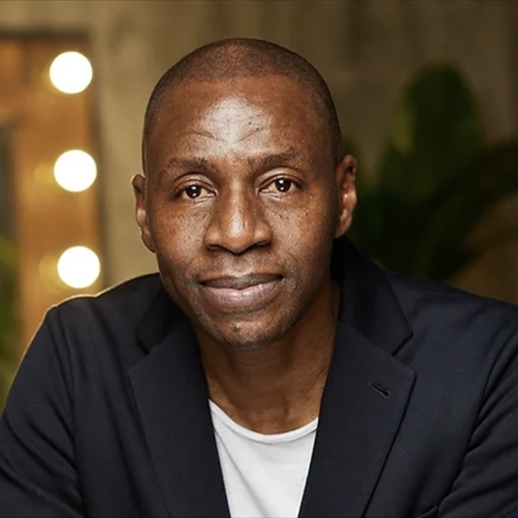
TUNDE: I’ll never forget, as a kid, riding my bicycle outside our house in London, then coming in to see my mum bawling her eyes out. I was so shocked, I begged her to stop crying. My dad had died. So my mum, my sister and I went back to Nigeria, and there we stayed.
About three years later, my stepfather came into the picture. Naturally, as a child, you’re a bit sceptical about a stepfather taking your father’s role — and mine was about to become head of state in Nigeria. When he visited us, there was a lot of fanfare, with soldiers, bodyguards. Sometimes we’d go to his place, where we’d have to go through security checks. Inside there was this cool, funny man who’d ask me and my sister about school. He was so sweet and charming, gradually I accepted he was my father.
He’s very family-orientated, with lots of wives, and he loves kids. I never got to know too much about his military side, and I’m not really into politics. When we were with him, he was just sort of normal. Not long after he married my mother, he retired as president to become a farmer with chickens, pigs and lots of land.
We lived in Lagos with my mother, but we’d go to hang out on the farm, in the southwest of Nigeria. He’d always say: “How’s school going?” or “You got any girlfriends? Anyone you fancy?” And he’d say: “The most important thing is to be able to stand on your own feet. Then everything else will fall into place.” That left a really strong impression on me.
Then, in 1995, he was locked up because people said he was plotting a coup. We thought he’d be killed. Nigeria had come to a standstill because of Abacha’s corruption, and people like Ken Saro-Wiwa [the environmental activist] were murdered. I was back in London by then. All I could do was pray. After three years, by some miracle, Abacha died, so my father was freed. It was like another miracle when he was chosen again to be president of a democratic government of Nigeria. He was more appreciative of life after being in prison. Now what I see is this person who’s very loving, very witty, and always wants the best for everybody. And he’s working hard for Nigeria.
I was very close to my mother. After my father was elected in 1999, my mum had to come to London for treatment for cancer. We thought she was getting better, but on April 1, 2000, she passed away. I just stopped and re-evaluated my life. The Lighthouse Family had been great, but I didn’t want to do it any more.
It was a difficult time. I remember a kid in a shopping mall asking me to sign a bit of paper. I had long hair and a beard, and I was like: “Wow, you recognised me through all this!” His mother blurted out: “Don’t stop what you’re doing; it means a lot to people.” It was weird, like a waking dream. As if my own mother was trying to tell me stuff through this woman. And I thought: “Right, I’ll give music another go.” That was the genesis of a change — making a record, telling my own stories. It’s become important for me to embrace my roots and my dad’s history. I wanted to express my love for him on my record. To me, he personifies Nigeria. My song Our History is my tribute to him, and Anaesthetic is about my mother passing away. It’s heavy but beautiful.
When my father comes to London, to see Blair or whatever, I’ll go to his hotel with my sister. The first thing he says is: “So, are you married yet?” He’s always pestering me. I’m like: “I’m working on it. I can’t just go and pick a girl from the street and say, ÔRight, I want to marry you.'” He’s a little tinker: he’ll call a girl and get her to visit. I say, “She’s not my type,” but he won’t let it go. Anyway, I think I’m definitely the marrying type.
It’s painful for me to hear what people say about my father in a political context. But he just laughs. He’s an amazing, wonderful guy. At 67 he still beats me at squash, I’m embarrassed to say. And he’s turned out to be more than I could wish for — as a father or stepfather.
PRESIDENT OBASANJO: In Africa we normally don’t count the number of our children. It’s superstition, really. When people ask you if you have one, you say: “Many.” If you have none you say: “Many.” And if you have many you say: “Many.” But the truth is that my children are probably still in single digits.
Tunde and I are very close — as close as any of my biological children. His mother, Elizabeth, was the second of my five wives, and a wonderful woman. She was quiet and considerate, and very beautiful and charming. We never had a cross exchange of words. I was very much in love with her, and it was important to her that I treat Tunde as my son.
Tunde was about five when I first knew him, and a very reticent, shy boy. The difficulty for a stepfather is getting the children to trust you. I felt I could conquer his shyness and reticence, and I decided to bring him to sleep with me in my bed, and we slept in my bed for some time. It made him feel secure with me. Since then he’s been a really loving boy.
When I met Tunde’s mother I was the head of the army. Shortly after that I became number one in Nigeria. And then, in 1976, I resigned as president and went to live in the countryside as a farmer. I was concerned about Tunde’s education, because for me it’s the foundation of everything. He gave his mother a bit of anxiety from time to time. When he was at boarding school, he wasn’t too serious about studying. He wanted to do arts subjects, but I wanted him to do science subjects — which he did, but he didn’t study very hard and had to leave this school. I was gravely disappointed.
The most difficult time for teenagers is when they’re 16 or 17 years old. They think they’re adults and can cope on their own, but really they are not strong enough. They’re also copycats. That is when they need support, understanding and firmness, which Tunde got from me.
I grew up in a village, in some poverty, and to really know what it is to be poor has stood me in good stead. I said to Tunde and my other children: “You’ve grown up with a silver or even a golden spoon in your mouth. I didn’t even have a wooden spoon. Don’t ever forget that your home is Nigeria, and that to excel in anything you need to work hard.”
Like all children, Tunde wanted to flee the coop, but I am glad to say he stayed on the path of rectitude. When he went back to the UK to continue his studies, I was sad to see him go, but we were constantly in touch. I even threatened to come and stay with him in Newcastle University. He was studying accountancy, but he was very into music — and being a musician isn’t really regarded as a profession in Nigeria. His mother was a little apprehensive. But I said: “Leave this young man to do what he feels he has to do. He’s done well and he may do well in music. We must pray for him.”
Today I am so proud of his music, and particularly that he has composed a song in honour of me and my travails in prison. That was awful. I was locked up and alone. When I needed to use myself [go to the toilet] I’d have to go past dungeons, and see what could happen to me if I misbehaved. I thought I would be killed — possibly poisoned. That’s what everyone thought. The aim of my captors was to totally isolate me and break my spirit, but they failed.
Tunde’s mother came to see me a couple of times, and then she went to the UK because she was very ill. If she knew it was terminal, maybe she was preventing me from the agony of her pain by not telling me. Her passing away was most unexpected. Tunde and I found comfort in each other in grieving together.
Tunde is not yet married, which distresses me. I keep trying to arrange things for him, but I don’t know what is Tunde’s type. I tried in London, I tried in Nigeria, but I never give up. Tunde looks shy, but he has great inner depths, and he is not as shy as he apparently looks. Really, he is a darling.

