Scotland has a parliament, a flag, a football team that loses with tremendous dignity, and roughly the population of Lagos’s Ikeja Local Government Area. The Yoruba nation and I use the word advisedly has an empire’s worth of history, a written and oral constitutional tradition running from Ile-Ife through the Oyo Mesi and the Alaafin’s checks and balances, a diaspora spanning three continents, and something in the region of forty million native speakers. One of these is routinely described in the Financial Times as a nation debating its constitutional future. The other is routinely described, by the same publication, as a tribe engaged in an ethnic dispute. I invite the reader to spot the empirical difference. I have been looking for thirty years and have found only prejudice wearing a monocle.
The Diminishing Deal: When Trump Demands the Whole Field and Settles for the Square Metre He’s Already Standing On by Lawson Akhigbe
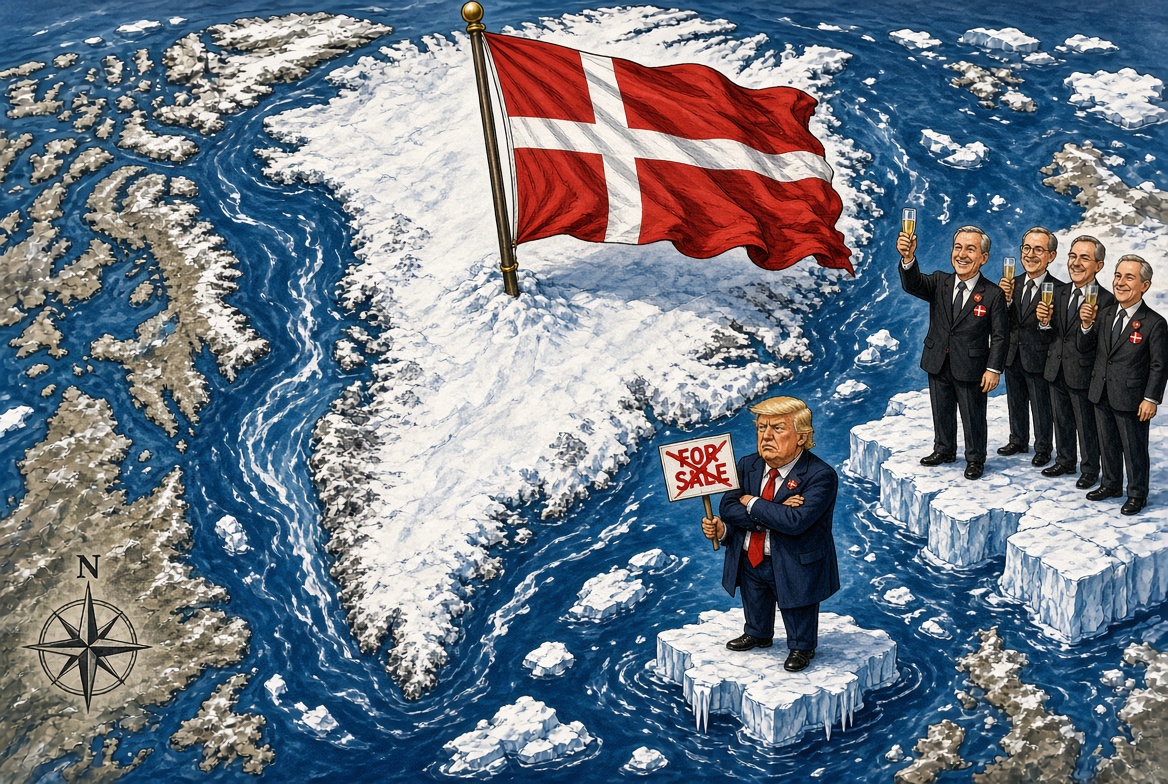
Donald Trump wanted Greenland. Not in the quiet, diplomatic, “let’s explore strategic interests over aquavit and polite nods” manner that grown-up nations occasionally attempt. No. He wanted it the way a toddler wants the biggest toy in the shop window: loudly, immediately, and with zero regard for the fact that it already belongs to someone else.
The Obituary of American Democracy Has Been Written So Many Times It Deserves Its Own Rest Home by Lawson Akhigbe
Every generation seems to produce its own undertakers, its own mourners and its own carefully worded obituary announcing that the republic is finally approaching the end.
Same Shit, Different Hat: A Timeless Fashion Statement in Political Extremism by Lawson Akhigbe
Ah, the internet has done it again. While the rest of us are busy arguing over pineapple on pizza or whether socks with sandals constitute a war crime, some genius has distilled centuries of ideological garbage into one glorious, four-panel roast. Behold the meme that slaps you harder than your uncle at Thanksgiving: "Same Shit, Different Hat."
The Curious Case of the Missing Shepherds by Lawson Akhigbe
There is a peculiar habit that appears with remarkable frequency in American and British political commentary. Whenever an issue is said to concern black communities, a familiar chorus emerges from television studios, newspaper columns and social media platforms.