

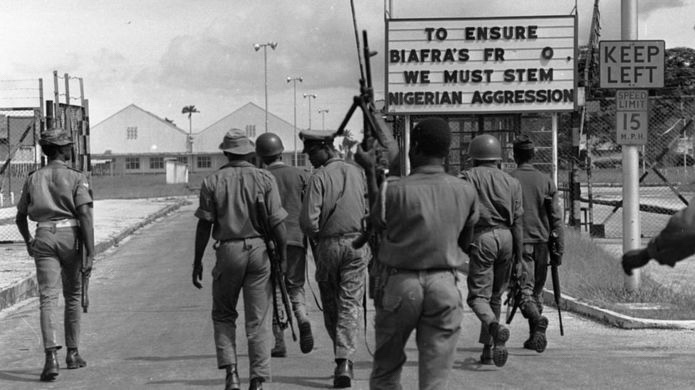
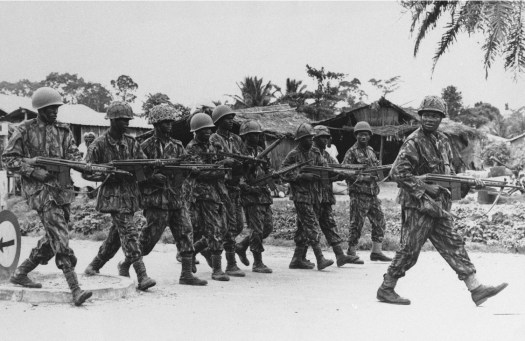
 ‘Biafra is a dream that haunts me – it was a dream that was on the cusp of being realised and yet failed so painfully,’ recalls Ije Ajibade, telling the story of injustice that has shaped her life
1 day ago
My earliest memories of Biafra are the same as my earliest memories of my father. I can remember sitting next to him on a bed and I touched his arm. He turned to me and he said: “Can’t you see your father is crying.” It was many years later that I realised he was crying because of Biafra. That was 50 years ago today. I didn’t see my father cry again. He was mourning the loss of the Biafra dream.
For me and for many of the diaspora, Biafra is a presence that haunts us. It is a part of our history that is not spoken about and yet we try to make sense of it by reading, watching plays and attending lectures. All of this in an attempt to understand this dream that was on the cusp of being realised and yet failed so painfully.
I was two when the war began and four when it ended. This was a civil war in Nigeria fought between the Nigerian government and the eastern region of Nigeria. Predominantly the home of the Igbo people, the eastern region – in response to violence and massacres, as well as political, economic, cultural and religious tensions – declared itself the State of Biafra on 30 May 1967 and seceded from Nigeria.
Nigeria was a creation of the British in 1914. It was established for colonial administrative convenience. It merged three separate cultures into one. To the north were the Fulani and Hausa-speaking people, often nomadic, principally of the Muslim faith. To the west of the River Niger were the Yoruba, largely farmers living under a rigid monarchical system and Christian. To the east were the predominantly Igbo-speaking people, also Christian, but with a strain of Judaism and more republican in their outlook. Nigeria is not (and never has been) a cohesive whole. However, in 1960, Nigeria was granted independence. Violence and coups ensued.
In response to Biafra’s secession, the Nigerian government, backed by the former colonial master, countered with a brutal war. Millions of Biafrans died, most as a result of the deliberate government policy of starvation. From July 1967 to January 1970, Biafrans fought to free themselves from Nigerian oppression and from the lingering vestiges of poisonous colonialism. Biafra was starved into submission. Biafra was, and still is, a powerful vision of freedom and self-determination.
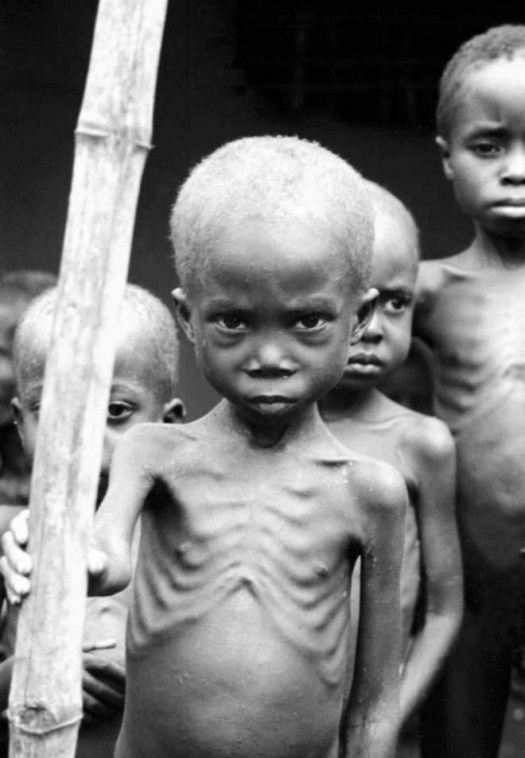
Starvation of Biafrans was a government policy (Sipa/Rex)
I have a deep and abiding rootedness in Biafra and the UK. My father studied at the LSE in the early 1960s and his first job as an academic was in England. I was born in the UK and brought up in two different cultures. To me, Biafra is a dream and a shadow. It is a dream of my father. I remember bouncing into the kitchen aged nine or 10 (we were living in Norwich at the time) and informing my mother that I was Biafran because Dad said so, and she told me (quite rightly) that Biafra does not exist. I ignored her. This was 1975, five years after the war had ended but my father still dreamed. He was Biafran and so were we. At least once a week we had to eat fufu, a traditional Biafran meal. As far as my father was concerned, fufu, like our Biafran identity, was both compulsory and necessary and he made sure that we knew this. My sisters and me would hanker after fish and chips!
My father died 17 years ago. We flew his body home to be buried. It went without saying that he needed to be laid to rest in the place that was truly home for him. My father’s tie to the home country was a tie to the dream of Biafra. He never stopped believing in Biafra. It was a passion and a dream that consumed him. His passion for Biafra shaped the way my two sisters and I were brought up. His passion for Biafra lingers in my life and has influenced the way I interact with the world and the way in which I struggle and thirst for justice.
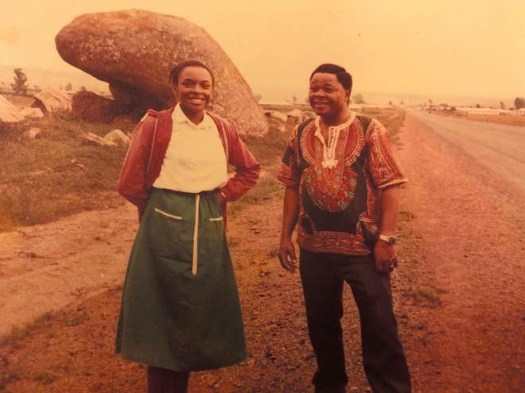
The author, left, took up her father’s passion for Biafra (Ije Ajibade)
But Biafra is also a shadow. Not just for me, but for many people. It is the shadow of our past in Nigeria as a nation, whether we acknowledge it or not. The shadow of Biafra exists in the memories of the war and the many stories that are told about it behind closed doors. The shadows and dreams of Biafra are invisible but still very profound.
His passion for Biafra shaped the way my two sisters and I were brought up. His passion for Biafra lingers in my life and has influenced the way in which I thirst for justice
Dad brought us up to believe in Biafra. He was always deeply passionate about Biafra and our home town of Mbaise. When I was 12, we moved to Nigeria from the UK. Dad wanted us to attend school in Nigeria. We lived in a small town called Idah on the eastern bank of the River Niger in the middle belt region of Nigeria.
My father had unwritten rules. We were not allowed to study in the north. We were not allowed to marry anybody from the north and he gave us strict instructions to marry from Mbaise in the southeast of Nigeria. Needless to say, that was the one time I disobeyed him because I eventually married a Yoruban man from the west of Nigeria.
 Centre for Nigeria Progress
What has been joined together should not be put asunder. And the upheaval of African countries dividing into ethnic enclaves will lead to tensions. Sudan and South Sudan as an example, succession is not the solution bothersome quarrels.
LikeLike
And why is the Federal Government against Biafra?
LikeLiked by 1 person