

There is something almost theatrical about the way “aid” is discussed in the West. When the average voter in the United States or the United Kingdom hears that their government has sent development assistance to a country like Nigeria, the reaction is predictable: a mix of irritation, suspicion, and the familiar refrain—“why are we giving them our money?”
It is an understandable question. It is also, in many cases, the wrong one.
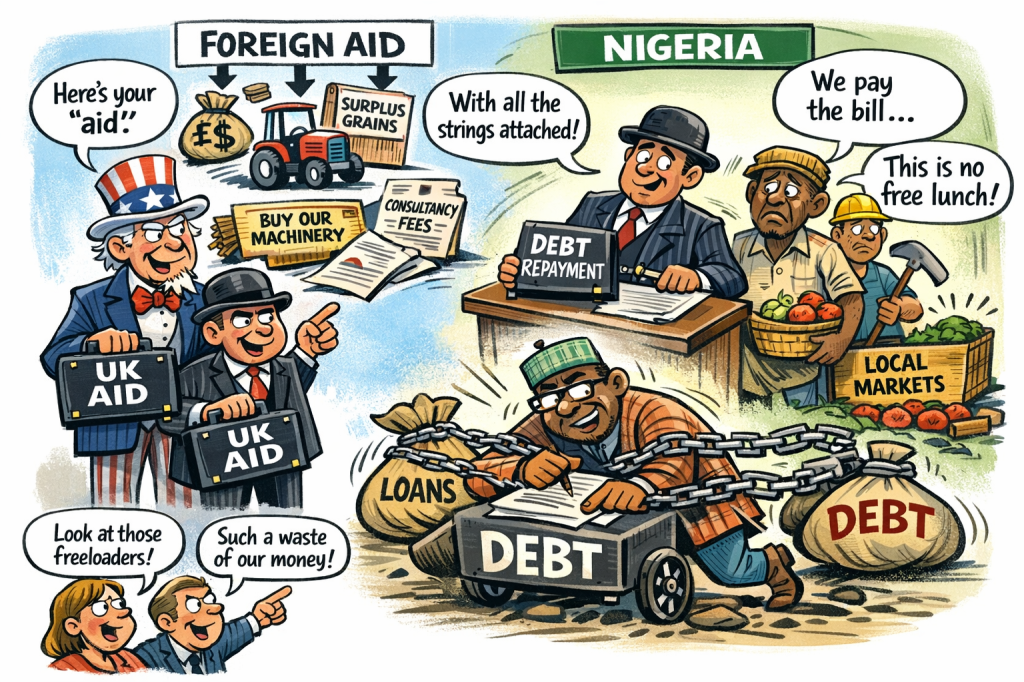
Because what is presented as generosity is often something closer to structured self-interest—aid not as charity, but as a carefully engineered economic instrument.
The Conditional Kindness of Aid
Take agricultural aid. On paper, it reads like benevolence: support for food production, rural livelihoods, and food security. In practice, the fine print tells a different story.
The recipient country is frequently required to:
- Purchase machinery from firms based in the donor country
- Engage consultants tied to donor institutions
- Adopt technical frameworks designed—and billed—abroad
The result? The “aid” money rarely leaves the donor’s economic orbit. It circulates back home, sustaining industries, creating jobs, and justifying the expenditure to domestic audiences.
Nigeria, meanwhile, carries the cost.
Loans Wearing Aid’s Clothing
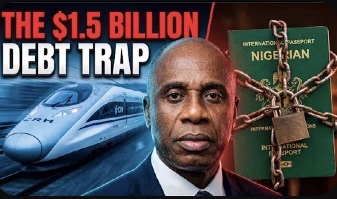
The illusion becomes even clearer in infrastructure financing. Consider port development projects tied to external financing arrangements. These are often described in diplomatic language as partnerships or support mechanisms.
But strip away the varnish and the structure looks rather different:
- The loan originates from a private bank in the donor country
- The donor government provides a sovereign guarantee
- The recipient country bears full repayment responsibility
- Project management and operational control are frequently domiciled abroad
In effect, Nigeria is not being handed a gift—it is being sold a product, financed on commercial terms, with risks socialised onto its own balance sheet.
The “aid” label becomes a branding exercise.
Food Aid and Market Capture
The same pattern plays out in food aid, particularly from the United States. Shipments of grain to African countries are often framed as humanitarian interventions. And in moments of acute crisis, they can indeed save lives.
But outside emergency contexts, the dynamic is more complicated:
- Surplus agricultural production in the US finds an external market
- Local farmers in recipient countries struggle to compete with subsidised imports
- Domestic agricultural ecosystems weaken over time
What begins as relief can end as dependency.
It is difficult to build a self-sustaining agricultural sector when your market is quietly being undercut in the name of assistance.
The Politics of Perception
Back in London or Washington, the narrative remains intact: taxpayer money is being shipped off to faraway lands, presumably with little accountability and even less return.
And so the finger-wagging begins.
Right-leaning commentators lament waste. Voters grumble about misplaced priorities. Nigeria becomes a symbol—not of partnership—but of perceived excess and ingratitude.
Yet this narrative omits a crucial detail: much of this “aid” is not a transfer of wealth outward, but a recycling of capital inward.
It is less Robin Hood, more boomerang.
The Uncomfortable Truth at Home
And yet—this is where the satire must briefly yield to sobriety—the West is only half the story.
The other half sits much closer to home.
Because these arrangements, however cleverly constructed, do not impose themselves. They are negotiated, signed, and implemented by leaders in the recipient countries. Leaders who often:
- Accept unfavourable terms without rigorous scrutiny
- Prioritise headline projects over sustainable economics
- Treat sovereignty as a negotiable instrument rather than a governing principle
It is here that the real failure lies.
Not in the existence of self-interested foreign policy—that is a constant of international relations—but in the willingness of domestic leadership to accept it uncritically.
No Free Lunch, Only Expensive Dinners
So the next time a voter in the United Kingdom or the United States complains about aid to Nigeria, one might gently suggest a reframing.
This is not a free lunch.
It is a catered event—fully billed, carefully itemised, and ultimately paid for by the guest of honour.
And if the meal feels overpriced, the question is not only who set the menu—
—but who agreed to order everything on it.
 Centre for Nigeria Progress
Yes and where the US has left off China is taking our place.
LikeLike