


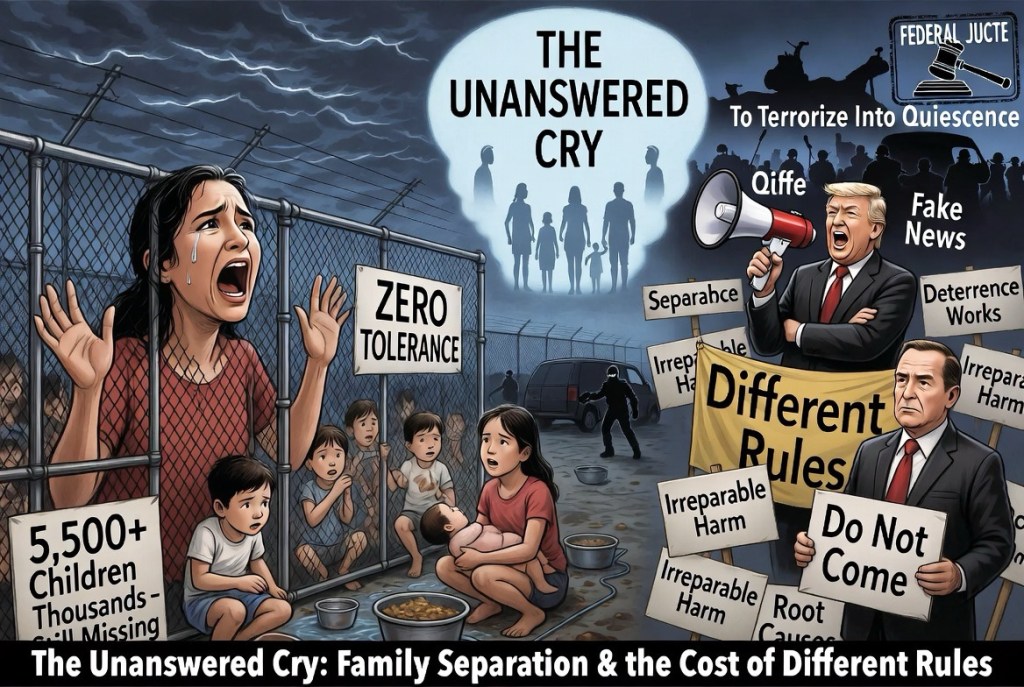
Family separation here refers primarily to the forcible or policy-driven splitting of parents/guardians from minor children during border processing, detention, or deportation proceedings. It does not include natural separations from conflict, voluntary migration, or standard child welfare removals (though overlaps exist). Globally, no major democracy has replicated the U.S. scale of systematic, deterrent-driven separations of accompanied families, but many countries detain migrant children (often with families) and externalize controls, leading to indirect harms.
1. United States: Systematic Deterrent Policy with Lasting Unresolved Harm
The U.S. stands out for explicitly using family separation as a tool of deterrence. Under the first Trump administration’s zero-tolerance policy (announced May 2018 by Attorney General Jeff Sessions), all adults crossing irregularly were criminally prosecuted for illegal entry. Because children cannot be held in criminal facilities, this resulted in automatic separations.
- Scale: Over 5,500 children separated (official counts cite ~4,600–5,569 from 2017–2021, including a 2017 pilot program). Conditions included “cages” (chain-link enclosures), inadequate food/hygiene, and cases of young girls caring for infants. Poor tracking left thousands initially unaccounted for; as of late 2024 reports, up to 1,360 children remained unreunited years later.13
- Intent and Implementation: Documents show deliberate design to deter migration by inflicting suffering (“We need to take away children”). Separations scattered children across facilities nationwide, often hundreds/thousands of miles away. The policy ended via executive order in June 2018 amid outrage, but separations continued on other grounds.
- Human Cost: Long-term psychological trauma (PTSD, attachment disorders, developmental delays) documented by medical experts. Critics, including Amnesty International, labeled aspects as torture due to intentional severe mental suffering for coercive purposes.
- Political Context and “Different Rules”: The blog post’s theme resonates here—aggressive enforcement faced backlash, yet accountability has been limited (no high-level prosecutions). Later administrations (Biden-Harris) emphasized reunifications via a task force but faced criticism for not fully resolving cases or preventing ongoing separations tied to Title 42, Remain in Mexico, or interior enforcement. In 2025–2026, renewed enforcement under a second Trump term has raised concerns about family impacts from mass deportations, though systematic zero-tolerance has not been reinstated as of early 2026.
- Nuances/Edge Cases: Separations also occur in interior deportations (U.S. citizen children left behind) or when trafficking/fraud is suspected. Alternatives like family detention centers exist but have been challenged on conditions.
This approach reflects a “play by different rules” dynamic: one side enforces harshly and weathers outrage; institutional responses often prioritize process over sustained moral reckoning.
2. Australia: Offshore Detention Without Routine Family Separation
Australia maintains one of the world’s strictest border regimes via “Operation Sovereign Borders” (turnbacks and offshore processing on Nauru and Manus Island for boat arrivals).
- Policy: No explicit policy of separating accompanied families upon arrival. Families are typically detained together in offshore centers (controversial for harsh conditions, self-harm, and mental health crises). As of 2018 data, small numbers of children were held (e.g., 7 under 18 in mainland detention, 22 on Nauru).
- Scale and Impact: Thousands processed offshore since 2013; children exposed to prolonged detention, abuse reports, and medical neglect. However, the focus is containment/externalization rather than splitting intact families. Domestic child detention for migration reasons has drawn UN criticism as violating the “best interests of the child.”
- Comparison to U.S.: More emphasis on deterrence through isolation and indefinite offshore holding than on-site separation. Public and legal pushback has led to some resettlements, but the system remains punitive. Unlike the U.S., Australia avoids the “cages” imagery for accompanied minors but faces similar accusations of systemic cruelty.
- Nuances: Temporary visa holders or community placements sometimes used as alternatives; family reunification for approved refugees is possible but slow.
3. European Union and Member States: Family Unity Emphasis with Detention and Externalization
EU law (e.g., Reception Conditions Directive) prioritizes keeping asylum-seeking families together “as much as possible” and prohibits routine detention of children solely for migration status in many contexts.
- Policy: No equivalent to U.S. zero-tolerance family splitting. Accompanied families are usually housed in reception centers while claims are processed (under Dublin Regulation, first-entry country responsibility). Unaccompanied or separated children (UASC) are common due to dangerous journeys, not policy-driven splits.
- Scale: In 2023, ~55,700 children arrived via key Mediterranean routes (Greece, Italy, Spain, etc.); ~64% unaccompanied/separated. EU-wide asylum applications from UASC fluctuated (e.g., peaks during 2015–2016 crisis). Some countries (e.g., Greece hotspots, Italian facilities) have faced overcrowding, poor conditions, and pushback allegations. Child detention occurs in limited cases (e.g., UK: 42 children in 2017; Canada: 155 minors, often with mothers).
- Human Cost: Trauma from journeys (e.g., drownings, exploitation in Libya), camp conditions, and age disputes. Externalization deals (e.g., EU-Turkey, Italy-Libya, UK-Rwanda proposals) shift burdens, indirectly causing family risks or separations en route.
- Comparison to U.S.: Far less deliberate splitting of accompanied families; focus on processing unity. However, variability across members (Hungary’s hardline stance, Greek island camps) creates inconsistencies. Over 100 countries detain children for migration reasons, drawing universal child rights criticism (UNCRC “best interests” principle).
- Nuances/Edge Cases: Pushbacks at borders (e.g., Poland-Belarus, Greece-Turkey) or returns can separate families indirectly. Some states use “housed minors” in adult facilities as a workaround.
4. Other Notable Contexts (Canada, UK, Broader Global Patterns)
- Canada: Avoids routine family separations; children often detained with mothers (fathers separate). Small numbers in detention; emphasis on alternatives. Strong family reunification pathways in legal immigration.
- United Kingdom: Limited child detention (declining trend); no systematic border family splitting. Focus on asylum processing and returns. Post-Brexit externalization attempts (e.g., Rwanda) criticized for family impacts.
- Global Trends: Over 100 countries detain migrant children. Many in the Global South (e.g., Mexico’s southern border: high unaccompanied child encounters) face resource strains. Conflict zones produce massive unaccompanied/separated children (e.g., Syria, Sudan, Venezuela flows), but these are not policy-driven border separations. International law (UN Convention on the Rights of the Child, ratified by most nations except the U.S.) mandates family unity and prohibits detention as a default for children.
Common Global Elements:
- Deterrence via Harshness: Many nations use detention, externalization, or pushbacks to discourage irregular migration, mirroring U.S. intent but rarely through explicit family splitting.
- Data Gaps: Unaccompanied/separated children numbers are underreported; journeys themselves cause separations (e.g., Darién Gap, Mediterranean crossings).
- Human Rights Consensus: Bodies like UNHCR, UNICEF, and HRW condemn child detention and family separation as harmful, violating non-refoulement and best-interests principles. Prolonged separation links to lifelong scars (anxiety, depression, impaired development).
Key Nuances, Implications, and Edge Cases
- Effectiveness vs. Morality: U.S. zero-tolerance reportedly reduced crossings short-term in some segments, but global evidence shows deterrence often displaces flows (e.g., to more dangerous routes) without addressing root causes (violence, poverty, climate). Australia’s offshore model “stopped the boats” but at high humanitarian cost.
- Political Asymmetry (“Different Rules”): The blog post critiques how the U.S. left an “unanswered cry” with limited accountability. Comparatively, Australia and some EU states face domestic/international lawsuits and inquiries but sustain policies through framing as “border security.” Weaker accountability in externalization deals (e.g., funding Libyan coast guard) allows deniability.
- Evolving Cruelty: Post-2018, U.S. debates shifted to interior enforcement, Title 42 expulsions, and (in 2025–2026) mass deportation infrastructure—potentially increasing family splits via parental removal. Globally, “elastic borders” (securitization + technology) and AI surveillance raise new risks of indirect separations.
- Alternatives and Best Practices: Family case management, community housing, or expedited processing with unity preserve bonds. Countries like Canada/Portugal score higher on family-friendly migration indices. Evidence shows family unity improves integration and child outcomes.
- Broader Implications: Separation policies exacerbate inequality (disproportionately affecting non-White, Global South migrants), strain foster/child welfare systems, and erode public trust. Long-term societal costs include mental health burdens, lost productivity, and moral injury to implementing nations. In a 2026 context of renewed U.S. enforcement, unresolved 2018 cases highlight risks of repeating cycles without reckoning.
- Edge Cases: Trafficking suspicions justify separations everywhere (but require due process). Deportations of long-term residents separate mixed-status families (U.S. estimates: hundreds of thousands of U.S.-citizen children affected historically). Climate/disaster displacement adds layers.
In summary, the U.S. 2018 policy remains an outlier in its deliberate, large-scale splitting of accompanied families as explicit deterrence—producing an “unanswered cry” of trauma and incomplete reunifications that few peers matched in form, though many share the punitive spirit through detention or externalization. This asymmetry underscores the blog post’s point: when norms erode without sustained accountability, the human and institutional costs compound, influencing global migration governance toward harder lines. True deterrence alternatives (legal pathways, root-cause investment, humane processing) remain underexplored everywhere, with profound implications for child rights, state legitimacy, and international cooperation.

