


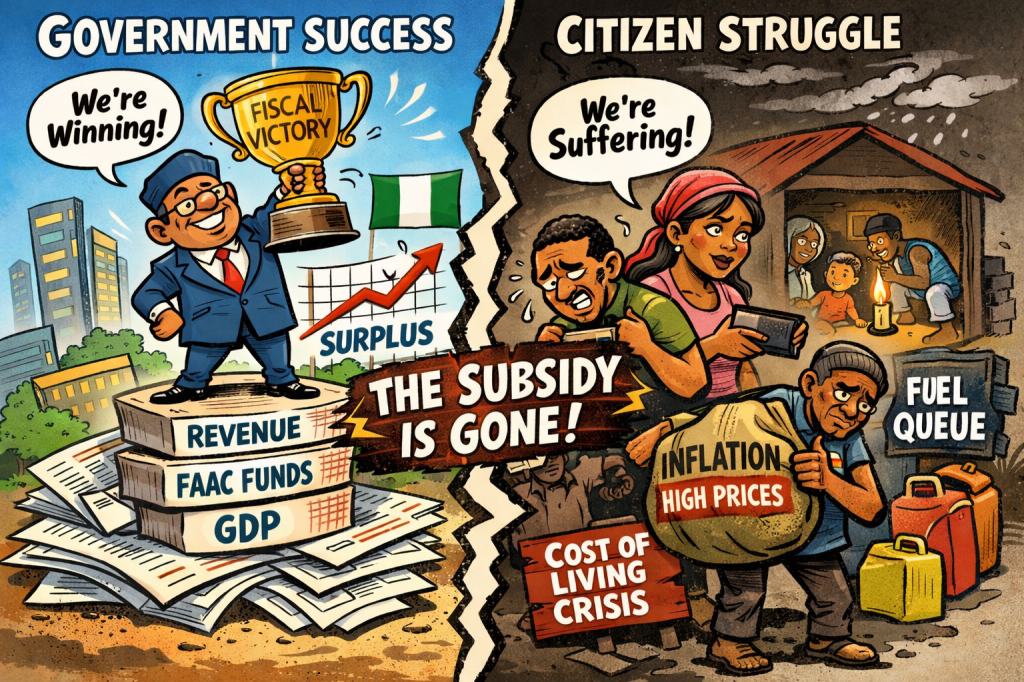
The government spokesman’s essay reads like a victory lap taken halfway through a marathon. Yes, the sentence delivered by Bola Ahmed Tinubu on inauguration day—“the fuel subsidy is gone”—was dramatic. But drama is not the same as delivery, and arithmetic is not the same as economics lived by citizens.
Let’s separate three things the spokesman deliberately blends together: fiscal correction, structural reform, and social outcome.
1. The “Organised Wealth Transfer” Argument—Convenient, But Incomplete
We are told the fuel subsidy was an “organised wealth transfer” to elites. That’s not entirely false—but it is strategically selective truth.
The subsidy system was indeed riddled with rent-seeking. But here’s the missing half:
it was also one of the last remaining shock absorbers for ordinary Nigerians in an economy with no meaningful social safety net.
Removing a corrupt system without replacing its social function is not reform—it is policy amputation without rehabilitation.
If the subsidy was a feeding bottle for elites, it was also, however inefficiently, a life support machine for millions. You don’t switch that off overnight and call it bravery; you call it high-risk governance.
2. The Fiscal Numbers—Accurate, But Misleading in Isolation
The spokesman leans heavily on improved fiscal indicators: deficit reduction, revenue growth, FAAC allocations.
Fine. Let’s accept those numbers at face value.
But here is the core issue:
macroeconomic stabilization does not automatically translate to microeconomic relief.
Nigeria may have doubled revenue on paper, but what did Nigerians experience?
- A collapse in real purchasing power
- Inflation that eroded wage value faster than any subsidy ever did
- Transport, food, and energy costs rising simultaneously
This is the classic policy trap: celebrating government balance sheets while households go bankrupt.
A state is not a corporation. Its success is not measured by improved revenue alone, but by whether citizens can survive the transition.
3. Exchange Rate “Reform”—Or Currency Shock Therapy?
The spokesman casually references the elimination of multiple exchange rates as a structural correction.
Let’s call it what it was: a forced convergence that triggered a currency shock.
Yes, arbitrage opportunities reduced. But the cost?
- Immediate inflation pass-through
- Imported hardship in an import-dependent economy
- Business uncertainty due to FX volatility
In economic terms, this was front-loaded pain with deferred—and still uncertain—gain.
4. FAAC Windfall—More Money, Same Governance Problem
We hear that FAAC allocations surged—₦33 trillion shared across tiers of government.
The obvious question the spokesman avoids:
What changed in governance outcomes?
- Did states suddenly become more efficient?
- Did infrastructure improve proportionately?
- Did public services expand meaningfully?
Or did we simply increase the size of the distributable pool in a system historically known for leakage?
Without structural accountability, increased allocation is not progress—it is scaled inefficiency.
5. The Bangladesh Comparison—A False Equivalence
Dragging Bangladesh into the argument is rhetorically clever but analytically weak.
Fuel queues in one country do not validate economic pain in another.
Policy evaluation is not a competition of suffering. Nigeria’s benchmark should not be “others are also struggling” but “are Nigerians better off than before?”
Right now, for the average citizen, that answer is difficult to defend.
6. The Real Question: Reform for Whom, and at What Pace?
No serious analyst disputes that subsidy removal was inevitable. The real debate is about sequencing and cushioning.
A competent reform framework would have included:
- Targeted cash transfers that actually reach people
- Transport and energy stabilisation mechanisms
- Phased implementation to prevent inflation spikes
- Institutional reforms before liquidity shocks
Instead, what we saw was simultaneous shocks across fuel, FX, and cost of living—a perfect storm.
7. Consequence vs. Competence
The spokesman calls Tinubu a “consequential president.”
That part is correct—but not in the way intended.
Every government is consequential. The real question is whether those consequences are:
- Managed or improvised
- Equitable or concentrated
- Temporary pain or prolonged distress
Right now, the reform looks less like a carefully sequenced transition and more like a fiscal emergency response rebranded as economic strategy.
Final Word
The subsidy is gone. That is a fact.
But what replaced it?
- Not a robust welfare system
- Not price stability
- Not institutional trust
What replaced it is a harsher economic reality for most Nigerians, accompanied by improved spreadsheets in Abuja.
And that is the central flaw in the spokesman’s argument:
He confuses the survival of the state with the wellbeing of its people.
A reform that stabilises government finances but destabilises citizens’ lives is not a completed success story.
It is, at best, an unfinished experiment.
Below is JJ Omojuwa defence of APC FGN
- The Subsidy Abolition: The Reform That Changed Everything
No single policy decision since May 1999 carries more consequence (hence my ‘consequential president’ in the message you replied) than the sentence Tinubu delivered on inauguration day: “the fuel subsidy is gone.” That sentence did what decades of reports, IMF recommendations, and World Bank conditions had failed to do.
Structural Context:
The fuel subsidy had become, by 2023, less a social protection mechanism and more an organised wealth transfer to a politically connected elite. By the time Tinubu assumed office, Nigeria was spending approximately 97 percent of its total revenue on debt servicing. Analysts described this situation as disastrous. The subsidy consumed whatever remained. The arithmetic was simple: the state could not survive it.
Before the reforms initiated in May 2023, the Nigerian economy was characterised by a deeply entrenched oligarchy, where a small group of political elites, military officers, and business moguls controlled state resources.
The pre-reform landscape included a fuel subsidy system described as rife with corruption and used as a feeding bottle for a select few, as well as multiple exchange rate windows that allowed FX subsidy merchants to exploit the gap between official and parallel market rates.
Macroeconomic Outcome:
The country’s fiscal deficit dropped from 5.4 percent of GDP in 2023 to 3.0 percent in 2024, bolstered by increased national revenue which rose from ₦16.8 trillion to ₦31.9 trillion. That is a near doubling of revenue in a single fiscal year. Note that this wasn’t due to the usual commodity windfall that only necessitated such progress in the past. It was a structural correction.
Allocations from the Federation Account Allocation Committee in 2025 experienced a significant surge, with the three tiers of government sharing over ₦33.27 trillion in the first eleven months. This was a 30 percent increase over the same period in 2024. This growth, driven by subsidy removal and exchange rate reforms, included record monthly distributions such as ₦3.64 trillion in September 2025.
One of your leader’s favorite countries, Bangladesh, and a number of other countries are battling the crippling effects of fuel queues as we speak, even leading to the death of some citizens. Nigeria is suffering the effect of the war in the ME but we would be in a much worse situation but for this reform.

