

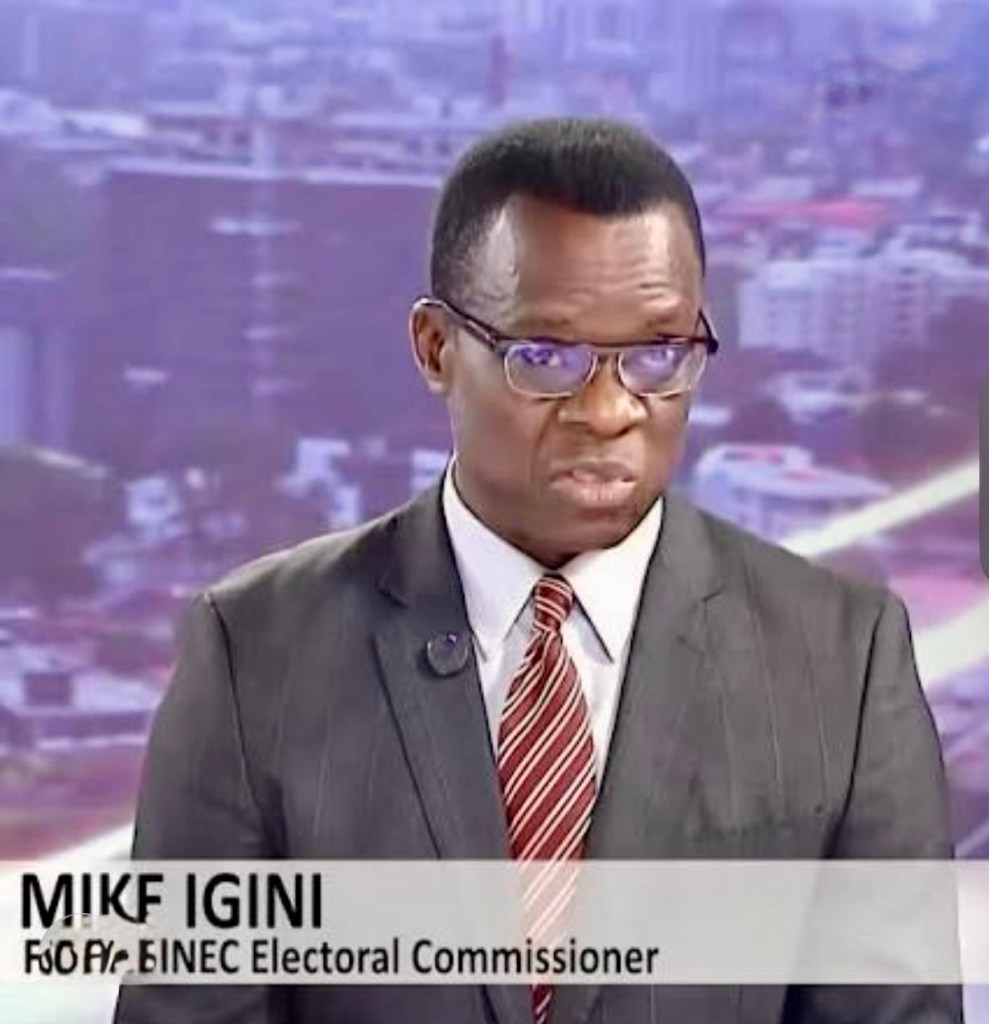
Public debate is healthiest when criticism is met with scrutiny rather than applause. Mr. Mike Igini, a former INEC Electoral Commissioner, has raised serious concerns about the 2026 Electoral Act—concerns that, on their face, deserve engagement rather than dismissal. But engagement must not mean uncritical acceptance. It requires placing his arguments in proper legal and institutional context.
Setting the Context: Igini’s Core Case
Mr. Igini’s critique rests on three principal provisions which, in his estimation, collectively weaken electoral integrity ahead of the 2027 general elections.
First, Section 63, dealing with ballot integrity. He argues that by permitting presiding officers to accept ballot papers even where they lack official manufacturer markings or prescribed security features, the law effectively lowers the evidentiary threshold for valid votes. In his view, this creates a permissive environment for the introduction of forged ballots, especially by actors with access to INEC materials.
Second, Section 138, which he characterises as conferring a form of immunity on electoral officials. His contention is that where an officer deviates from INEC guidelines but does not explicitly violate the Act, such conduct is insulated from consequence. He labels this a “rigging provision,” warning that it erodes accountability and incentivises non-compliance with operational rules.
Third, Section 137, which addresses the structure of election petitions. He notes that the provision removes the necessity of joining presiding or returning officers as respondents. According to him, this makes it procedurally more difficult to challenge the conduct of those directly responsible for alleged irregularities, thereby weakening the evidentiary chain in election litigation.
Flowing from these concerns is his broader warning: that these provisions may push the judiciary into an uncomfortable role as the ultimate arbiter of political disputes, thereby exposing the courts to undue political pressure. His prescription is equally clear—repeal or amend these sections before 2027, and encourage a purposive judicial approach to prevent abuse.
That is the case. It sounds alarming. It is also, on closer inspection, overstated.
Section 63 and the Myth of “Legalised Rigging”
The suggestion that Section 63 legalises ballot stuffing rests on a rigid, almost laboratory-style view of elections. In practice, electoral systems must accommodate operational realities—printing inconsistencies, logistical disruptions, and human handling errors.
What the provision appears to do is prevent the wholesale invalidation of votes based purely on technical defects where authenticity can still be reasonably inferred. The alternative is not electoral purity; it is voter disenfranchisement on a potentially massive scale.
Discretion, properly supervised, is not an invitation to fraud. It is a necessary tool in administrative law. The real safeguard lies in auditability, monitoring, and post-election review—not in pretending that elections can be reduced to mechanical compliance.
Section 138: Immunity or Necessary Legal Threshold?
Mr. Igini’s reading of Section 138 conflates two distinct concepts: non-compliance with guidelines and illegality.
INEC guidelines, while operationally critical, do not possess the same legal force as statutory provisions. If every deviation from a guideline becomes actionable in the same way as a breach of the Act, the system becomes paralysed. Election administration is not a zero-defect enterprise.
The provision does not grant carte blanche immunity; it sets a threshold. It compels litigants to demonstrate that the breach complained of is legally material, not merely procedurally untidy. Without such a threshold, election petitions risk devolving into catalogues of minor infractions dressed up as constitutional crises.
Section 137 and the Structure of Election Litigation
The objection to Section 137 reflects a misunderstanding of the nature of election petitions.
These proceedings are not designed to assign personal liability to individual officers. They are designed to determine whether an election outcome is valid. The necessary parties, therefore, are the declared winner and the electoral body responsible for the process.
Requiring every presiding or returning officer to be joined would not enhance justice—it would render the process unwieldy, slow, and practically unmanageable. The law rightly separates evidential relevance from party status. Misconduct can be proved without turning every official into a litigant.
The Judiciary Is Not a Democratic Repair Shop
Mr. Igini’s appeal to the judiciary as the “last line of defence” reflects a familiar but problematic tendency to overburden the courts.
Courts interpret law; they do not manufacture electoral legitimacy. When judges are routinely asked to resolve deeply political disputes, it is not a sign of judicial strength but of systemic weakness elsewhere.
The call for “purposive interpretation” is attractive, but it carries risks. If stretched too far, it invites judicial subjectivity and undermines legal certainty—two outcomes that are particularly dangerous in electoral matters where predictability is essential.
The Real Issue: Institutional Behaviour, Not Legislative Text
Ironically, the most compelling part of Mr. Igini’s argument is also the least controversial: that the success of any electoral framework depends on the integrity of those who operate it.
This is the point at which the alarmism about statutory provisions begins to look misplaced. Nigeria’s electoral vulnerabilities have historically stemmed less from the wording of laws and more from enforcement deficits, weak sanctions, and political interference.
A flawed system cannot be legislated into perfection. It must be disciplined into functionality.
Conclusion: Precision Over Panic
Mr. Igini raises legitimate anxieties, but his conclusions do not necessarily follow from his premises. The provisions he critiques are not obviously instruments of electoral subversion; they are, in large part, attempts—imperfect, no doubt—to balance legal certainty with operational flexibility.
Calls for amendment are welcome. Calls for alarm should be tested.
Because in the end, democracy rarely collapses because of what is written in Section 63, 137, or 138. It collapses when institutions, and the people who run them, decide that the law is optional.
And no legislative amendment can cure that.

