

NATO, Trump, and the Unravelling of Western Hegemony
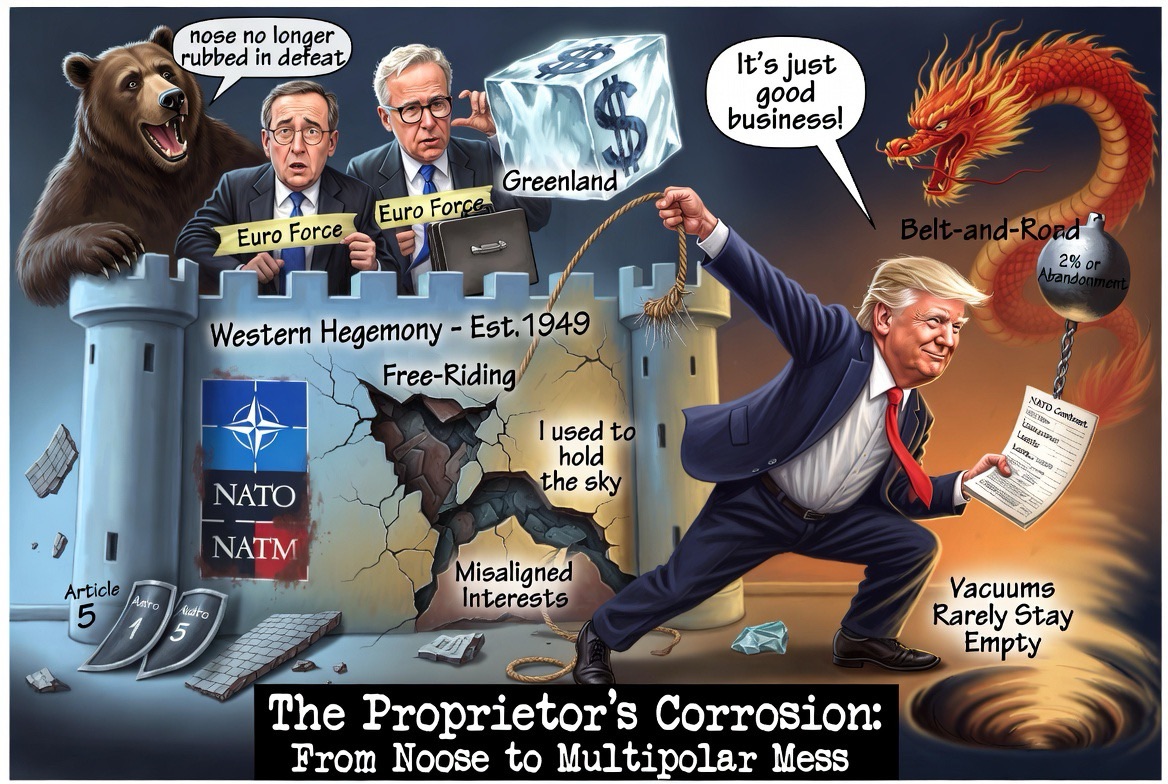
The article “NATO, Trump, and the Unravelling of Western Hegemony” published April 3, 2026, frames the current geopolitical inflection point with provocative clarity. It traces NATO’s evolution from a post-WWII defensive bulwark to a tool of power projection, highlights Trump’s transactional “proprietor” approach as internal corrosion rather than external assault, and posits a paradoxical outcome: the alliance’s potential dissolution or fragmentation could ease Russian grievances (no more “nose rubbed in defeat” via eastward expansion) while creating power vacuums that rarely stay empty. The core implication? The unipolar moment yields to a “more distributed balance of power” among the United States, China, Europe, and Russia— a multipolar world where America is “diminished” yet “normalised.”0
This shift is not abstract theory but an accelerating reality in 2026, driven by Trump’s second-term policies (tariffs, NATO spending ultimatums, territorial probes like Greenland, and signals of U.S. retreat from underwriting global order). Analyses from Brookings, CFR, Carnegie, and others confirm we’re in an interregnum: the old rules-based order is decomposing, power is diffusing, and no cohesive replacement has solidified. Some call it multipolarity (multiple poles of influence); others a “multi-order world” with overlapping, ideologically distinct systems (U.S.-led liberal remnants, Chinese Belt-and-Road, Russian Eurasian).326
Below, I explore the implications deeply across multiple angles—security, economics, governance, regional dynamics, risks, opportunities, and edge cases—drawing on the article’s insights while integrating broader 2026 context for completeness. This is inherently uncertain terrain: multipolarity is neither inherently stable nor chaotic, but its outcomes depend on how actors adapt.
1. Defining Multipolarity: From Unipolar Hegemony to Distributed Power
- Historical baseline (per the article): Post-1945 bipolarity (NATO vs. Warsaw Pact) gave way to unipolar U.S. dominance after 1989. NATO’s “provocative” eastward expansion stabilized Europe for the West but encircled Russia, planting seeds of tension. Interventions in Yugoslavia, Libya, Afghanistan, and Iraq blurred “defensive shield” into “sword.”
- Multipolarity today: Multiple centers (U.S., China, Russia, a potentially autonomous Europe) with rising middle powers (India, Brazil, Gulf states, Turkey) wielding selective influence. It’s not equal poles—U.S. retains military and tech edges—but relative decline in America’s ability (or willingness) to subsidize global security and norms. Trump accelerates this by reframing alliances as transactions, not sacred pacts.1
- Nuance vs. alternatives: Some analysts distinguish “multipolarity” (power diffusion among states) from “multi-order” (parallel ideological orders coexisting). The latter better captures fragmentation: U.S. spheres in the Americas, Russian influence in Eurasia, Chinese economic gravity in Asia/Africa. Disordered multipolarity risks anarchy; spheres-of-influence models offer uneasy stability but invite great-power collusion or proxy clashes.217
2. Security and Military Implications: Balancing, Vacuums, and Escalation Risks
- For the U.S.: A “normalised” America sheds the burden of being “Atlas” holding the world order. Trump’s National Security Strategy explicitly ends indefinite global propping-up. Benefits include fiscal relief and focus on Western Hemisphere primacy. Risks: Overstretch if rivals test boundaries (e.g., Indo-Pacific deterrence without full European buy-in). Allies may hedge, eroding U.S. leverage.4
- For Europe: Existential reckoning, as Akhigbe notes. Decades of free-riding end; a “Euro force” anchored by France’s nuclear deterrent becomes plausible. NATO allies are ramping defense spending toward 5% GDP targets by 2035 in some scenarios. Opportunity: Strategic autonomy. Edge case: Internal divisions (e.g., UK historically braking integration) or over-reliance on U.S. tech could delay this, leaving a vulnerable transition window.19
- For Russia: Paradoxical relief—NATO’s erosion removes the “symbol of defeat.” Yet vacuums breed chaos: potential for opportunistic expansion but also isolation if China dominates economically. Russia’s power projection is declining relative to others; multipolarity may not favor it as much as hoped.1
- For China: Gains as a peer pole, expanding Belt-and-Road influence. But U.S.-China rivalry compresses space for neutral hedging. Systemic risks (Taiwan, South China Sea) could escalate if multipolarity fragments deterrence.
- Broader: Higher risk of regional/low-intensity conflicts (not great-power war, per some historical data), arms races, and proxy battles. Nuclear proliferation concerns rise (e.g., South Korea, Japan eyeing options). On the flip side, multipolarity may lower great-power war odds by complicating rigid blocs, forcing diplomacy.21
3. Economic Implications: Fragmentation, Realignment, and “Multiplex” Globalization
- Trade and supply chains fragment along geopolitical lines: U.S. tariffs weaponize integration; friends/rivals alike face “reciprocal” costs. Emerging markets drive growth, but multipolarity enables South-South globalization and alternative institutions (BRICS+).
- Middle powers thrive via “multi-alignment”: India, Gulf states, Southeast Asia leverage modular coalitions for tech, energy, and standards-setting. However, U.S.-China competition politicizes chains, raising costs.
- Global South gains agency but faces volatility—e.g., debt traps in Chinese finance or exclusion from Western markets. Positives: More representative economic governance; negatives: Inequality spikes without a hegemon enforcing commons (climate, AI).716
- Nuance: Not total de-globalization but “multi-speed” order—trade moves on different clocks than security or tech.
4. Global Governance and Norms: Erosion or Reform?
- Multilateralism fractures: UN, WTO, IMF lose primacy as powers pursue minilaterals or parallel orders. Opportunity: Reform for inclusivity (e.g., Global South voice), ending Western-centric biases.
- Risks: “Might makes right” replaces rules; populism and democratic backsliding (now structural) erode cooperation on transnational threats (climate, pandemics, cyber/AI). Systemic issues demand bounded U.S.-China accommodations despite rivalry.30
- Article’s lens: Without NATO as anchor, what fills the vacuum? A rawer order where influence is earned, not inherited.
5. Regional and Actor-Specific Dynamics
- Indo-Pacific: U.S. deters Chinese hegemony without full primacy; India multi-aligns but faces limits in a bipolar-tilted reality.
- Global South: Empowered as “global majority,” shaping norms via BRICS or non-alignment 2.0. Yet internal diversity limits cohesion.
- Middle powers: Greater maneuverability but constrained by big-power gravity. “If you’re not at the table, you’re on the menu.”
6. Risks, Opportunities, and Edge Cases
- Risks: Instability from vacuums (e.g., post-NATO Eastern Europe); escalation in fluid alliances; economic coercion wars; climate/AI governance gaps. Historical precedents (pre-WWI Europe) warn of miscalculation. Trump’s wrecking ball risks revolution at home spilling globally.6
- Opportunities: Reduced U.S. overstretch fosters sustainable power; balanced order may prove more peaceful long-term; innovation in hybrid cooperation (issue-based, not value-based). Non-Western history offers precedents for stable multipolarity without chaos.13
- Edge cases:
- Pure spheres-of-influence (“Big Three” U.S.-China-Russia) vs. disordered anarchy.
- Multi-order hybrid: Overlapping systems allow selective engagement.
- Internal U.S. dysfunction (debt, polarization) accelerates decline more than external rivals.
- Tech/AI wildcard: Compresses decision cycles, amplifying escalation or enabling new deterrence.
- If Europe fails autonomy: Subordinate pole, heightening transatlantic resentment.
7. Broader Considerations and Forward Outlook
Multipolarity’s implications are not binary—optimists see check-and-balance peace and inclusivity; pessimists foresee fragmentation and predation. Akhigbe’s provocation lands: Trump’s corrosion achieves externally impossible outcomes, forcing Europe to confront misaligned interests. Yet history shows orders evolve through shock and adaptation; 2026’s interregnum (per Stimson, CFR) is undecided.4
For individuals, businesses, and states: Agility trumps prediction. Resilience via diversification, early rule-setting, and issue-specific coalitions will define winners. The article leaves us with the core question: Not if NATO changes, but what world survives the change? A diminished yet normalised America in a distributed order offers realism over nostalgia—but demands proactive navigation of its uncertainties, from security vacuums to economic realignments.
This exploration reveals multipolarity as neither utopia nor apocalypse, but a complex, contested transition with profound stakes for stability, prosperity, and agency. If specific angles (e.g., economic modeling or a region) warrant deeper drilling, provide more details for further analysis.- Nuance
 Centre for Nigeria Progress