

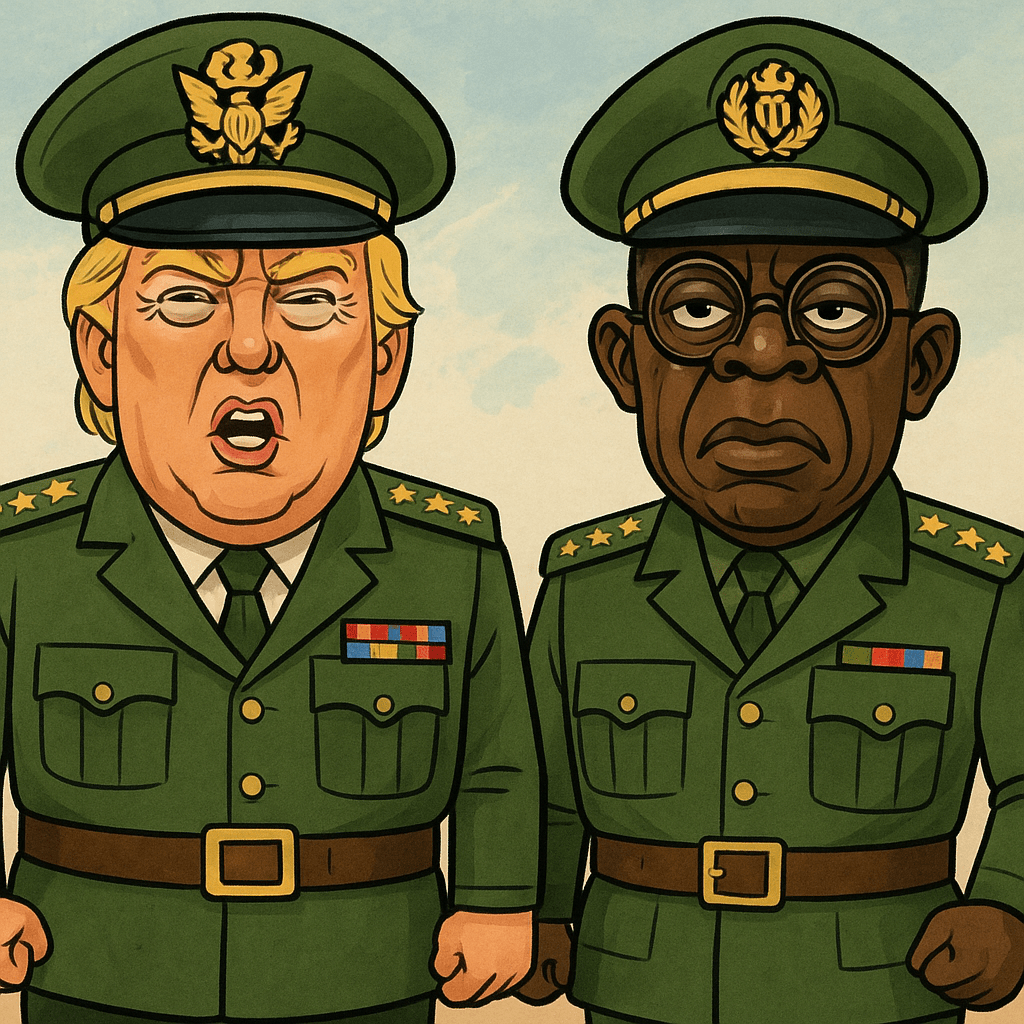
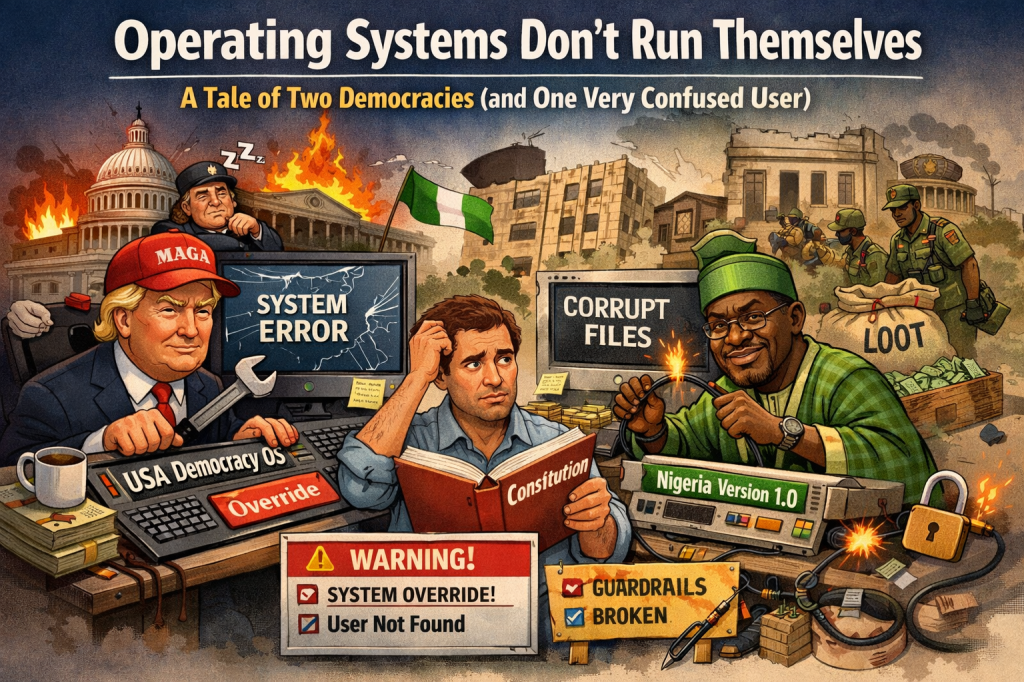
Somewhere in a quiet policy paper, probably written in a room with good air conditioning and zero Nigerian electricity experience, a very confident sentence was born:
“A well-crafted constitution is an operating system for national behavior.”
Beautiful. Elegant. Almost poetic.
There’s just one small problem.
The real world—particularly places like United States and Nigeria—has decided to treat that sentence the way people treat software terms and conditions: scroll, scroll, Agree, and immediately proceed to ignore everything.
The American Experiment: When the Operating System Meets a Creative User
For over two centuries, the United States has proudly marketed its constitution like Apple markets iOS—secure, robust, and incapable of being tampered with by mere mortals.
And then along came… reality.
The system said: Congress controls tariffs.
Enter Donald Trump, who looked at that clause the way a teenager looks at parental controls—less as a rule, more as a puzzle.
“Interesting,” he seems to say. “But what if… I just… don’t?”
Now, in theory, the American system is full of guardrails:
Separation of powers Judicial review Congressional oversight
In practice, those guardrails sometimes behave like British queue etiquette—strong in theory, negotiable in practice.
Congress can push back… if it wants to.
Courts can intervene… eventually.
Institutions can resist… depending on who had coffee that morning.
The result? The “operating system” works—but occasionally like Windows 98: functional, but prone to freezing at the worst possible moment.
Nigeria: When the Operating System Ships Without Antivirus
If the US is Windows 98, Nigeria is that laptop you bought in Computer Village where the seller swore, “Everything is installed,” but forgot to mention the system has no security updates and one mysterious folder called “Do Not Open.”
Nigeria didn’t just test the theory—it stress-tested it.
On paper, Nigeria has:
A constitution A separation of powers Courts Legislatures
In reality, the system often runs like a demo version:
Features exist, but are “not activated” Enforcement comes with a “subject to availability” disclaimer Accountability is treated like optional DLC
Here, the issue isn’t whether the operating system is well-designed.
It’s whether anyone has the admin password—or if it was shared in a WhatsApp group in 2003 and never changed.
The Fatal Assumption: Humans Will Respect the Software
The original argument assumes something quietly heroic about human behavior:
That if you design the system well enough, people will obey it.
This is adorable.
Humans don’t just use systems—we negotiate with them, bend them, reinterpret them, and occasionally drive a convoy of political interests straight through them.
A constitution is not self-executing. It has no police. It cannot shout. It cannot arrest anybody. It cannot even send a strongly worded email.
It relies on:
People respecting it Institutions defending it Consequences enforcing it
Remove any one of those, and your “operating system” becomes… a PDF.
Guardrails: Decorative or Functional?
The American case shows something subtle but important:
Even with strong guardrails, determined actors can push boundaries to the edge of legality—and sometimes beyond—before the system reacts.
The Nigerian case shows the next level:
If enforcement is weak, the guardrails aren’t guardrails at all. They are suggestions. Very polite suggestions.
It’s the difference between:
A speed limit with cameras (US) A speed limit with vibes (Nigeria)
So, Is the Theory Dead?
Not quite. But it needs an upgrade.
Yes, systems matter. Incentives matter. Structures matter.
But here’s the patch note they forgot to include:
Version 2.0: “System performance depends on users not actively trying to hack it.”
A constitution can:
Shape incentives Slow down abuse Provide tools for accountability
But it cannot:
Manufacture political will Enforce itself in real time Stop bad actors who face no consequences
The Real Insight (Hidden in Plain Sight)
The problem is not that the “operating system” idea is wrong.
It’s that it’s incomplete.
A constitution without enforcement is theory.
A constitution without political culture is decoration.
A constitution without consequences is… Nigeria on a good day, and America on a bad one.
Final Thought: The User Problem
In tech, when software keeps failing, engineers ask a brutal question:
“Is this a system problem… or a user problem?”
In governance, the uncomfortable answer is:
It’s both.
You can design the best system in the world, but if the users are constantly looking for loopholes—and the referees are either asleep or compromised—you don’t get order.
You get… creative governance.
And as both the United States and Nigeria are demonstrating in their own unique, sometimes chaotic ways:
Even the best operating system cannot save you from a determined user with admin access and questionable intentions.

