There is a peculiar kind of public official who arrives in high office not as a destination earned through demonstrated competence, but as a man who simply wandered into a room he was not supposed to be in and sat down before anyone could stop him. Monday Okpebholo, Governor of Edo State, is that man. And Edo State is that room.
To watch Governor Okpebholo attempt to explain government is to experience something between sympathy and alarm, the intellectual equivalent of watching a man assemble furniture without the manual, without the tools, and apparently without the furniture.
The Great Pocket Money Confusion
Let us begin with the most illuminating exhibit in this gallery of governance failures: the Governor’s remarkable understanding of public finance.
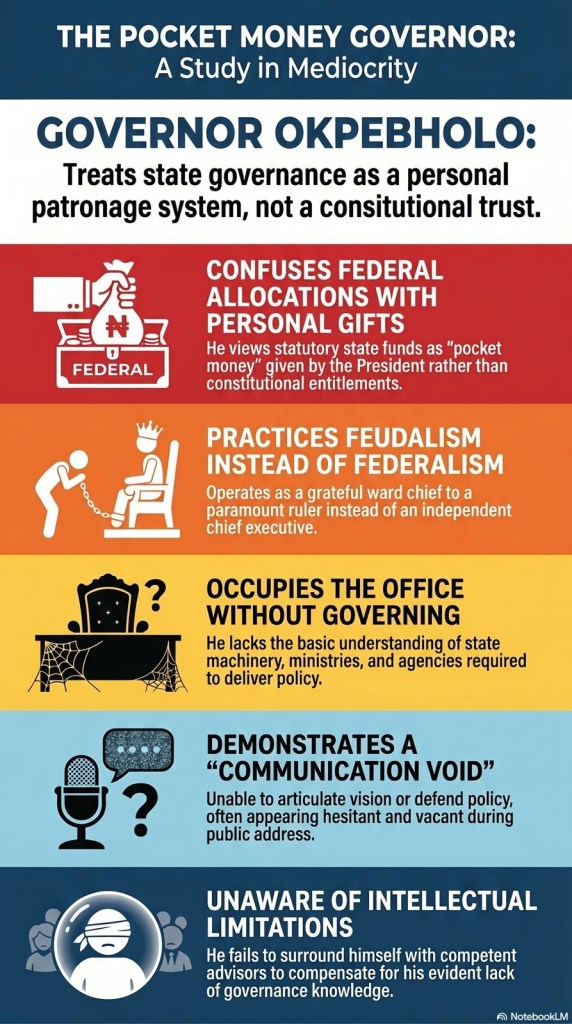
In a moment of candour that no spin doctor could rescue, Governor Okpebholo has spoken about federal allocations and presidential intervention in terms that would make a first-year public administration student wince. The framing, stripped to its essence, is this: the President gives him money for development.
Not “statutory allocations disbursed under the Revenue Mobilisation Allocation and Fiscal Commission framework.” Not “federation account disbursements accruing to Edo State under constitutional formula.” No. The President. Gives. Him. Money.
One might charitably assume this is merely imprecise language, a rhetorical shorthand deployed for a lay audience. One might assume that. One would be wrong.
Because the implications of that framing are not merely semantic. They are constitutional, political, and frankly, quite embarrassing. When a governor conceptualises federal allocations as personal gifts from the president, he has not just made a grammatical error. He has revealed his entire operating framework. He understands himself not as a constitutionally mandated chief executive of a federating unit, exercising independent authority derived from the electorate of Edo State, but as a grateful recipient of presidential benevolence, a ward chief who has pleased the paramount ruler and been rewarded accordingly.
This is not federalism. This is feudalism with a press office.
The money flowing to Edo State is not the President’s money. It is not a favour. It is not generosity. It is the constitutionally guaranteed entitlement of Edo people, generated from national resources, distributed by formula, and owed to the state regardless of whether the Governor is in political fellowship with Abuja or not. The RMAFC does not run on sentiment. The federation account does not dispense loyalty bonuses.
For a sitting governor to speak otherwise is not humility. It is ignorance. And it is a dangerous ignorance — because a man who thinks development funds are pocket money from a patron will spend them accordingly.
On the Machinery He Has Not Read the Manual For
Beyond the finances, there is the broader question of whether Governor Okpebholo understands the machinery of government at all, and the evidence, regrettably, suggests he has encountered that machinery largely in the way one encounters a moving vehicle: suddenly, and from the wrong side.
Modern federalism, even in Nigeria’s frequently dysfunctional iteration of it, rests on a conceptual architecture. There are tiers of government with distinct constitutional competencies. There are executive powers vested in governors not as personal privileges but as public trusts. There are instruments of administration, civil services, ministries, agencies, that are supposed to translate policy into delivery. A governor who does not understand these structures does not merely govern poorly. He does not really govern at all. He occupies.
The distinction matters enormously for the people of Edo State, who presumably expected, when they cast their votes, something resembling administration. They did not vote for occupancy.
The Voice and the Void Behind It
Then there is the matter of communication, which, in a democracy, is not a decorative skill but a functional one.
A governor must be able to articulate a vision. He must be able to defend a budget, explain a policy, respond to a crisis, inspire confidence. These are not the luxuries of eloquent leaders; they are the baseline requirements of the office. The people of Edo State deserve a governor who can, at minimum, complete a thought in public without appearing to discover it mid-sentence.
What we observe instead is the political equivalent of a man reading from a teleprompter that has gone blank, the voice trailing, the conviction absent, the sentences arriving at their ends visibly surprised to have made it. There is a particular quality of hesitancy that signals not nervousness, but vacancy: when the pause before an answer is not the pause of a man choosing his words carefully, but of a man searching for words he does not have.
Confidence in public life is not arrogance. It is the natural product of knowing what you believe, why you believe it, and how you intend to pursue it. It flows from conviction. It flows from competence. And it flows, crucially, from having actually thought about the things you are asked about before you are asked about them.
By these measures, the Governor presents himself as a man for whom thought is largely a reactive enterprise.
The Real Indictment
To be clear: this is not merely about one man’s intellectual limitations. Brilliant governance has been delivered by leaders of unremarkable personal intellect who surrounded themselves with excellent advisers, listened to them, and had the wisdom to recognise the boundaries of their own understanding. Intellectual humility, properly deployed, can compensate considerably for intellectual deficit.
The deeper problem with Governor Okpebholo is the combination: the evident limitations compounded by the apparent unawareness of them. It is one thing to not know. It is another to not know that you do not know, and to therefore not seek out the people, the frameworks, and the institutional knowledge that might fill the gaps.
A man who thinks the President is giving him pocket money for development has not merely misunderstood a constitutional provision. He has revealed that he has not thought to ask the right questions. And a governor who has not thought to ask the right questions about where the money comes from is unlikely, one fears, to ask the right questions about where it goes.
Conclusion: What Is To Be Done
The people of Edo State did not make an unreasonable request. They asked, in the democratic idiom available to them, for competent stewardship of their state. They asked for someone who understood the government they were being asked to lead. They asked for a voice that, when it spoke on their behalf, would not cause the rest of the country to quietly change the channel.
What they received, it appears, is a governor who is learning on the job, except that in this case, “the job” is an entire state, and “learning” has the unfortunate side effect of being conducted at the expense of four million people who cannot wait for the curriculum to be completed.
There is, in the end, no elegant solution to the problem of an underqualified leader in a high-stakes office. Democratic systems must generally endure their choices until the next available exit. The exit, in this case, is some years away.
Edo State, one suspects, is already counting.