

In 1969, the small Scandinavian nation of Norway discovered one of the largest offshore oil deposits in the world. The discovery of the Ekofisk changed everything.
Almost overnight, Norway found itself sitting on extraordinary wealth beneath the waters of the North Sea.
History, however, had already shown what usually happens when sudden natural resource wealth arrives.
Many nations follow a familiar path:
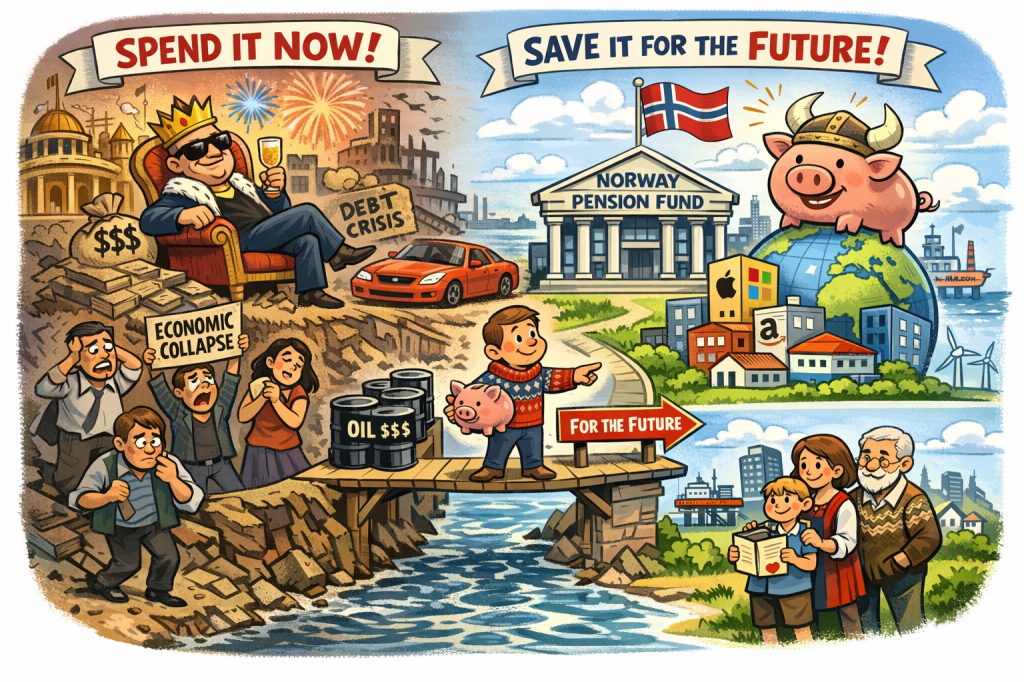
Immediate spending of the windfall Grand projects and monuments to political vanity Economic bubbles built on temporary income Wealth captured by a small elite while the wider population struggles
And when the resource eventually runs out, the result is often debt, instability, and institutional collapse.
The examples are not difficult to find. Countries such as Nigeria, Venezuela, and Iraq all discovered vast oil reserves but struggled to convert that natural wealth into sustainable prosperity.
Norway observed these cautionary tales carefully.
And then it chose a radically different path.
A Radical Decision in 1990
In 1990, the Norwegian parliament established what is now known as the Government Pension Fund Global.
The rules governing the fund were simple but revolutionary.
All oil revenues would flow into the fund.
The fund would invest that money globally across thousands of companies.
And the Norwegian government could only withdraw a small portion each year—initially set at 4 percent of the fund’s value and later reduced to 3 percent.
The rest of the money would remain invested.
In effect, the country made a collective decision: oil wealth would not be consumed by the present generation alone.
It would belong equally to future Norwegians.
At the time, many observers thought the idea was unrealistic. Why accumulate wealth for citizens who had not yet been born? Why not lower taxes, expand government programmes, or simply enjoy the windfall immediately?
Norway’s answer was disarmingly simple:
Future Norwegians will exist.
They deserve this wealth just as much as we do.
The First Deposit — and the Hard Part
In 1996, Norway made the first deposit into the fund: $150 million.
What followed was perhaps the most remarkable part of the story.
They stayed disciplined.
Year after year, oil revenues were deposited into the fund.
Year after year, the fund quietly invested in global markets—stocks, bonds, and real estate spread across more than seventy countries.
Year after year, politicians resisted the powerful temptation to dip into the fund for short-term political advantage.
Every election cycle brought calls for more spending.
Every economic downturn triggered pressure to loosen the rules.
Every crisis produced the familiar argument: break the rules “just this once.”
Norway consistently refused.
The Power of Patience
The fund’s managers did not attempt speculative bets or try to outperform the market through risky strategies.
Instead, they followed a simple philosophy.
Buy small stakes in thousands of companies and hold them for the long term.
Today the fund owns shares in roughly 9,000 companies worldwide.
The result has been extraordinary growth.
By 2000, the fund had reached $50 billion By 2010, it had grown to $500 billion By 2017, it surpassed $1 trillion Today, it has exceeded $2 trillion
For a nation of just 5.6 million people, that equates to roughly $340,000 per citizen.
But an even more remarkable fact lies beneath those numbers.
More than half of the fund’s value did not come from oil revenues.
It came from investment returns.
Norway effectively converted temporary oil income into permanent financial wealth.
Owning a Piece of the World
The fund now owns approximately 1.5 percent of every publicly traded company on Earth.
It holds stakes in global giants such as:
Apple Microsoft Amazon
Along with thousands of other corporations across continents.
In practical terms, this means that when consumers anywhere in the world buy products from major companies, a tiny fraction of that economic activity flows back to Norway.
The fund’s strict 3 percent withdrawal rule ensures the principal remains intact.
That modest annual draw now finances roughly a quarter of Norway’s national budget—supporting education, healthcare, infrastructure, and pensions without exhausting the capital itself.
The End of Oil — Without the End of Wealth
Norway’s oil reserves will eventually decline. Perhaps in thirty years. Perhaps in fifty.
But the country’s prosperity will not disappear with the last barrel.
By the time the oil fields fall silent, Norway will possess a multi-trillion-dollar investment fund generating returns indefinitely.
This is the central lesson.
The real genius was not discovering oil. Many countries have done that.
The genius was making three disciplined decisions:
Save almost all of the windfall Invest it globally and patiently Resist political pressure to spend it immediately
This required something rare in politics: thinking beyond the next election cycle.
It required discipline to follow strict rules for more than three decades.
And it required humility—the recognition that future citizens have the same claim to national wealth as the present generation.
A Choice Few Nations Make
In 1996, Norway started with just $150 million in its sovereign wealth fund.
Today that figure exceeds $2 trillion and continues to grow.
Long after the oil rigs in the North Sea have stopped pumping, Norwegian children will still attend well-funded universities, retirees will still enjoy financial security, and public services will remain strong.
All supported by wealth generated from oil that may have stopped flowing decades earlier.
Because in 1990, Norway made a choice that most countries rarely make.
It chose the long-term welfare of its grandchildren over the short-term desires of the present generation.

