

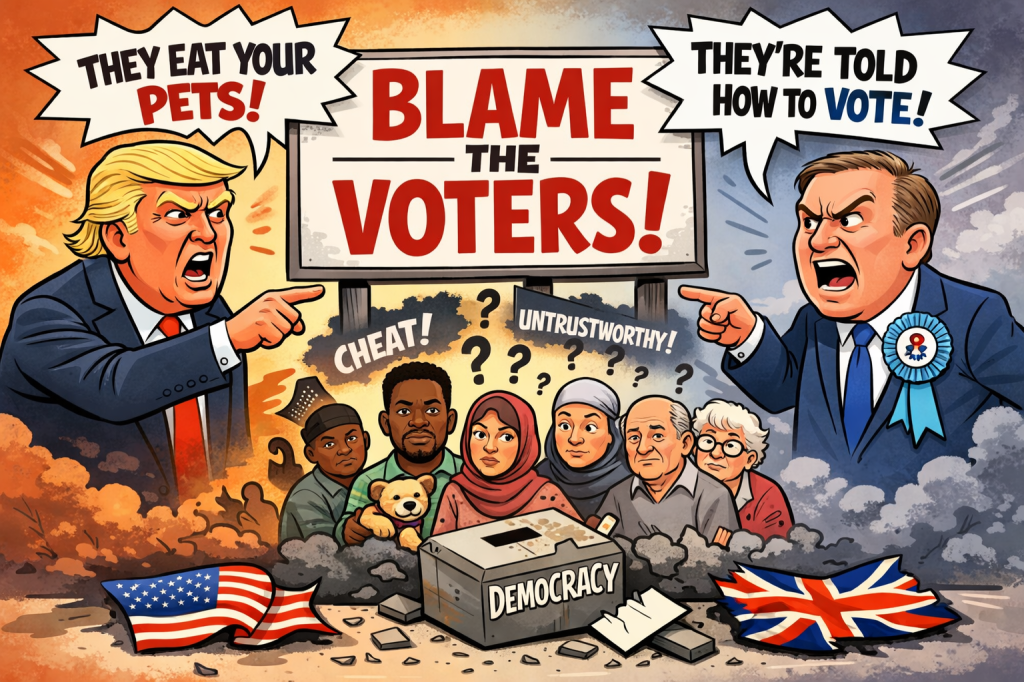
In the fevered theatre of the 2024 United States presidential election, Donald Trump delivered one of those lines that would be dismissed as parody if it were not uttered in earnest. At a presidential debate, he alleged that Haitians in Springfield were eating the pets—dogs and even swans—of local residents. It was the sort of claim that requires no rebuttal so much as a pause for collective disbelief. Yet it served a purpose. It was not about Haitians, nor about Springfield. It was about planting suspicion—about telling a segment of the electorate that “those people” are a threat, and by implication, that their participation in civic life is suspect.
Across the Atlantic, the script feels increasingly familiar. Following a by-election defeat, Reform UK Ltd reached for a similar playbook. Rather than interrogate its own appeal to voters, it alleged that Muslim families were effectively herding relatives to the polls to vote en bloc against them. The implication was clear: these voters were not exercising independent judgment, but were instead participants in some shadowy, communal directive. Agency was quietly stripped away, replaced with insinuation.
There was, however, a problem—reality. Investigations into the Gorton and Denton by-election found no evidence of so-called “family voting” or coercion. The police, inconveniently for the narrative, concluded that the allegation was without foundation. But by then, the claim had already done its work. It had introduced doubt, cast aspersions, and, most importantly, shifted the conversation away from why voters might have rejected Reform UK in the first place.
This is not coincidence. It is a pattern.
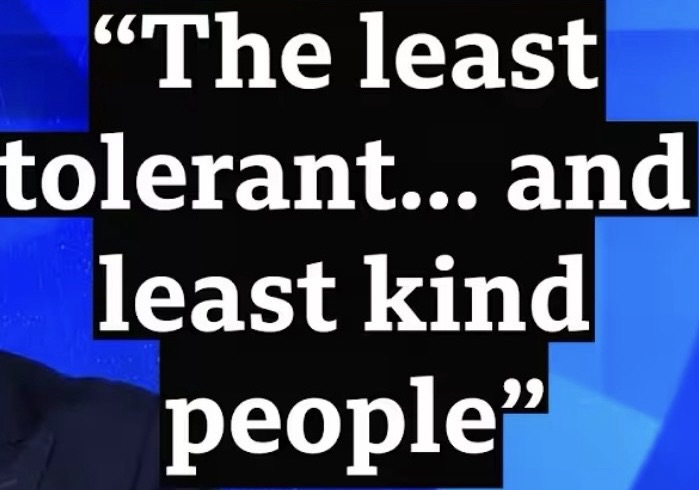
When far-right political actors anticipate defeat—or are confronted with it—they often turn not inward, but outward. The electorate itself becomes the problem. If voters reject them, it cannot be because their policies are unconvincing, economically incoherent, or socially divisive. No, the fault must lie with the voters: they are misled, manipulated, illegitimate, or in some cases, not entirely human in their habits if one follows the more colourful claims.
The logic is as cynical as it is effective. By undermining trust in specific groups of voters—immigrants, minorities, religious communities—these politicians create a hierarchy of legitimacy. Some votes are “real,” others are suspect. Some citizens are rational actors, others are merely extensions of a collective will. It is a short step from there to the conclusion that certain people perhaps should not be voting at all, at least not until they can be trusted to vote “correctly.”
What is striking is the quiet contempt for the very electorate these politicians claim to champion. There is an implicit admission buried beneath the rhetoric: a lack of faith in the people. Not just in their choices, but in their capacity to choose. Democracy, in this framing, is acceptable only when it delivers the “right” outcome. When it does not, the system—or more conveniently, the voters—must be discredited.
This would be merely ironic if it were not so corrosive. Democracy depends not just on the mechanics of voting, but on a shared belief that voters, in aggregate, have the right to decide—even when they decide against you. To erode that belief is to chip away at the foundation of the system itself.
And so we arrive at an uncomfortable question. If a political movement consistently finds itself at odds with the electorate, is the problem really the voters? Or is it that the electorate, with all its diversity and unpredictability, has taken a long, hard look at what is being offered—and declined?
It is, of course, easier to blame the voter. Much easier than rewriting a manifesto, moderating a tone, or confronting the possibility that the public has simply made up its mind.
In the end, these episodes tell us less about Haitians in Springfield or Muslim families in Manchester, and far more about the politicians making the claims. When defeat looms, the mask slips. The champion of “the people” reveals a rather conditional affection for them—warm and enthusiastic, so long as they vote the right way.
Anything else, it seems, must be explained away.

