

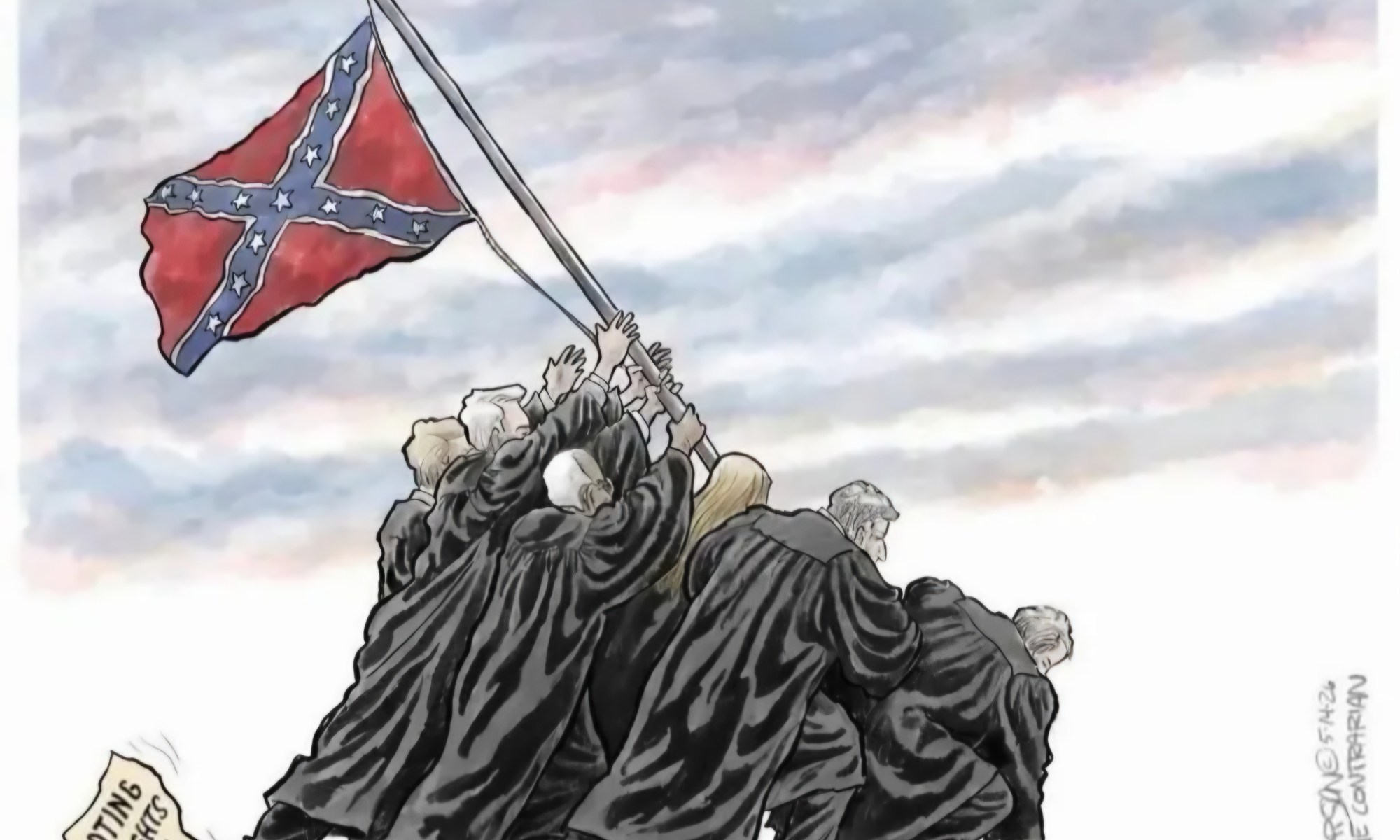
How the Supreme Court of the United States has spent sixty years dismantling the most consequential civil rights legislation in American history, with all the care and precision of a surgeon removing a patient’s spine.
There is a particular kind of legal violence that wears a robe. It does not arrive with fire hoses or police batons. It comes, instead, with footnotes. It speaks in the measured cadences of constitutional doctrine, cites precedent with the gravity of a priest reading scripture, and, having thoroughly gutted the protection in question, thanks everyone for their time. This is what the United States Supreme Court has been doing to the Voting Rights Act of 1965 for the better part of two decades, and it is worth calling it what it is: a systematic, judicially-managed demolition, dressed up in the language of federalism and completed with the workmanlike efficiency of people who know exactly what they are doing.
The Voting Rights Act was not a modest piece of legislation. It was the legal acknowledgment of a seventy-year national crime. It was the federal government finally, reluctantly, admitting that the franchise, that foundational promise of democratic participation, had been a carefully administered fiction for millions of Black Americans since the end of Reconstruction. To understand what is being dismantled today, you must first understand what was built, and why it took so long to build it at all.
The Long History of “We’ll Get to That Later”
After the Civil War, Black men were formally granted the right to vote under the Fifteenth Amendment in 1870. This was, by the standards of the era, a revolutionary act. It was also, by the standards of Southern state legislatures, an inconvenient suggestion rather than a binding legal obligation. What followed was an astonishing catalogue of creativity in the service of exclusion: poll taxes that were “race-neutral” on their face but ruinous in a sharecropping economy; literacy tests administered with a flexibility that mysteriously correlated with the applicant’s skin colour; grandfather clauses that permitted voting only for those whose grandfathers had voted, a requirement that, in the American South, tended to exclude precisely the people it was designed to exclude.
Editorial Note: The grandfather clause is genuinely one of the more audacious legal instruments ever devised. It essentially said: “We will allow you to vote if your grandfather was allowed to vote”, in a country where your grandfather had been legally classified as property. One must admire, in a deeply uncomfortable way, the sheer architectural boldness of the thing.
By the time Lyndon Johnson signed the Voting Rights Act on August 6, 1965, and wept doing so, if you believe the accounts, there were precisely 72 Black elected officials in the entire American South. Seventy-two, in a region of tens of millions. The Act, with its elegant mechanisms of federal oversight, changed that with almost indecent speed. By 1980, that number had climbed past 1,500. This was not a coincidence. This was law working exactly as law is supposed to work when it actually means what it says.
“By 1980, the number of Black elected officials in the South had risen from 72 to over 1,500. This was not a coincidence. This was law working exactly as law is supposed to work.”
The mechanism that made this possible was deceptively simple. Section 5 of the Act required certain states, jurisdictions with a documented history of voting discrimination, to obtain federal “pre-clearance” before changing any voting law or procedure. You could not quietly redraw a district map, move a polling station, or alter registration requirements without first proving to the federal government that the change would not make things worse for minority voters. It was, in effect, a parole condition for states that had demonstrated they could not be trusted.
This is where the Supreme Court enters the story, stage right, holding a scalpel and wearing an expression of perfect innocence.
Shelby County v. Holder: The Murder Weapon, Cleaned and Returned
Shelby County v. Holder (2013)
The Supreme Court, in a 5–4 decision authored by Chief Justice John Roberts, struck down the coverage formula of Section 4 of the Voting Rights Act — effectively gutting the pre-clearance requirement of Section 5. The Court held that the formula, last updated in 1975, was based on outdated data and therefore unconstitutional. Congress was invited to update the formula. Congress, predictably, has not done so.
Effect: Section 5 pre-clearance rendered inoperative
The Shelby County decision is a masterclass in the art of killing something while insisting you have done no such thing. Chief Justice Roberts did not say the Voting Rights Act was unconstitutional. He did not say discrimination had ended. He said, with a kind of studied reasonableness, that the formula used to determine which states required federal supervision was outdated. The data was old. Things had changed. The country had moved on.
It was, as a technical matter, a reasonable observation wrapped around a catastrophic conclusion. Yes, the data was old. It was old because Congress had not updated it. Congress had not updated it partly because the existing formula was working. You do not typically renegotiate the terms of probation when the probationer has stopped committing crimes; you wait until they do and then note, with satisfaction, that the system worked. The Roberts Court, in effect, cut off the probationer’s ankle monitor because he had not re-offended lately, and then expressed surprise when the re-offending began almost immediately.
And begin it did. Within hours of the decision, several states moved to implement voting restrictions that had previously been blocked under pre-clearance. Texas announced it would enforce a voter ID law that the Department of Justice had rejected. North Carolina passed an omnibus voting restriction bill of such baroque comprehensiveness that a federal court later found it targeted Black voters “with almost surgical precision” — a phrase that has the distinction of being simultaneously a legal finding and an indictment of the entire enterprise.
Note of Clarification: When a federal court describes legislation as targeting a racial group “with almost surgical precision,” this is the judicial equivalent of being described by a coroner as “not accidentally dead.” The politeness of the language is inversely proportional to the severity of the finding.
The “Intent” Standard: Proving the Unprovable
If Shelby County removed the pre-emptive protection of Section 5, the Court’s subsequent assault on Section 2 has made the retrospective protection nearly as useless. Section 2 was the other major enforcement mechanism of the Act, the provision that allowed plaintiffs to challenge voting laws that had a discriminatory effect on minority voters, regardless of whether discriminatory intent could be proved. This was important, because proving intent is extremely difficult. Legislators do not typically circulate memoranda saying, “Here is our plan to suppress the Black vote.” They say things like, “We are merely concerned about election integrity,” and then proceed to close polling stations in precincts that voted against them at rates approaching statistical improbability.
The landmark case of Thornburg v. Gingles (1986) had established a workable framework for Section 2 claims, allowing courts to examine the totality of circumstances and the demonstrable effects of redistricting on minority voting strength. For nearly four decades, this was the law. Then came Louisiana v. Kelly.
Louisiana v. Kelly (recent)
The Supreme Court shifted the Section 2 legal standard back towards requiring plaintiffs to demonstrate discriminatory intent, rather than merely demonstrating discriminatory results. This effectively overrules the practical legacy of Thornburg v. Gingles, raising the evidentiary bar for voting rights plaintiffs to a level that, in most cases, cannot realistically be met.
Effect: Section 2 claims made substantially harder to bring
The intent standard is, to put it bluntly, a near-perfect shield for discriminatory legislation. It demands that plaintiffs crawl inside the minds of legislators and produce evidence of what motivated them. Given that modern discriminatory intent tends to be expressed through dog whistles, coded statistical analyses, and the careful manipulation of facially neutral criteria, this is an evidentiary standard that functions, in practice, as an almost complete bar to relief.
Imagine, if you will, a scenario in which someone burns down your house. The fire marshal confirms that accelerant was used and that the fire started in three separate locations simultaneously. But because no one saw the arsonist and no note was left, you cannot prove intent. The insurance company is very sorry. The arsonist, meanwhile, has already applied for a permit to build a new structure on your lot. This, in rough metaphorical terms, is the current state of Section 2 litigation.
Rucho v. Common Cause and the Partisan Gerrymander: A Gift With No Ribbons
1965
Voting Rights Act signed. Federal oversight of redistricting begins in covered jurisdictions.
1986
Thornburg v. Gingles: Supreme Court establishes a workable framework for Section 2 racial gerrymandering claims.
2013
Shelby County v. Holder: Section 5 pre-clearance gutted. States with histories of discrimination freed from advance federal oversight.
2019
Rucho v. Common Cause: Federal courts declared unable to adjudicate partisan gerrymandering claims. State legislatures now effectively unchecked on redistricting.
Recent
Louisiana v. Kelly: Section 2 weakened. The intent standard imposed, raising the bar for minority voting rights plaintiffs to near-impossible heights.
In 2019, the Supreme Court delivered a ruling in Rucho v. Common Cause that deserves its own chapter in the literature of judicial abdication. The Court held, 5–4, that federal courts cannot hear challenges to partisan gerrymandering. Not because partisan gerrymandering is legal. Not because it is harmless. But because it is a “political question”, a matter, apparently, too political for the branch of government that decides everything else.
The practical consequences of this ruling are difficult to overstate. Redistricting is the architecture of democracy. Every ten years, following the census, district boundaries are redrawn. The party that controls the state legislature at the moment of redistricting controls the map for the next decade. With Rucho, state legislatures now have federal judicial permission to draw those maps in whatever shape serves their interests, constrained only by state courts, which are themselves subject to partisan capture, and the increasingly hollow racial protections of a Voting Rights Act that the same Court has been systematically hollowing out.
“Partisan gerrymandering is too political for the branch of government that decides everything else.”The implicit logic of Rucho v. Common Cause (2019)
The result is a closed loop of disenfranchisement. Minority voters are packed into heavily concentrated districts or “cracked” across multiple districts to dilute their influence. When they challenge the racial dimensions of this manipulation, they now must prove intent, something almost impossible to demonstrate. When they challenge the partisan dimensions, federal courts decline jurisdiction entirely. When they seek pre-emptive protection before maps are enacted, the pre-clearance mechanism that once provided it no longer functions. The wall, in every direction, is solid.
The Quiet Audacity of “Equal Sovereignty”
There is one more dimension of the Shelby County ruling that merits attention, because it reveals something important about the jurisprudential scaffolding being constructed. Chief Justice Roberts, in striking down the coverage formula, invoked a doctrine he called “equal sovereignty of the states”, the principle that the Constitution does not permit Congress to treat some states differently from others without sufficient justification.
This is, as constitutional principles go, not a long-standing one. It was essentially invented in a 2009 case called Northwest Austin Municipal Utility District No. 1 v. Holder, also authored by Roberts, and then amplified in Shelby County four years later. The Constitution actually contains substantial textual evidence for the proposition that Congress may treat states differently when those states have differently treated their citizens, particularly in the context of the Reconstruction Amendments, which were explicitly designed to give Congress broad power to remedy exactly the kind of discrimination the Voting Rights Act addressed.
But the “equal sovereignty” doctrine is elegant in its utility. It locates the problem not in what states have done to their voters, but in what the federal government has done to the states. It reframes the aggrieved party. It transforms the narrative from one about voter suppression into one about federal overreach. This is sophisticated ideological work, and it should be recognised as such.
A Thought Experiment: One wonders whether the “equal sovereignty” doctrine would have been developed quite so energetically if the states requiring federal supervision had been suppressing the votes of, say, people who owned yachts. The Constitution is, after all, a document with many possible emphases. The art lies in choosing which ones to develop.
What Is to Be Done, Practically Speaking
The fashionable response to the state of American democracy is exhaustion, and one cannot entirely fault it. There is something genuinely wearying about watching a law that took a century of struggle to enact be dismantled, ruling by ruling, across six decades, by a Court whose membership is determined by the very political processes the law was designed to protect. It has a certain circularity that would be elegant if it were not so destructive.
But the analysis demands an honest accounting of what remains. Two paths present themselves, neither simple, neither quick, and both requiring the kind of sustained political engagement that American democracy has historically been reluctant to sustain.
I. Congressional Action
Congress could update the Voting Rights Act. This is not a novel suggestion. The John Lewis Voting Rights Advancement Act, which has passed the House multiple times, would restore a pre-clearance formula that meets the evidentiary standards the Roberts Court demanded in Shelby County. It would not require magic, only a functioning Senate majority willing to treat voting rights as something other than a partisan bargaining chip. This has, so far, proved elusive. The path forward runs through midterm elections, Senate composition, and the structural mathematics of a chamber that has historically over-represented the geographic areas most resistant to voting rights expansion. It is a long path. The question is whether the urgency of the situation can be translated into the kind of durable political coalition that legislative change requires.
II. Supreme Court Reform
The more difficult conversation concerns the Court itself. The current majority has demonstrated a coherent and consistent jurisprudential vision of what the Voting Rights Act should do, which is, approximately, not very much. That vision does not reflect the view of Congress that passed the Act in 1965, or the Congress that reauthorized it unanimously in 2006. It reflects the views of six justices, appointed by presidents who lost the popular vote in three of the past six elections, confirmed by a Senate structured in ways that amplify some voices and diminish others.
Court reform is controversial precisely because it touches the mythology of judicial independence. But the mythology and the reality have diverged considerably. A Court that can create doctrine out of whole cloth, inventing “equal sovereignty of the states” as a new constitutional principle, is exercising a form of power that is already, in important senses, political. The question is not whether the Court is a political institution, but whether the accountability mechanisms surrounding it are sufficient for its current posture. That is a legitimate debate, and it is past time it was conducted seriously.
A Closing Observation
The Voting Rights Act of 1965 was never a perfect document. It was a compromise between the achievable and the necessary, a federal intervention into state sovereignty that was always legally contested and politically fraught. But it worked. For decades, it worked visibly and measurably, translating formal legal rights into actual political representation for millions of people who had been systematically excluded from the democratic process.
What the Supreme Court has done, slowly, methodically, across four major decisions spanning twenty years, is to return American voting rights law to a state that more closely resembles the pre-1965 condition than the post-1965 promise. Not all at once. Not with any single, dramatic ruling that could serve as a clear focal point for opposition. But incrementally, doctrinally, in the careful language of constitutional interpretation, in ways that are difficult to explain to a general audience and therefore easy to accomplish without generating the kind of political response they deserve.
This is what sophisticated legal violence looks like. It does not come with fire hoses. It comes with a 6–3 majority, a footnote about outdated coverage formulas, and a quiet invitation to Congress to sort it out whenever it gets around to it. Congress, of course, has not sorted it out. The polling stations remain closed. The maps remain drawn. And the Court continues, in the meantime, to take cases.

