
There’s a familiar script in British politics, and it’s being performed again with renewed conviction. The villains are well-rehearsed: the poor, the unemployed, the benefit claimant, convenient stand-ins for a much broader set of structural failures. For elements of the Conservative right, and increasingly for Reform UK Ltd, it has become almost doctrinal to argue that the welfare state is not a safety net but a sinkhole, the root cause of national decline.
This framing is not just simplistic; it is economically and historically illiterate. The United Kingdom does not, by any serious comparative metric, operate an excessively generous welfare system. Within the OECD, UK social spending sits below the upper tier. Yet the political rhetoric suggests a bloated system strangling productivity and draining the exchequer. The numbers do not support the narrative, but the narrative persists because it serves a purpose.
That purpose is political engineering.
The erosion of the welfare state has never been a single, dramatic act. It is incremental, technical, often disguised as reform. One of the most consequential moves in recent decades was the gradual dismantling of universality, particularly in benefits like child support. When universality is stripped away, welfare ceases to be a shared national institution and becomes a targeted intervention for “others.” And once it becomes about “others,” it becomes vulnerable.
This is not accidental. It is strategic.
When benefits are no longer seen as something the middle class might rely on, even contingently, they lose their broad political constituency. What follows is predictable: suspicion replaces solidarity. The system is recast as one riddled with fraud, exploited by outsiders, or captured by those unwilling to contribute. The language shifts subtly but decisively, from “support” to “burden.”
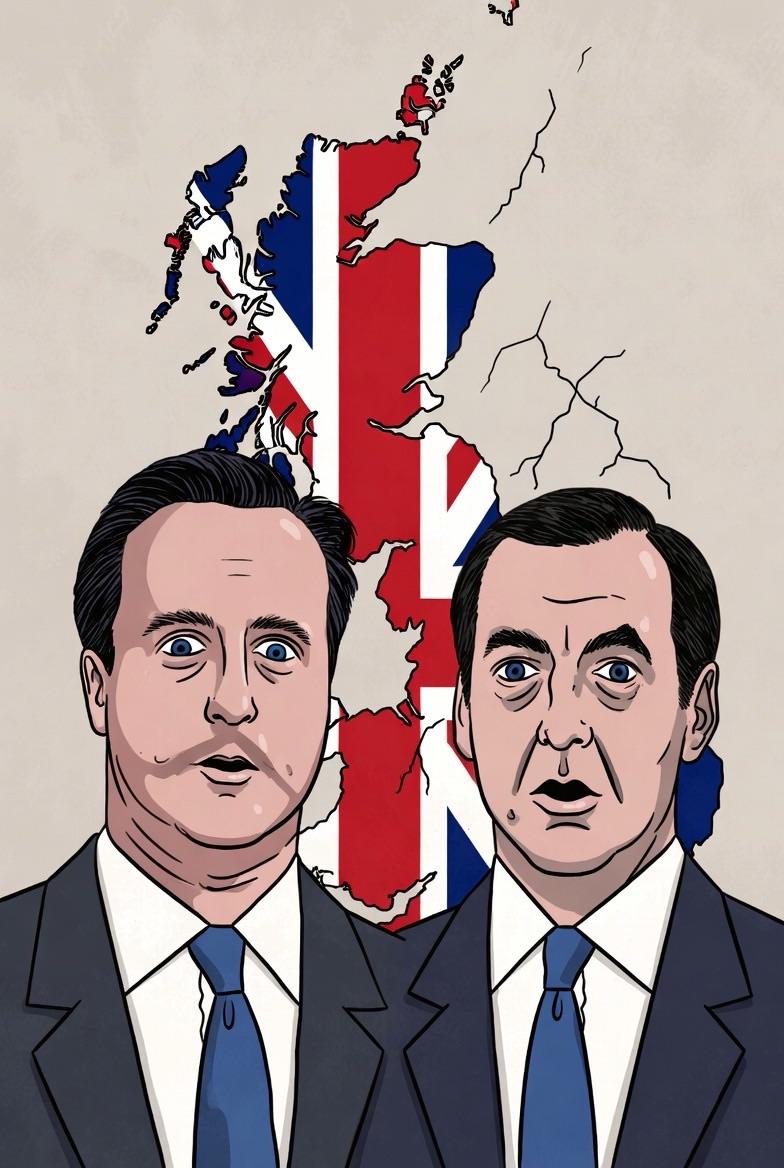
We have seen this playbook before. Under George Osborne, the housing crisis in London was reframed not as a failure of supply, planning, and investment, but as a moral question about who deserved to live in the capital. Why, it was asked, should low-income individuals remain in London when cheaper housing existed elsewhere? Why should the unemployed occupy space in a city where working people struggled to afford rent?
These are not policy questions. They are rhetorical devices, designed to reassign blame.
The same logic extended into family life: why should poorer households have more than one child when working families must “make hard choices”? In this formulation, poverty is no longer an economic condition shaped by wages, housing costs, and labour markets—it becomes a behavioural flaw. A failure of discipline. A moral shortcoming.
This inversion of cause and effect is the intellectual core of modern populism.
Today, figures like Kemi Badenoch have adopted a similar tone, suggesting, implicitly or explicitly, that reducing or eliminating welfare dependency would unlock solutions to a wide array of national challenges, from defence spending to immigration pressures. It is an argument that collapses under minimal scrutiny. Defence budgets are not constrained by benefit claimants; immigration dynamics are not driven by social housing recipients; fiscal sustainability is not determined by child benefit payments.
But the argument is not meant to withstand scrutiny. It is meant to resonate.
What we are witnessing is not a serious policy debate but a narrative construction, one that relies on selective data, anecdotal exaggeration, and the careful cultivation of public resentment. Insert flawed premises, and the conclusions will be equally flawed. In computing terms: garbage in, garbage out. In politics, however, the consequences are far more profound.
Because once a society accepts the premise that its most vulnerable members are the source of its problems, it becomes far easier to dismantle the systems designed to protect them.
And that is the endgame.
The real risk here is not just economic inefficiency, it is social fragmentation. A welfare state, at its best, is not merely a redistribution mechanism; it is an expression of collective responsibility. It binds citizens together across income levels and life stages, recognising that vulnerability is not a fixed identity but a condition that can affect anyone.
Strip that away, and what remains is a transactional society, one where support is conditional, suspicion is endemic, and solidarity is replaced by stratification.
The irony is that those most persuaded by this rhetoric are often those most likely to be harmed by its outcomes. That, too, is part of the design. Divide the working and middle classes, and you remove the only coalition capable of defending the institutions that serve them both.
It is not new. It is not accidental. And it is not benign.
It is a strategy.
The UK has a propaganda problem.
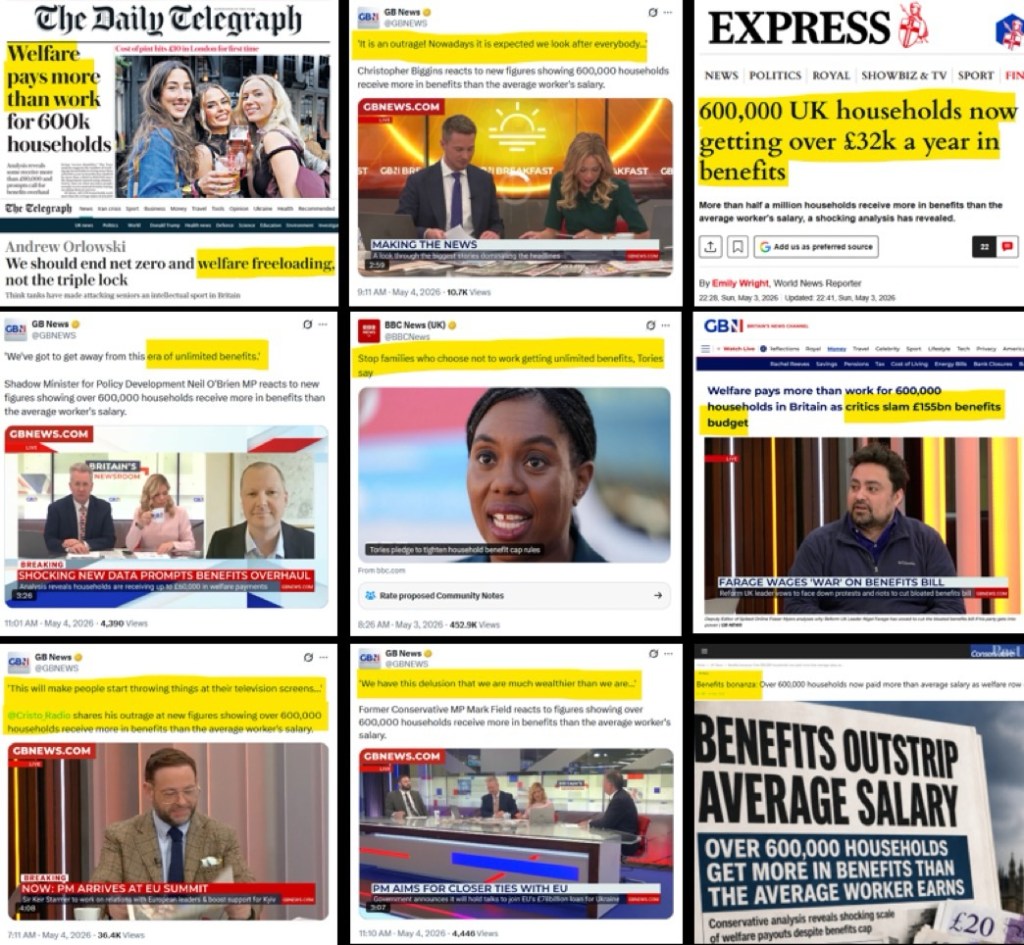
The evidence is crystal clear: Britain is categorically NOT a “high tax, high welfare” country, benefits payments are NOT comparatively generous, yet here are just some of the misleading anti-welfare headlines from the last 24hrs (debunk below):
@GBNEWS:
- “Era of unlimited benefits”
- “Farage wages war on benefits bill”
- “It’s an outrage: It is expected we look after everybody”
- “We vave this delusion that we are much wealthier than we are”
- “This will start making people throw things at their television screens”
- “Welfare pays more than work for 600,000 households as critics slam £155bn benefit bill”
@ConsPost:
- “Benefits outstrip average salary”
@BBCNews:
- “Stop families who choose not to work getting unlimited benefits”
@Telegraph (front page splash):
- “Welfare freeloading”
- “Welfare pays more than work for 600K households”
@Daily_Express:
- “600,000 UK households now getting over £32k a year in benefits” — “shocking analysis.”