

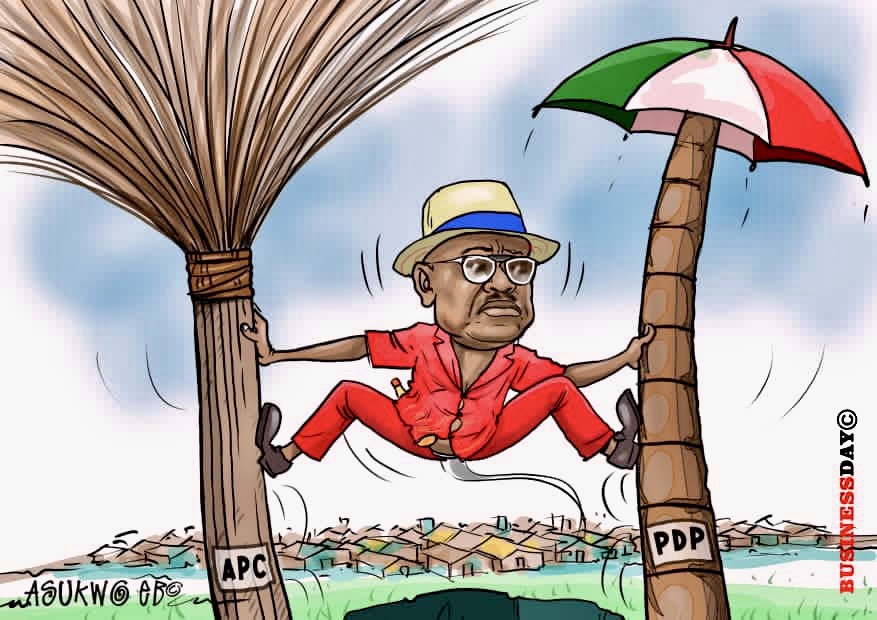
There is an old journalistic adage, attributed variously to everyone from New York editors to Fleet Street drunks, that a dog biting a man is not news, but a man biting a dog is. Nigerian political journalism, however, long ago exhausted even that modest standard of novelty. In Nigeria, the dog bites. The man bites back. Both of them then appear on television denying the existence of teeth.
Into this peculiar ecosystem walks Nyesom Wike, former Governor of Rivers State, current Minister of the Federal Capital Territory, and arguably the most expensive open secret in Nigerian public life.
The Rivers of Milk and Honey (Unaudited)
Rivers State is, by the arithmetic of petroleum geology and federal allocation formulas, the richest state in Nigeria. It sits atop oil. It breathes gas. Its derivation revenues make the finance ministers of landlocked states weep quietly into their budget proposals. To govern Rivers State is, in the crudest possible terms, to hold the keys to a vault that no serious audit has ever been permitted to examine with any thoroughness.
Wike held those keys for eight years.
What he did with them was, depending on your vantage point, either a masterclass in political construction or a case study in the institutionalisation of patronage as statecraft. He built roads, yes, and he named them, inaugurated them, and inaugurated them again. He built flyovers and judicial complexes and government houses with the zealous infrastructure enthusiasm of a man who understood that concrete is the most photogenic form of money laundering ever devised. But beneath the ceremonial commissioning of the nth project, there ran another current, quieter, nocturnal, and considerably more consequential.
The night activities, as one might delicately describe them, were the real architecture of Wike’s political empire. By day, Rivers State was governed. By night, it was *distributed*. To politicians who needed liquidity. To judges whose rulings required a certain judicial temperament, commercially induced. To law enforcement officials who discovered that the relationship between the law and its enforcement was, in Rivers State, somewhat flexible. To men and women of apparent standing, people of stated wealth, of polished credentials, of public rectitude,who nonetheless found, in the quiet arithmetic of their lives, that stated wealth and actual cash flow are two different animals, and that Wike, improbably, kept a very well-stocked larder.
The price, as always, was fealty. And the currency of fealty, in Wike’s court, was compromise.
The Particular Problem of Secrets
Here is where the story takes a turn that would be farcical if it were not so illuminating.
Nyesom Wike is, by all observable evidence, constitutionally incapable of keeping a secret. This is not a character flaw in the usual political sense, most politicians leak strategically, selectively, with the precise calibration of a surgeon bleeding a patient. Wike leaks *recreationally*. He leaks as a form of self-expression. He leaks the way a man sings in the shower, not because anyone needs to hear it, but because the acoustics are good and the inhibitions are dissolved.
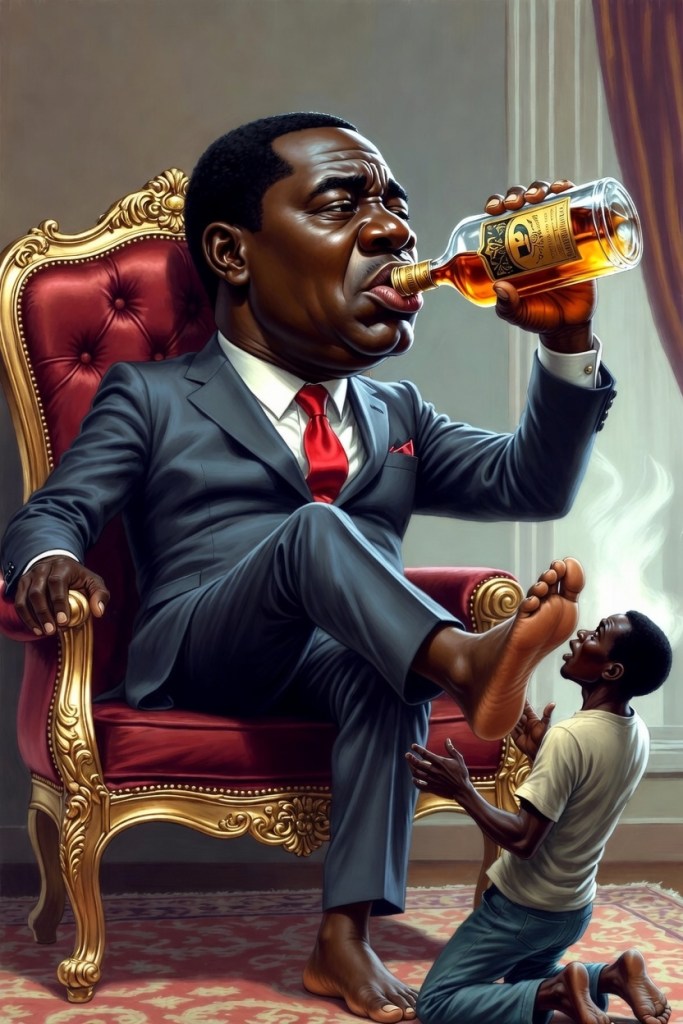
The inhibitions being dissolved, it must be noted, with considerable assistance from expensive alcohol, which Wike consumes with the dedication of a man who has confused his liver for an opponent to be defeated.
The pattern is consistent and, by now, entirely predictable. Wike finds an ally. The ally enters his orbit. Favours flow. Secrets accumulate. Then, through the inevitable processes of political appetite, unmet ambition, or simple human ingratitude, a falling-out occurs. And within a news cycle, sometimes within an evening, Wike is on a podium or a microphone, performing the political equivalent of upending the entire table and announcing every dish that was ever served on it.
Ask Rotimi Amaechi.
Amaechi was Wike’s predecessor as governor of Rivers State, his political patron, the man who had, in the received narrative, facilitated Wike’s ascent. When the two men were allies, their partnership was one of the more robust in Nigerian politics, a succession managed, a structure maintained, a mutual interest served. When they became enemies, as Nigerian political alliances inevitably, almost cosmically, tend to do, Wike proceeded to dismantle Amaechi’s reputation with the systematic thoroughness of a man who had spent years carefully noting where every body was buried, and who had now decided, in the public interest, to provide a full cartographic survey.
Nothing was sacred. Nothing was too small. The catalogue of Amaechi’s alleged sins and infractions was delivered not in measured tones but with the theatrical gusto of a man who had been *waiting* for this moment, who had been storing up these revelations the way some people store wine, patiently, in a cool dark place, against the day when they would be most useful.
The Abati Affair, or: Do Not Bite the Hand That You Have Already Told Everyone About
The case of Reuben Abati is instructive in a different, more tragicomic register.
Abati is a man of letters, a journalist, a presidential spokesman under Goodluck Jonathan, a commentator of some standing who, in his media incarnations, has periodically offered critical perspectives on Nigerian political figures including, at one point, Wike himself.
This was, as it turned out, an unwise editorial decision.
Because when Wike took offence, and Wike takes offence the way most people take vitamins: regularly, as part of a daily routine, he reached for the arsenal that only a man in his position could deploy. He informed the Nigerian public, with apparent relish, that Abati’s wife had come to him, hat in hand, seeking financial assistance during the period when Abati himself was in the considerable discomfort of an EFCC investigation.
The revelation was many things simultaneously. It was a warning. It was a punishment. It was a demonstration of power. And it was, above all, a window, not into Abati specifically, but into the entire ecosystem that Wike had spent years cultivating: an ecosystem in which men of stated wealth and public dignity quietly made their way, by night or by proxy, to the court of the Governor, and accepted what was on offer, and understood, or should have understood, what that acceptance meant.
The Real Question
At this point, the serious analyst must step back from the spectacle of Wike himself, entertaining as that spectacle undeniably is, and ask the more uncomfortable question.
Not: why does Wike behave this way? That question answers itself. Wike behaves this way because he can, because the system rewards it, and because a man with unaudited access to the revenues of Nigeria’s wealthiest state, a man with no apparent inhibition and an inexhaustible supply of aged whiskey, will inevitably become *this* man. That is not a character study; that is structural analysis.
The real question, the one that stings, the one that the Nigerian commentariat generally prefers to avoid, is this: *why do they keep going?*
Why, given the abundant and well-documented evidence that Wike’s discretion has the half-life of a fruit fly, do judges and politicians and journalists and their wives and their proxies continue to make the pilgrimage? Why do men and women of apparent standing, of professional reputation, of public morality, continue to queue at the very door from which previous visitors have been expelled, loudly and publicly, with their business announced to the press?
The answer, uncharitable as it is, is that they are not embarrassed. That is the crucial thing. In a society where shame functioned as a regulatory mechanism, where public exposure carried genuine social cost, Wike’s compulsive revelations would constitute a powerful deterrent. Compromise a judge, get found out via a drunken press conference, face professional ruin: the math would work.
But Nigerian elite culture has, over the course of several decades and multiple republics, performed a remarkable feat of moral engineering: it has decoupled reputation from behaviour. The elite are not embarrassed to be exposed because exposure, in their world, carries no real consequence. What matters is access. What matters is the stomach, or, in the charming vernacular of Nigerian political commentary, *stomach infrastructure*. The belly must be fed. The lifestyle must be maintained. The gap between stated wealth and actual cash flow must be quietly, nocturnal bridged.
And if Wike eventually tells everyone? Well. He tells everyone about the others too. They are all, in that sense, equally compromised. A secret shared by the entire elite class is not really a secret; it is just the undisclosed operating manual.
Coda: The Dog and the Man
So we return to the old journalistic problem. A dog biting a man is not news. Wike betraying an ally is not news. Wike, fortified by Cognac and grievance, standing before a microphone and dismantling someone’s reputation is not news. It is, at this point, *weather*. It is a known phenomenon, seasonally recurring, whose arrival surprises no one.
What should be news, what should scandalize, if Nigerian public life retained any capacity for genuine scandal l, is the queue that keeps forming at the door. The respectable men and their wives. The law enforcement officials. The judges in their robes. The journalists with their critical columns.
They know what Wike is. He has told them, repeatedly and in considerable detail, by his own example.
They go anyway.
That is not Wike’s problem. That is ours.

