

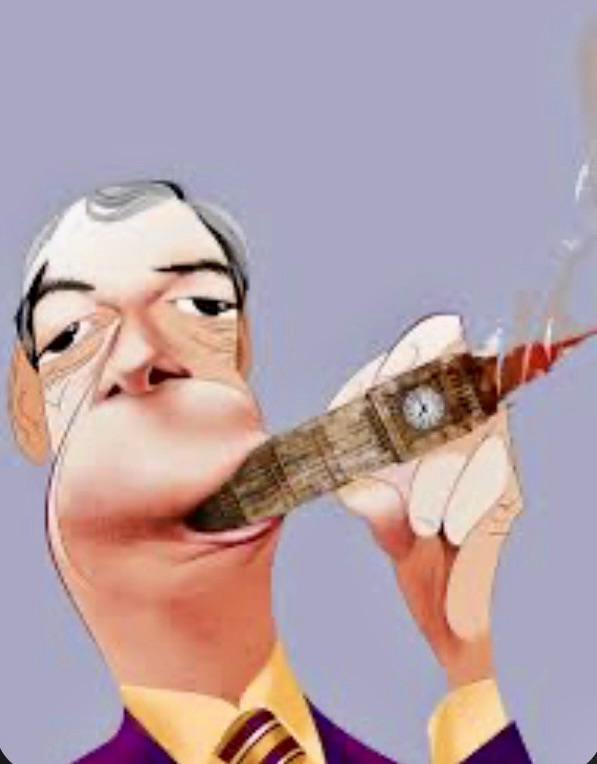
There was a time when the BBC treated fringe politics the way a sensible person treats a raccoon in the kitchen: observe from a distance, do not feed, and absolutely do not invite it onto Question Time with a microphone.
Fast forward, and here we are—watching Nigel Farage being ushered into studios like a slightly controversial uncle who says outrageous things at Christmas but still gets handed the gravy.
At this rate, one half expects the continuity announcer to say:
“Up next: Countryfile, followed by Nigel Farage explaining why sheep are too woke.”
From Pariah to Panel Regular
Once upon a time, Britain had standards. Not high standards, but standards nonetheless.
Take the British National Party. When they appeared on the BBC, it was treated like a controlled detonation. Hazmat suits on, public warned, experts deployed. The entire exercise had the tone of: “We’re showing you this so you understand the danger, not so you invite it round for tea.”
Contrast that with Reform UK—a party that often sounds like the BNP after a rebrand, a focus group, and a haircut—and yet is treated like a slightly quirky startup in the democracy marketplace.
“Ah yes, Reform UK—disrupting politics, like Uber, but for outrage.”
The BBC’s New Editorial Policy: If It Polls, It Rolls
The BBC insists it is merely reflecting reality. Reform is polling, therefore Reform must be platformed.
By that logic, if “Bring Back Hanging for People Who Walk Slowly” hit 12% in a YouGov poll, Fiona Bruce would be moderating a lively debate by Thursday.
The numbers are, frankly, comedy gold. Reform getting more airtime than the Liberal Democrats is like a TikTok influencer getting more coverage than a qualified surgeon because, well, engagement.
News has become vibes-based.
Nigel Farage: Man, Myth, Perpetual Guest Slot
Farage himself is not a politician in the traditional sense. He is a one-man content factory.
Where others see policy complexity, he sees a camera and an opportunity to look mildly exasperated on behalf of “the British people”—a group he represents with the confidence of a man who has never lost an argument in his own head.
The BBC didn’t create him, but it certainly gave him the gym membership, protein shakes, and a regular slot on leg day.
You don’t see this level of commitment to exposure outside of reality TV. At this point, Farage is less a guest and more a recurring character. Somewhere between the weather and the sport, but with more wind.
Historical Comparisons (Or: Please Put Down the Brownshirts Analogy)
Now, invoking the Sturmabteilung—the Brownshirts—is a bit like bringing a flamethrower to light a birthday candle. It makes a point, but also alarms the neighbours.
Weimar Germany’s media landscape was chaotic, partisan, and frequently unhinged. The BBC, for all its sins, is not that.
But here’s the uncomfortable overlap: media exposure can launder reputations. Not by endorsement, but by repetition. Familiarity breeds not contempt, but acceptance.
Say something often enough on a respectable platform, and eventually it starts to sound… respectable.
Or at least debatable between the weather and a segment on air fryers.
Due Impartiality, or “Let Them Fight”
The BBC’s favourite phrase—due impartiality—has evolved into something resembling organised chaos.
The format is simple:
- One person states something incendiary
- Another person looks horrified
- The presenter nods gravely
- Everyone goes home feeling “balanced”
What’s often missing is scrutiny—the boring, unsexy work of saying: “Hang on, that’s not true, and here’s why.”
Instead, we get political WWE. Farage plays the heel, the audience boos (or cheers), and the BBC declares victory for democracy.
The Real Trick: Moving the Furniture
Here’s where Farage is genuinely effective: he doesn’t just join the conversation, he rearranges the room.
Things that once sat firmly in the “absolutely not” category are nudged into “well, let’s discuss.” And once something is discussable on the BBC, it has effectively passed through the velvet rope into mainstream politics.
That’s not normalisation by decree. It’s normalisation by osmosis.
Final Thought: The BBC as a Reluctant Influencer
The BBC still thinks of itself as a mirror held up to society.
But increasingly, it behaves like an algorithm:
- Rewarding engagement
- Amplifying controversy
- And occasionally wondering how things got so out of hand
Farage, to his credit, understands this perfectly. He doesn’t need the BBC to agree with him—he just needs it to keep inviting him back.
And Auntie Beeb, ever polite, keeps setting an extra place at the table.
At this point, the raccoon isn’t just in the kitchen.
It’s hosting the show.

