

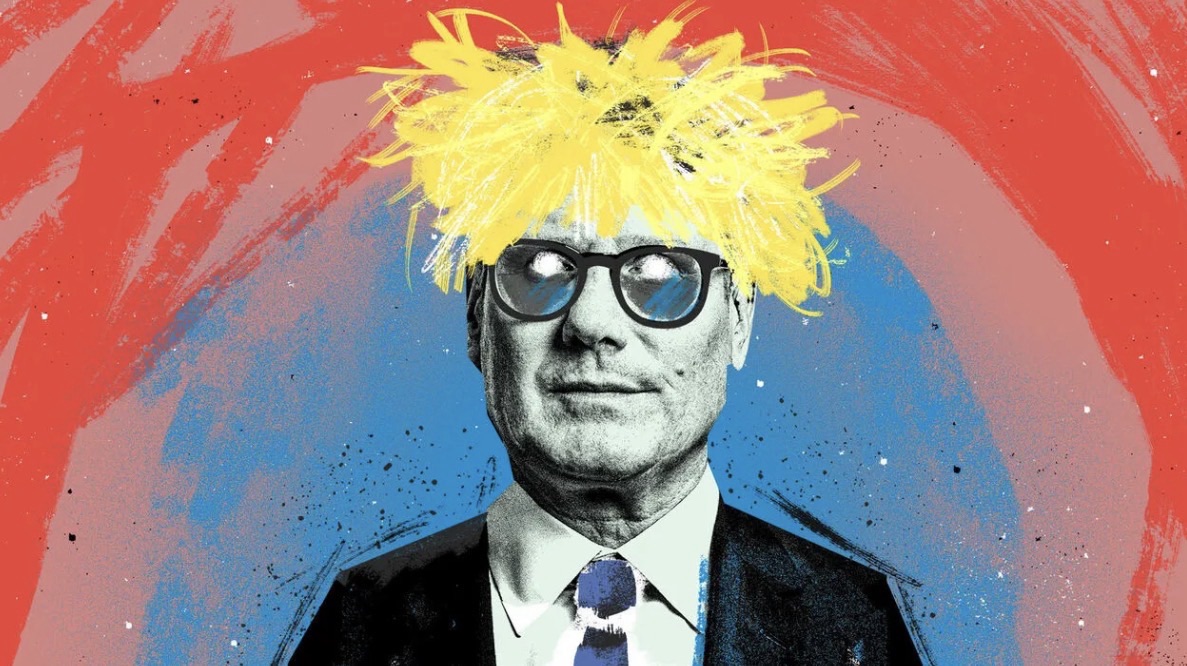
There was a time in British politics when dullness was considered a virtue. A Prime Minister who governed competently, balanced competing interests, kept the machinery of state functioning and avoided national melodrama was seen as doing his job. Today, such a politician would be eaten alive before the first Prime Minister’s Questions clip hit TikTok.
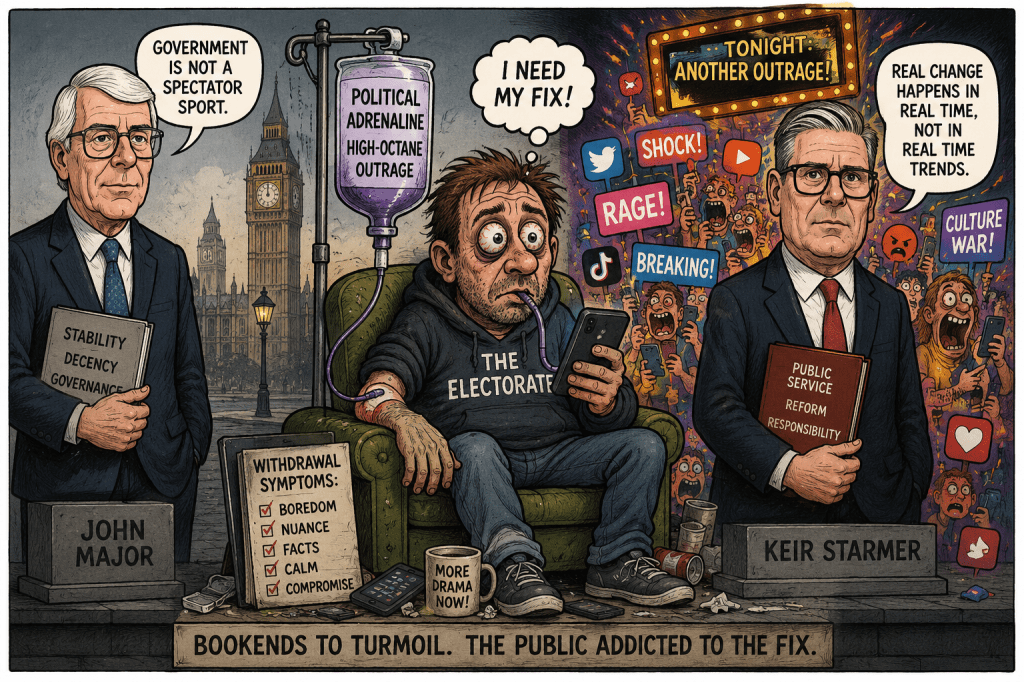
John Major and Keir Starmer are bookends to two eras of political exhaustion. Both inherited countries tired of political psychodrama. Both arrived promising sobriety after excess. Both discovered that modern electorates increasingly mistake emotional stimulation for leadership.
Major inherited the wreckage of Thatcherism’s civil wars. Starmer inherited the hangover from Brexit trench warfare, Boris Johnson’s theatre production masquerading as government, and the national nervous breakdown that briefly elevated Liz Truss into office long enough to terrify mortgage holders and lettuce farmers alike.
Both men represent administrative politics. They are process men. Committee men. Men who believe government should resemble plumbing rather than professional wrestling.
The problem is that the electorate no longer wants plumbers. It wants stunt performers.
Modern politics has become chemically dependent on adrenaline. Voters, media platforms and online activists now consume politics the way a drugee seeks a fix. Calm governance produces withdrawal symptoms. Competence feels boring. Procedure feels weak. Nuance feels like betrayal.
A politician who says, “This is a complicated issue requiring gradual reform,” is now competing against another shouting, “THE COUNTRY IS COLLAPSING!” in capital letters beside a thumbnail with a flaming Union Jack.
Guess who wins the algorithm.
Social media did not merely change politics; it altered the public’s neurological expectations of leadership. Politics is no longer evaluated in parliamentary terms but in entertainment metrics: virality, emotional intensity, outrage production and meme compatibility.
A nineteenth-century statesman needed a parliamentary majority.
A twenty-first-century politician needs engagement statistics.
Major suffered because he governed in the first age of rolling media hysteria. Starmer suffers because he governs in the age of permanent digital psychosis. Major was undermined by newspapers. Starmer is attacked simultaneously by newspapers, YouTubers, influencers, anonymous burner accounts, factional activists and men broadcasting from their cars wearing wraparound sunglasses.
Neither inspires frenzy. That is precisely their problem.
The public claims to want stability but repeatedly rewards instability wrapped in charisma. It says it wants honesty but gravitates toward performers who transform every issue into an existential battle between good and evil. The electorate complains about division while algorithmically subsidising outrage.
Politics has become emotional energy production.
This explains why highly charged political figures dominate discourse even when their actual governing records are chaotic. They provide stimulation. They make supporters feel permanently mobilised. Every speech becomes a crusade. Every compromise becomes treason. Every policy becomes civilisation’s final battle.
The public no longer consumes politics as citizenship.
It consumes it as dopamine.
That is why calm politicians appear strangely anachronistic. Major looked grey in an age that wanted Thatcherite drama. Starmer looks bloodless in an era addicted to populist spectacle. Neither man naturally produces the emotional narcotic modern politics demands.
Yet history may judge them more kindly than contemporaries do.
The irony of democratic societies is that voters often only appreciate low-octane leadership after surviving the consequences of high-octane politics. Fireworks are exciting until the house burns down.
Britain today resembles a nation permanently refreshing its political feed searching for emotional stimulation. Every week requires a scandal, a betrayal, a culture war, a constitutional crisis or a villain. Silence itself has become suspicious. If politics is not generating outrage, many assume nothing is happening.
But governing is not content creation.
A functioning state is supposed to be boring. Trains arriving on time is boring. Stable interest rates are boring. Competent procurement is boring. Ministers quietly reading briefing papers before making decisions is boring.
Civilisation itself is, in many ways, glorified boredom.
The danger for democracies is that electorates increasingly reject this bargain. They crave leaders who make them feel something intensely and immediately. The long-term consequences become secondary to the short-term emotional hit.
Like all addictions, the dosage eventually escalates.
Soon ordinary political disagreement is insufficient. Everything must become apocalyptic. Opponents cannot merely be wrong; they must be evil. Elections cannot simply matter; they must become “the most important in history.” Every setback becomes national humiliation. Every compromise becomes surrender.
The result is political inflation. Yesterday’s outrage no longer satisfies. The system requires ever more dramatic personalities and ever more extreme rhetoric to maintain public attention.
Major and Starmer stand awkwardly against this tide. They belong to a tradition that sees politics as administration rather than performance art. They speak the language of governance in an age obsessed with spectacle.
The tragedy is that democracies may only rediscover the value of boring politicians after exhausting themselves on exciting ones.
 Centre for Nigeria Progress
Interesting, one step back (fundamentalism) two steps forward.
LikeLiked by 1 person