


There is an old rule in British politics: when the Labour Party finally reaches power after years in opposition, it immediately begins searching for inventive ways to destroy itself. Some parties govern countries. Labour often behaves like a travelling Shakespearean troupe performing betrayal scenes for internal audiences.
The first great Labour suicide note was the 1983 manifesto, famously described as “the longest suicide note in history.” The second arrived in 2019, when the party somehow looked at the wreckage of 1983 and decided the problem had been insufficient enthusiasm.
Now comes the third note.
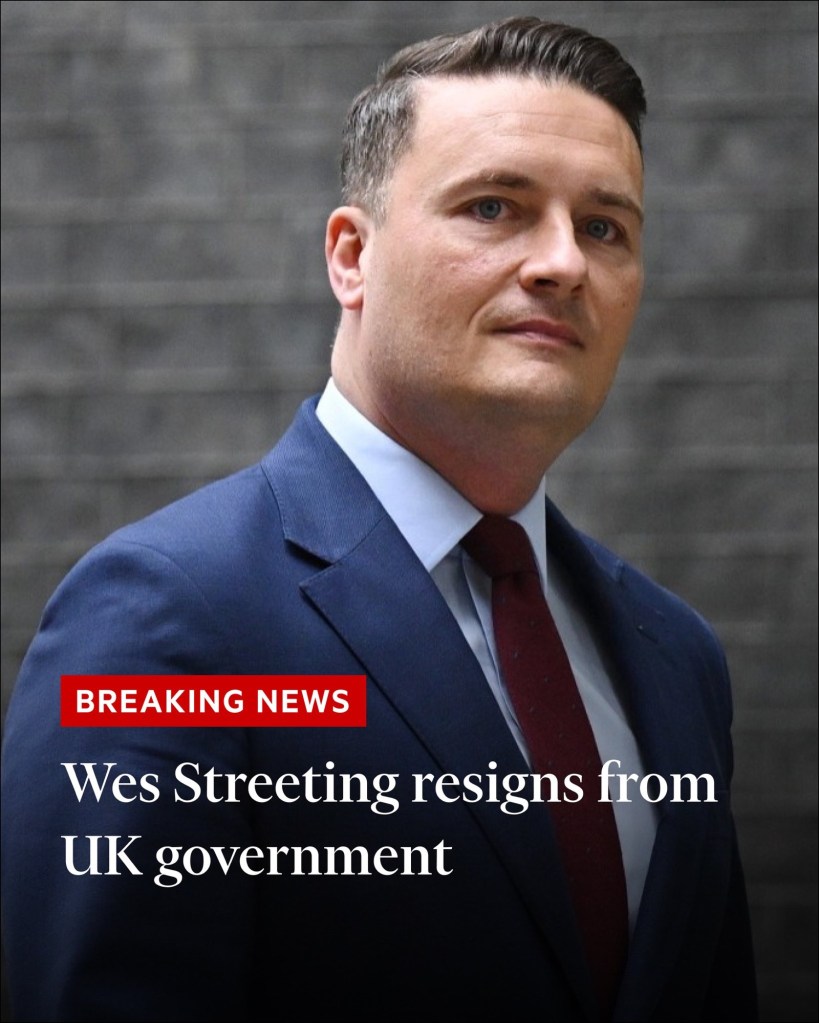
Not in manifesto form this time, but in the carefully choreographed resignation theatrics surrounding Wes Streeting, a man whose political career has long existed somewhere in the overlapping Venn diagram of Blairism, ambition and strategic impatience.
And hovering over this drama like Banquo’s ghost in an expensive suit is Peter Mandelson.
Of course it always comes back to Mandelson.
In Labour mythology, Mandelson occupies a unique role. To admirers, he is the grand architect of modern electability: the dark prince who helped drag Labour from unelectable protest movement into government. To critics, he is the patron saint of triangulation, spin and ideological flexibility so advanced it could qualify as yoga.
But one thing is universally acknowledged: Mandelson understands power better than almost anyone Labour has produced in the last half-century.
Which is precisely why his appointment as ambassador to the United States reportedly unsettled parts of Keir Starmer’s circle.
Not because Mandelson lacks ability. Quite the opposite. Mandelson possesses the rare Westminster talent of entering any room and somehow appearing both indispensable and faintly dangerous at the same time. He is a political operator from the old school: charming, intelligent, ruthless and permanently networked into the wiring of power itself.
Prime ministers generally prefer ambassadors who represent the government abroad.
Not ambassadors who may quietly represent alternative futures back home.
The irony is exquisite. Starmer spent years centralising authority, purging rivals and constructing perhaps the most disciplined Labour leadership operation since Blair. Yet the moment Mandelson re-enters the frontline, Westminster immediately starts whispering about succession politics like medieval courtiers spotting an ageing king cough during dinner.
And at the centre of those whispers sits Streeting, widely regarded as one of Mandelson’s political protégés.
This is where Labour’s internal psychodrama becomes almost Shakespearean. The master strategist is elevated to Washington while his ideological heir manoeuvres in London. The mentor departs physically yet his political shadow grows larger domestically. It is less a government than a prestige HBO drama about ambitious people drinking expensive wine while plotting against colleagues.
Streeting’s frustration appears rooted in a calculation increasingly common among ambitious Labour modernisers: Starmer may have been the correct vehicle for winning power, but not necessarily the figure for wielding it long term.
That is always the danger for transitional leaders. They are useful until they become inconvenient.
Starmer’s strength was forensic opposition politics. Discipline. Caution. Decontaminating Labour after the Corbyn years. He was the human equivalent of a risk assessment form. Reassuring to middle England precisely because he seemed incapable of spontaneous ideological combustion.
But governments eventually move from opposition management to political vision. And that transition exposes weaknesses brutally.
Labour’s modernising wing increasingly fears that Starmer’s greatest political talent, managerial caution, may also be his greatest limitation. Governments cannot survive indefinitely on the promise of not being the previous lot.
Streeting clearly senses opportunity in that vacuum.
Yet there is something profoundly dangerous about trying to ride Mandelson’s tiger.
Because Mandelsonism is not merely a political tendency. It is an ecosystem of permanent manoeuvre. Loyalty is transactional. Alliances are temporary. Every conversation carries three meanings: the public one, the private one and the one intended for journalists two months later.
Many politicians imagine they can inherit Mandelson’s methods without becoming consumed by them. Few succeed.
Blair managed it because he possessed enormous electoral charisma.
Brown tried and spent years consumed by paranoia.
Countless Labour modernisers ended up trapped somewhere between focus-group liberalism and permanent factional intrigue.
Streeting risks a similar fate. For all his media fluency and political sharpness, the British electorate has historically viewed leadership conspiracies with suspicion. Voters may dislike weak prime ministers, but they dislike visibly ambitious subordinates even more.
Especially when the knives appear to emerge before the government has had time to govern properly.
There is also the deeper irony haunting Labour. After years attacking Conservative psychodrama, Boris
 Centre for Nigeria Progress