
Eighteen years, one certified true copy, two German loanwords, and a constitutional sledgehammer: the Court of Appeal has handed the EFCC its most consequential defeat yet, and the Commission arguably handed it to itself.
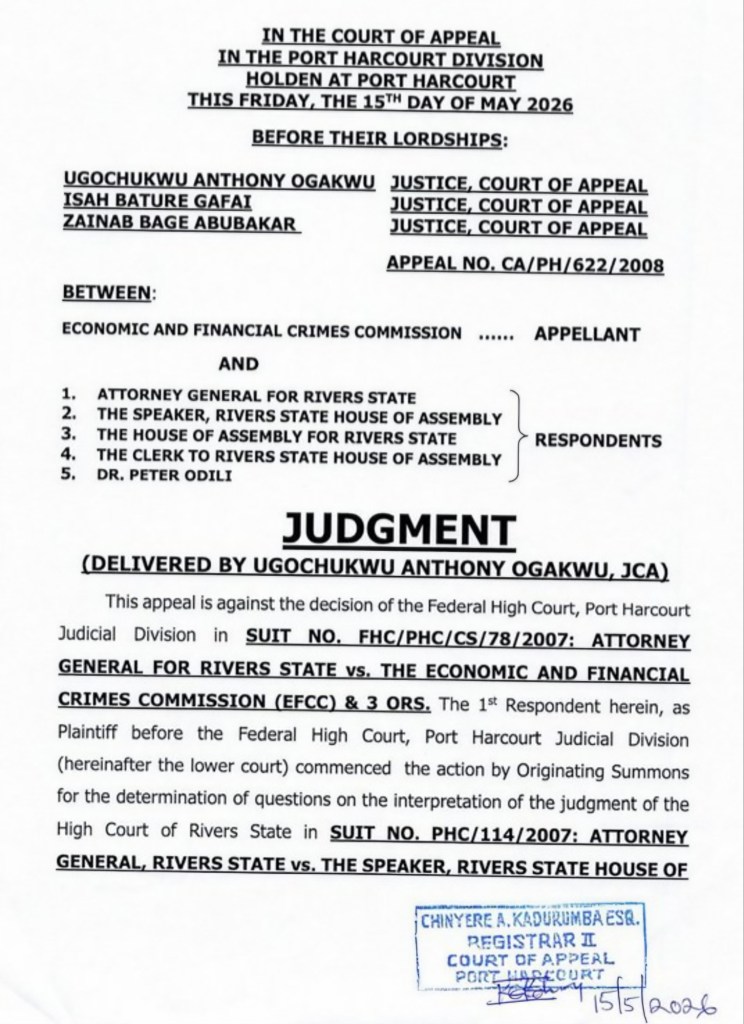
Appeal No. CA/PH/622/2008
There is a particular species of Nigerian legal drama that can only be fully appreciated with a glass of something fortifying and a comfortable chair. It involves institutions that have been fighting in court since before some of their current staff members graduated secondary school, constitutional questions of genuine national consequence, and, every so often, a judge who deploys nineteenth-century German romanticism to describe a federal agency’s predicament. EFCC v. Attorney-General for Rivers State & Ors CA/PH/622/2008 is precisely that drama, and on the 15th of May 2026, the curtain finally came down.
The verdict, delivered by Justice Ugochukwu Anthony Ogakwu of the Court of Appeal, Port Harcourt Division, with Justices Gafai and Abubakar concurring, is unambiguous: the Economic and Financial Crimes Commission does not have the constitutional authority to investigate the public funds of Rivers State. The EFCC Establishment Act, however purposefully drafted, cannot override the Constitution of the Federal Republic of Nigeria. And the appeal, filed in 2008, nursed through the courts across five presidential administrations, has been dismissed in its entirety.
Cue the albatross.
A Brief History of an Extraordinary Mess
To understand the judgment, one must first understand the litigation, which is itself a monument to institutional stubbornness, strategic oversight, and the peculiar genius of Nigerian lawyers for making a bad situation worse through sheer persistence.
- February 2007 The High Court of Rivers State, in PHC/114/2007, AG Rivers State v. Speaker, Rivers State House of Assembly & Ors, interprets Sections 120–128 of the 1999 Constitution and holds that the Rivers State House of Assembly alone has constitutional authority over the public funds of Rivers State. The EFCC is not a party to this suit. Crucially, the EFCC does not appeal this judgment.
- March 2007 The Federal High Court, Port Harcourt, in FHC/PH/CS/78/2007, rules against the EFCC on the question of investigating Rivers State finances. Justice I.N. Buba delivers a decision broadly consistent with the constitutional logic established by the State High Court a month earlier. The EFCC appeals this one.
- 2007 Former Governor Peter Odili obtains a perpetual injunction from the Federal High Court in Port Harcourt, barring the EFCC from investigating, arresting, or prosecuting him, and from probing Rivers State finances during his tenure. It is, in effect, a legal force field obtained at retail.
- 2008 The EFCC files Appeal No. CA/PH/622/2008. The appeal sits, breathes, accumulates dust, and outlives several governments.
- 2018 The Court of Appeal grants the EFCC leave to challenge the 2007 Odili injunction out of time. Rivers State’s Attorney General and House of Assembly Speaker, not to be outdone, appeal this grant to the Supreme Court.
- March 2025 The Supreme Court dismisses the Rivers State appeals, clearing the EFCC to proceed with its challenge at the Court of Appeal. Hope stirs in the anti-graft community.
- 15 May 2026 The Court of Appeal, Port Harcourt Division, delivers judgment in CA/PH/622/2008. The EFCC’s appeal is dismissed. The decision of the Federal High Court is affirmed. The albatross is named.
The Constitutional Holding: Simple, Severe, and Significant
The legal heart of the judgment is the Court’s treatment of Sections 120, 121, 122, 124, 125 and 128 of the 1999 Constitution, provisions dealing with the Consolidated Revenue Fund of Rivers State, its management, the Auditor-General for the State, and the powers of the House of Assembly to investigate public funds.
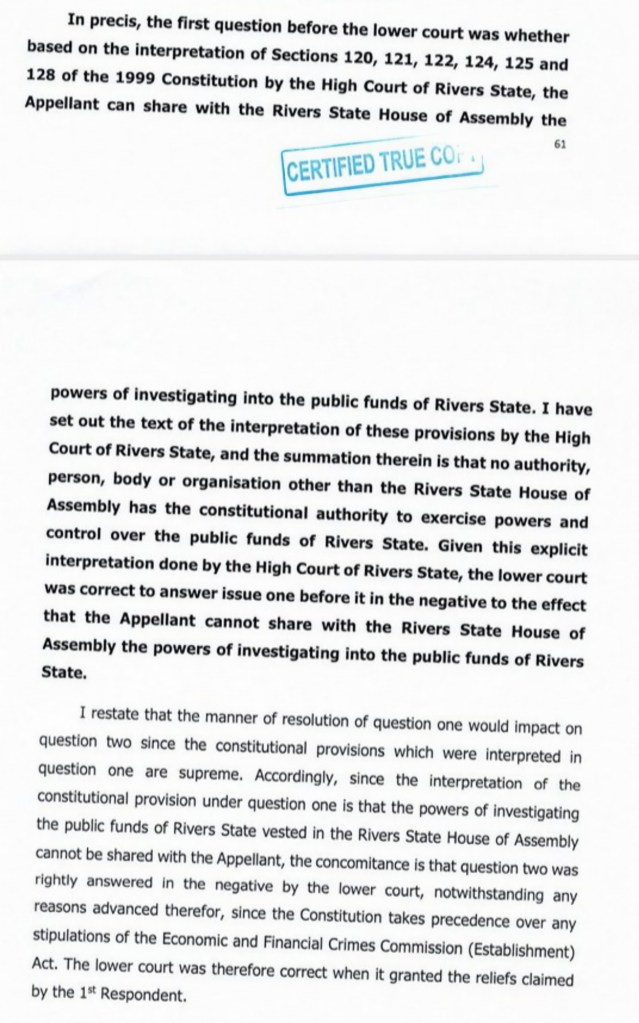
The High Court of Rivers State had, in 2007, interpreted these provisions to mean that the constitutional authority over Rivers State public funds vested exclusively in the Rivers State House of Assembly. No other authority, person, body, or organisation, however named, however federally mandated, could share in that power.
“No authority, person, body or organisation other than the Rivers State House of Assembly has the constitutional authority to exercise powers and control over the public funds of Rivers State.” Ogakwu JCA, CA/PH/622/2008, delivering the Court’s judgment
The Court of Appeal, accepting this interpretation as constitutionally correct, drew the inevitable conclusion about the EFCC: since the constitutional provision was supreme, any contrary stipulation in the EFCC Establishment Act must yield. The Constitution is not a document that accommodates rivals. It does not negotiate. It does not make exceptions for agencies that have helpfully named themselves after financial crimes.
The ruling is therefore not merely about the EFCC. It is a statement about the hierarchy of laws under Nigeria’s constitutional order and, indirectly, about the limits of federal power in a nominally federal state. The EFCC Act cannot do what the Constitution forbids. Full stop.
The Albatross: Where the Commission Shot Itself
But the judgment’s most withering passage, and the one that will be quoted in Nigerian legal circles for years, concerns not what the Constitution says, but what the EFCC failed to do in 2007.
The State High Court judgment in PHC/114/2007, delivered in February 2007, was the foundational stone of the entire constitutional edifice. It was not a Federal High Court decision. It was not a decision the EFCC had standing to automatically challenge. But the EFCC, having apparently not fully appreciated its implications, did not appeal it.
Ogakwu JCA does not let this pass. In a paragraph that must have produced considerable discomfort in Wuse II, he writes:
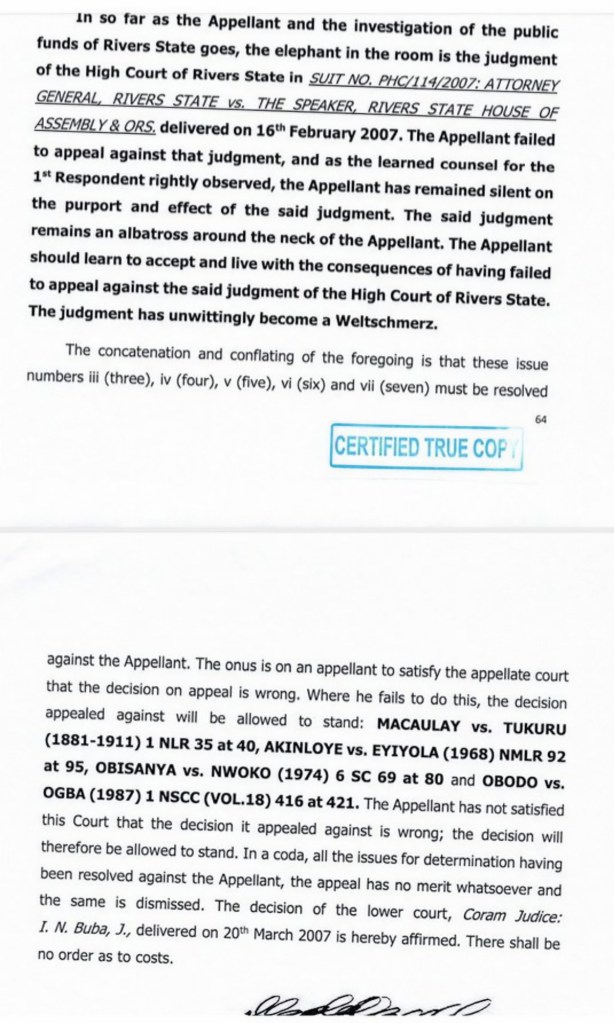
“The Appellant failed to appeal against that judgment, and as the learned counsel for the 1st Respondent rightly observed, the Appellant has remained silent on the purport and effect of the said judgment. The said judgment remains an albatross around the neck of the Appellant. The Appellant should learn to accept and live with the consequences of having failed to appeal against the said judgment of the High Court of Rivers State. The judgment has unwittingly become a Weltschmerz.” Ogakwu JCA, CA/PH/622/2008
Weltschmerz: a German word, popularised by the Romantic poets, meaning a deep, pervasive sadness about the state of the world, a weary anguish at the gap between how things are and how they ought to be. It is not a word one frequently encounters in Nigerian jurisprudence. It is, one imagines, exactly the word that captures the mood at EFCC headquarters upon receipt of this judgment.
The Court was making a point as sharp as any steel: you cannot spend eighteen years appealing a federal court decision while ignoring the state court decision that forms its constitutional foundation. When you fail to challenge the root, you cannot complain that the tree stands.
The Irony That Writes Itself
Here is the thing about this judgment that makes it particularly rich material for anyone interested in how Nigerian law and Nigerian politics interact. The 1999 Constitution’s provisions on state finances were designed, among other things, to protect the autonomy of state governments from federal overreach. The House of Assembly, democratically elected, locally accountable, constitutionally mandated,was to be the watchdog of state public funds.
The architects of that constitutional arrangement presumably assumed that the watchdog would actually watch. They did not fully model the scenario in which the watchdog is domesticated, defanged, or as has periodically been the case in Rivers State, involved in its own constitutional crisis so spectacular that it requires federal mediation to determine who is, in fact, the Speaker.
Section 15(5) of the same 1999 Constitution, it is worth noting, places an obligation on the State itself to abolish corruption and abuse of power. The constitutional design entrusts the enforcement of that obligation, at state level, to the very institution whose independence from the executive cannot always be assumed.
The Court has therefore, in impeccable constitutional logic, created a position where the body with exclusive authority to investigate state public funds is also the body most susceptible to political capture by the very executive whose funds are to be investigated. This is not a criticism of the judgment, which is doctrinally defensible, but it is a profound observation about the architecture of accountability in Nigeria’s federal system.
Corruption at state level, in other words, is constitutionally assigned to be addressed by the institutions of state government. One is left to ponder the wisdom of that assignment in quiet moments.
What Remains: The Odili Question and the Supreme Court
This judgment does not end the litigation universe around Rivers State and the EFCC. Two questions in particular remain open.
The first is the fate of the EFCC’s challenge to the Odili perpetual injunction, the one the Supreme Court cleared it to pursue in March 2025. That challenge was principally about whether the EFCC could probe Odili’s personal conduct and the finances of his tenure. The Court of Appeal’s ruling that the EFCC constitutionally cannot investigate Rivers State public funds does not automatically collapse the Odili challenge, but it profoundly undermines its state-funds dimension. An investigation into how Rivers State’s money was spent during 1999–2007 is precisely what the Court has now held the EFCC cannot constitutionally do. Odili’s lawyers will read this judgment with considerable satisfaction.
The second, and more consequential question, is whether the EFCC will appeal to the Supreme Court, and whether the apex court will take the opportunity to settle, definitively, the question of federal anti-corruption jurisdiction over state financial crimes. It ought to. The constitutional tension between the EFCC’s federal mandate and the states’ fiscal autonomy is too important to be resolved by anything short of the Supreme Court’s authoritative voice.
One also notes that a personal criminal investigation of a state official, as opposed to an institutional investigation of state funds, may travel on different constitutional tracks. Whether an official’s receipt of bribes, or diversion of funds to personal accounts, constitutes “investigating the public funds of the state” is a question this judgment leaves productively open.
Case Reference & Key Facts
Case: Economic and Financial Crimes Commission v. Attorney General for Rivers State & 4 Ors
Appeal No.: CA/PH/622/2008
Court: Court of Appeal, Port Harcourt Division
Delivered: 15 May 2026
Coram: Ogakwu JCA (lead judgment); Gafai JCA; Abubakar JCA
Lower Court: Federal High Court, Port Harcourt — FHC/PH/CS/78/2007 (Justice I.N. Buba, 20 March 2007)
Outcome: Appeal dismissed. Lower court decision affirmed. No order as to costs.
Key Constitutional Provisions: Sections 120–128, 1999 Constitution (as amended)
The State of the Law as It Stands Today
Legal Position, Post CA/PH/622/2008
- 🔴 The EFCC does not have constitutional authority to investigate the public funds of Rivers State. The constitutional powers of oversight vest exclusively in the Rivers State House of Assembly.
- 🔴 The EFCC Establishment Act cannot override the 1999 Constitution. Where the two conflict on this point, the Constitution prevails.
- 🟡 The ruling applies to institutional investigation of state public funds. The extent to which personal criminal conduct by state officials falls outside this protection remains legally arguable.
- 🟡 The EFCC’s challenge to the Odili perpetual injunction, cleared by the Supreme Court in March 2025 remains pending, but is now considerably weakened on its state-funds dimension.
- 🟢 A Supreme Court appeal remains available to the EFCC and is arguably the appropriate next step given the national constitutional significance of the questions involved.
A Final Word on Eighteen Years
There is something almost poignant about Appeal No. CA/PH/622/2008. It was filed when Umaru Musa Yar’Adua was President, when the iPhone was one year old, when Peter Odili had only just left Government House Port Harcourt, and when the EFCC, then still carrying the reforming energy of the Ribadu era — believed it could sweep aside legal obstacles through sheer institutional momentum.
Eighteen years later, the Commission has its answer. It is not the answer it wanted, and part of the reason it is not is that somewhere in 2007, someone in the Commission’s legal directorate looked at a State High Court judgment, decided it was not their immediate problem, and moved on. That judgment became the albatross. The albatross became the Weltschmerz. The Weltschmerz became eighteen years of appellate proceedings that ended in dismissal.
There is a lesson in there somewhere about the importance of comprehensive legal strategy, about the danger of fighting the battle in front of you while ignoring the one being decided down the corridor. It is a lesson that applies beyond anti-graft agencies and high courts. It applies to anyone who has ever thought that an inconvenient legal development, if ignored long enough, will simply go away.
It will not. It will sit quietly, gather constitutional weight, and eventually be cited back at you in a 23-page judgment that ends with German romantic philosophy.
The EFCC’s next move, whether to the Supreme Court or to a fundamental rethink of how federal anti-corruption enforcement interacts with constitutional federalism, will say much about the institutional maturity of Nigeria’s premier anti-graft agency. One hopes the move comes faster than eighteen years.