


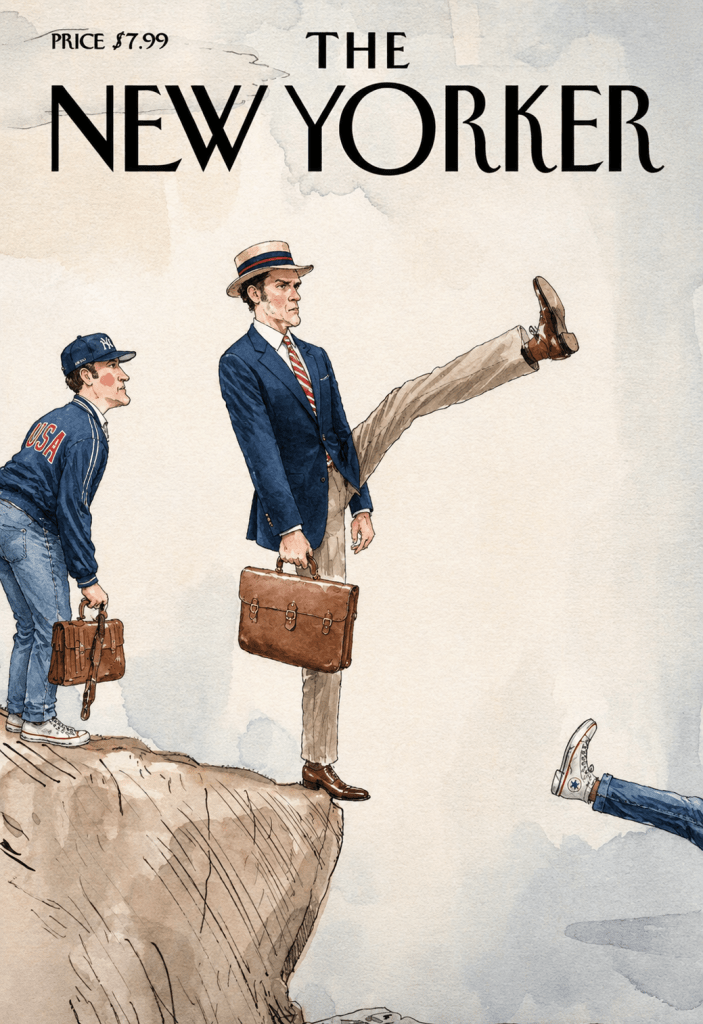
There comes a point in the life of a democracy when the debate is no longer about ideology, taxation, immigration, or even war. The debate becomes far more primitive and far more dangerous: can supposedly intelligent adults still distinguish reality from obedience?
That is where America now finds itself in May 2026.
The astonishing thing is no longer Donald Trump. America has had demagogues before. History is full of loud men with orange-tinted egos, theatrical rage, and an allergy to truth. The truly alarming development is that after a decade of scandal, chaos, criminal investigations, failed predictions, political vandalism, self-inflicted economic pain, and endless national exhaustion, Trump still possesses near-total control over Republican elected officials.
That is the real scandal.
At some point, one would expect basic human instinct to kick in. One imagines senators waking up in the middle of the night, staring at the ceiling fan like a character in a political thriller, whispering to themselves: “What exactly are we doing?”
Apparently not.
Instead, the modern GOP behaves like a political caravan marching obediently toward a cliff edge while arguing about the correct shade of the parachute.
Even now, Republican caucuses continue to vote exactly as Trump commands. Nominees rise or fall based almost entirely on whether the president approves of them. Principles no longer matter. Competence no longer matters. Scandal no longer matters. The old Republican language of “character,” “family values,” “constitutional conservatism,” and “fiscal discipline” has vanished into the same warehouse where they stored the dignity of Lindsey Graham.
And perhaps nothing captures the intellectual collapse of the party more perfectly than the rise of Ken Paxton.
The idea that Paxton could emerge as a serious Senate nominee would once have sounded like satire written by an exhausted Netflix screenwriter. Here is a man so permanently surrounded by allegations, investigations, ethical controversies, whistleblower complaints, impeachment proceedings, and legal clouds that one suspects his Wikipedia page requires its own risk assessment department.
Yet in today’s GOP, this is not disqualifying. It is practically a recommendation.
The Republican Party once claimed to be the party of law and order. It now resembles a rehabilitation centre for politically connected chaos merchants.
And the tragedy is that many Republican voters are not fools in the traditional sense. They run businesses, raise families, pay mortgages, and navigate ordinary life successfully. Yet politically, many seem trapped in a permanent state of emotional hostage-taking. Every scandal is dismissed as persecution. Every failure becomes somebody else’s conspiracy. Every economic problem is blamed on immigrants, China, “globalists,” universities, windmills, or whichever villain the outrage-industrial complex selected for the week.
Meanwhile, the consequences pile up.
America has endured self-inflicted inflation worsened by reckless political brinkmanship and tariff obsessions masquerading as economic nationalism. Foreign policy has become increasingly erratic, driven less by strategic coherence than by cable television theatrics and social media impulses. Institutional trust continues to erode. Corruption accusations follow Trumpworld figures with the reliability of gravity. Yet the political loyalty remains almost theological.
One begins to understand that Trump himself may merely be a symptom of something deeper, a broader collapse in elite courage inside the Republican Party.
Because the truth is painfully simple: Trump can only dominate because grown adults permit it.
Senators permit it.
Governors permit it.
Donors permit it.
Media personalities profit from it.
And voters reward it.
At any moment, Republican leaders could collectively decide they have had enough. They could rediscover the ancient political concept known as “shame.” They could choose competence over spectacle, seriousness over grievance, governance over permanent outrage.
But that would require courage.
And courage, sadly, has become the rarest commodity in modern American conservatism.
The GOP today increasingly resembles one of those once-prestigious companies that quietly abandoned quality control years ago but still survives on brand recognition and nostalgia. The logo remains familiar. The internal machinery is broken.
There was once a conservative movement in America that believed in institutions, alliances, fiscal prudence, and constitutional restraint. Whatever one thought of its policies, it at least possessed an identifiable philosophical spine.
Now? The movement often appears animated primarily by resentment, performative anger, and personal loyalty to one man.
This is why many observers keep misunderstanding the moment. They keep waiting for Trumpism to collapse under the weight of its contradictions. But personality cults do not operate on logic. They operate on identity, tribalism, and emotional dependency.
The followers become the system.
And that is why the rot is indeed much deeper than many suspected.
Trump may eventually leave the stage. Time defeats all politicians eventually. But the more troubling question is what remains afterward. A political party that has spent years punishing dissent, rewarding extremism, and treating reality itself as negotiable may discover that rebuilding seriousness is much harder than destroying it.
The Republican Party is not merely losing elections or arguments. It is losing its institutional soul.
And America may spend decades paying the price for that collapse.


the GOP is a joke it is a cult and responsible for every recession since Reagan. The party is long dead
LikeLiked by 1 person
It’s like a mass psychosis afflicting a segment of the US population.
LikeLike