

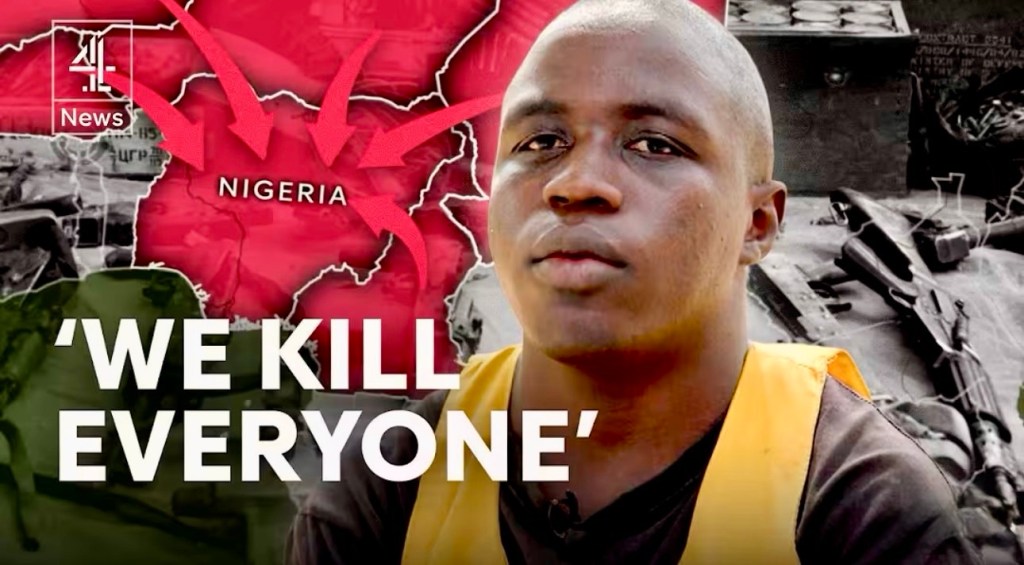
A recent report by Channel 4 News offers a rare, embedded perspective into Nigeria’s long-running war in its northeast—a conflict too often reduced to statistics, yet stubbornly resistant to simple narratives. What emerges is not just a military campaign, but a layered contest over territory, legitimacy, and ultimately, belief.
The Sahel’s Expanding Fault Line
To understand Nigeria’s predicament, one must situate it within the broader entropy of the Sahel—that vast, semi-arid belt now synonymous with insurgency creep. From Mali to Chad, jihadist groups have exploited weak borders, fragile states, and local grievances to build transnational networks.
Nigeria’s own theatre of war is anchored in the activities of Boko Haram and its more structured offshoot, the Islamic State West Africa Province. These are not ragtag militias; they are adaptive, ideologically driven insurgencies capable of both guerrilla warfare and proto-state administration. They move across borders with ease, trafficking not just arms but narratives—of grievance, of identity, and of belonging.
The Military’s Dual-Track War
On the ground, the Nigerian Army is fighting a war that is as much about intelligence as it is about firepower. The report underscores a reliance on local knowledge—villagers, defectors, and, controversially, vigilante groups. These civilian auxiliaries, often familiar with the terrain and the insurgents themselves, serve as the military’s eyes and ears in dense forest regions like Sambisa.
It is a pragmatic, if imperfect, solution. Arming civilians introduces its own risks—accountability gaps, potential abuses, and the perennial danger of today’s ally becoming tomorrow’s problem. Yet in a conflict defined by asymmetry, conventional doctrine bends.
The Arsenal of an Insurgency
One of the more striking elements of the report is the display of captured weaponry: assault rifles, belt-fed machine guns, even anti-aircraft systems. This is not the inventory of a disorganised rebellion; it is evidence of a supply chain—one that feeds off regional instability, black markets, and perhaps, uncomfortable international linkages.
More revealing, however, are the personal effects: mobile phones, narcotics, everyday items. These artefacts humanise the insurgents, stripping away the abstraction. They are not faceless actors but individuals—networked, resourced, and, crucially, replaceable.
Winning Territory vs Winning People
If military victories were sufficient, this war would have ended years ago. The Nigerian Army’s evolving doctrine recognises this, placing increasing emphasis on what is often termed the “hearts and minds” campaign.
This includes deradicalisation and reintegration programmes for captured or surrendered fighters. The messaging is deliberate: this is not a war against Islam. Indeed, many of the victims—and many of the soldiers—are Muslim. The objective is to delegitimise the insurgents’ ideological claim, to sever their appeal at the root.
But here lies the real challenge. Ideology does not yield easily to force, nor does distrust dissolve overnight. For communities that have lived under both insurgent coercion and state neglect, allegiance is often transactional.
The Human Story Beneath the Strategy
Perhaps the most compelling aspect of the report is its human lens. The story of Babaji Ibrahim, a 20-year-old former member of Boko Haram, cuts through the strategic jargon. His disillusionment is not uncommon: the promised utopia gives way to brutality, suspicion, and survivalism.
Yet his story also raises uncomfortable questions. If recruitment pipelines remain open—fuelled by poverty, lack of education, and governance deficits—then each defection is merely a temporary gain. The system that produces insurgents remains intact.
A War Without Illusions
What the Channel 4 News report ultimately reveals is a conflict in stalemate—not in the sense of inactivity, but in the absence of decisive resolution. The Nigerian military can clear territory, disrupt cells, and degrade capabilities. But the insurgency, hydra-like, adapts.
This is the paradox of modern counter-insurgency: tactical brilliance often coexists with strategic ambiguity. Nigeria is not losing the war in any conventional sense. But neither is it conclusively winning.
And until the battle for governance, opportunity, and legitimacy is fought with the same vigour as the battle for land, the northeast will remain what it has become—a proving ground not just for weapons, but for ideas.

