

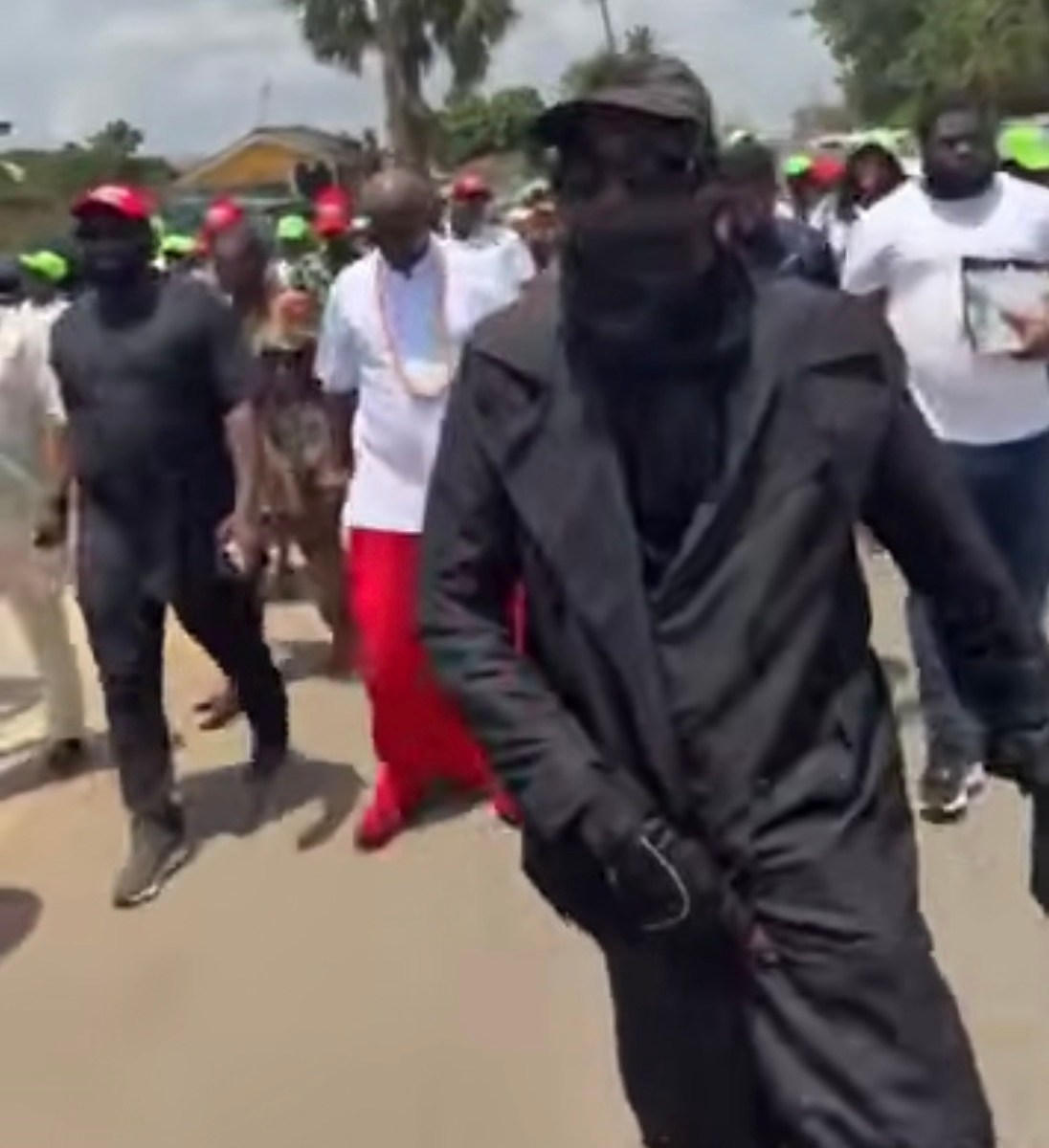
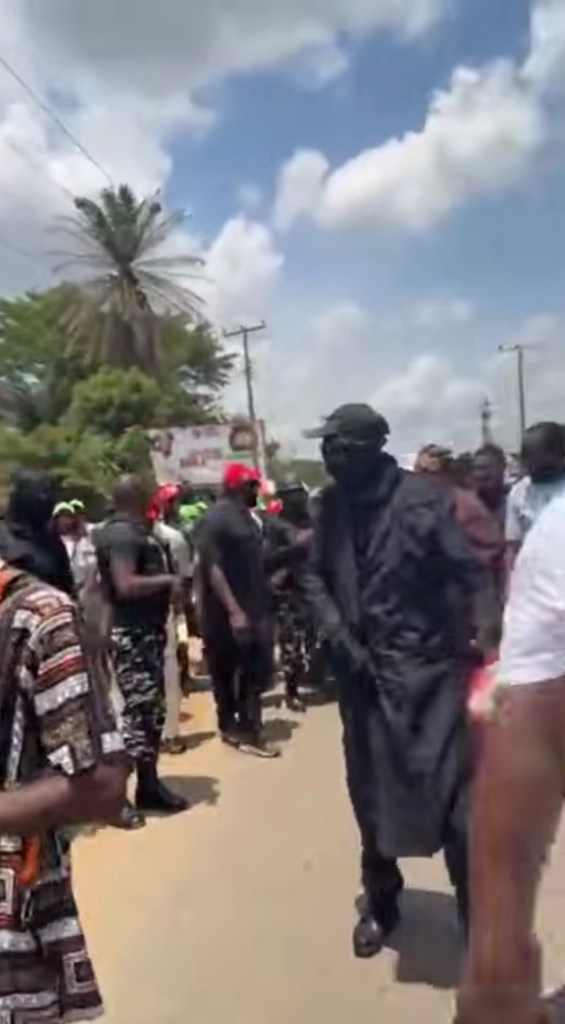
In a country where politics already carries the voltage of a live wire, it sometimes takes just one image to capture the entire mood of a moment. As part of the security entourage accompanying the Governor of Edo state, Mr Monday Okpebholo, that image arrived, uninvited, unbothered, and dressed as if Benin city had suddenly developed a winter season.
Front and centre: a security operative clad head-to-toe in black, face concealed behind a ski mask, draped in what looks suspiciously like a trench coat better suited to Moscow than Benin City. Behind him, the political machinery rolls on, supporters, party colours, and at the heart of it all, Monday Okpebholo , the state governor he was reportedly guarding.
The image went viral for obvious reasons. Nigerians are many things, resilient, politically engaged, and deeply allergic to unnecessary theatrics. So when a man appears dressed like a cross between a covert operative and a Nollywood reboot of The Matrix, questions were inevitable.
Security or Spectacle?
Let’s start with what we know, or rather, what we don’t. The man is widely believed to be part of a private security detail or possibly linked to Nigeria’s Department of State Services. But as is often the case with such matters, official confirmation is conspicuously absent. In Nigeria, silence is sometimes its own form of classification.
What remains is interpretation, and Nigeria never lacks for that.
The Logic Behind the Look
At first glance, the outfit appears absurd. Nigeria is not a country where one worries about frostbite. With temperatures regularly exceeding 30°C, the ensemble feels less tactical and more theatrical. Yet, beneath the memes lies a method to the madness.
Anonymity is the first principle. In a volatile political environment, security operatives often mask their identities—not for style points, but survival. Visibility invites vulnerability.
Then there’s the intimidation factor. The all-black aesthetic, the concealed face, it sends a message. Not subtle, not nuanced, but unmistakable: “approach at your own risk.” Whether this deters actual threats or simply unsettles bystanders is another matter.
More pragmatically, the trench coat likely serves as mobile concealment. Tactical teams routinely carry equipment, body armour, communication devices, sometimes firearms, that are better kept out of public view. A heavy outer layer provides both coverage and flexibility.
Finally, despite appearances, not all such gear is designed for cold weather. Some are engineered for breathability and durability, offering protection against dust, sun, and the general chaos of campaign trails.
Still, none of that fully answers the deeper question: was this necessary?
Nigeria Reacts: With Laughter and Suspicion
If there is one institution more powerful than Nigerian politics, it is Nigerian social media. And it delivered its verdict swiftly.
Nicknames flew. “John Wick.” “The Undertaker.” One suspects that if Batman had campaigned in Edo, he too would have been politely dragged.
But beneath the humour sat a more serious discomfort. Many observers questioned whether such an overtly aggressive security posture was appropriate for a democratic exercise. Campaigns are meant to court voters, not intimidate them.
The optics matter. In political communication, perception is often more powerful than policy. A masked operative stalking ahead of a candidate risks sending the wrong signal: not accessibility, but distance; not reassurance, but unease.
Power, Performance, and Political Messaging
What this episode ultimately reveals is not just about one man in black, but about the evolving grammar of political power in Nigeria.
Security, once discreet, is increasingly performative. Protection is no longer just operational, it is symbolic. The presence of heavily stylised security can project strength, control, and seriousness. But it can also backfire, suggesting paranoia or detachment.
In a democracy, leaders must strike a delicate balance: appearing secure without seeming inaccessible, protected without appearing insulated.
Final Thought
The “Man in Black” may never be officially identified. His employer may remain classified, his intentions inferred rather than declared. But his impact is undeniable.
In a single frame, he forced a national conversation, not about policy or manifestos, but about how power chooses to present itself.
And in Nigeria, where politics often feels like theatre, perhaps that was the most fitting role of all.

