


One of the enduring mysteries of Nigerian governance is the ease with which public money appears to materialise whenever an executive official makes an announcement.
A governor wakes up and approves N5 billion for flood victims.
A president announces N10 billion for a health emergency.
A state government declares N20 billion for security operations.
The public applauds, the media reports the announcement, and everyone moves on.
Rarely does anyone ask a simple constitutional question: where exactly is the money coming from?
In every constitutional democracy, the answer should be straightforward. Public expenditure must be authorised by law. The executive proposes spending, but the legislature authorises it. That arrangement is not a mere administrative formality; it is one of the oldest principles of constitutional government.
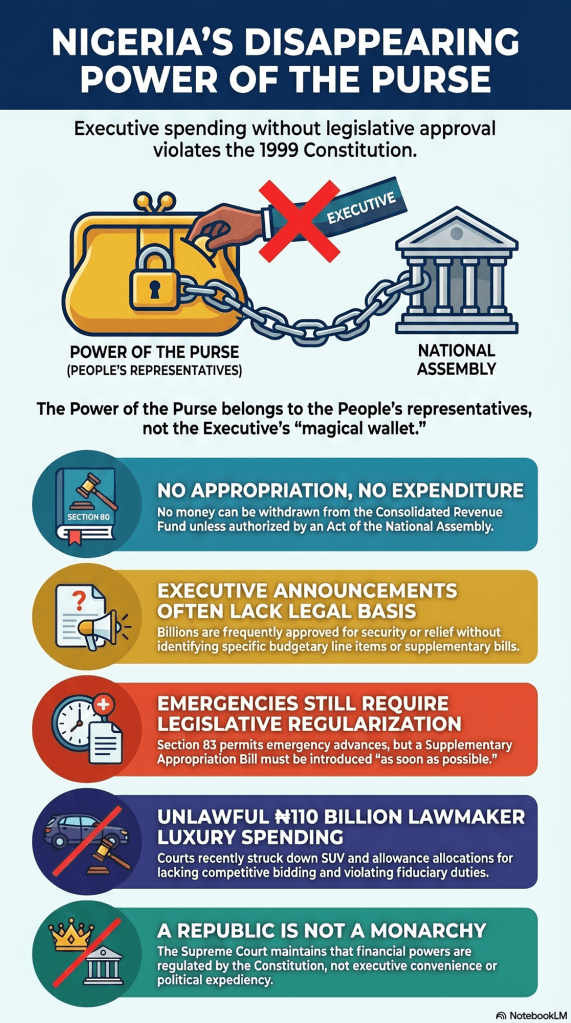
The power of taxation and expenditure, the power of the purse, belongs to the people’s representatives.
Yet in Nigeria, one often gets the impression that the executive possesses a magical wallet from which billions can be withdrawn at will.
The Constitutional Framework
The Nigerian Constitution does not establish a monarchy.
It establishes a constitutional republic in which public revenue is paid into designated funds and withdrawn only in accordance with constitutional and statutory procedures.
Section 80(2) of the Constitution is remarkably clear:
“No moneys shall be withdrawn from the Consolidated Revenue Fund of the Federation except to meet expenditure that is charged upon the fund by this Constitution or where the issue of those moneys has been authorised by an Appropriation Act, Supplementary Appropriation Act or an Act passed in pursuance of section 81.”
Section 80(4) goes further by providing that no money shall be withdrawn from the Consolidated Revenue Fund or any other public fund except in the manner prescribed by the National Assembly.
Section 81 establishes the annual budget process. The President must present estimates of revenue and expenditure to the National Assembly and the approved expenditure becomes law through an Appropriation Act. Significantly, Section 81(4) provides that where the appropriated amount is insufficient, or where expenditure arises for which no amount was appropriated, a supplementary estimate must be laid before the National Assembly and incorporated into a Supplementary Appropriation Bill.
The constitutional architecture is therefore straightforward:
No appropriation. No expenditure.
At least, that is what the Constitution appears to contemplate.
The Practical Reality
The practical reality often looks very different.
Government budgets are passed with thousands of line items. Months later, major expenditures emerge that were never publicly discussed during the appropriation process.
The public hears of billions approved for security operations, disaster relief, agricultural interventions, palliatives, infrastructure projects and emergency responses.
The announcements rarely identify:
- The precise budgetary line item from which funds will be drawn.
- Whether the expenditure was already appropriated.
- Whether a supplementary appropriation bill has been submitted.
- Whether the expenditure comes from a contingency fund.
- Whether the spending is authorised under a specific statute.
- Whether the relevant executive council approved the expenditure.
Instead, the announcement is often presented as though the executive possesses independent spending authority.
This creates the perception that public finances are governed by executive discretion rather than constitutional rules.
The Ebola Example and the Contingencies Fund
Defenders of executive spending often point to emergencies.
Fair enough.
The Constitution itself anticipates emergencies.
Section 83 authorises the establishment of a Contingencies Fund and permits the President to make advances where there is “an urgent and unforeseen need for expenditure for which no other provision exists.”
However, the Constitution does not stop there.
Section 83(2) immediately requires that:
“A Supplementary Estimate shall be presented and a Supplementary Appropriation Bill shall be introduced as soon as possible.”
In other words, even emergency spending must ultimately return to the National Assembly for approval. The contingency power is temporary. It is not a blank cheque.
The same principle applies at the state level under Section 123 of the Constitution. Governors may access state contingency funds for unforeseen emergencies, but supplementary appropriations must follow.
This raises a legitimate question whenever billions are announced for emergencies:
Was the money appropriated beforehand?
Was it drawn from a contingency fund?
Has a supplementary appropriation bill been submitted?
The Constitution requires answers.
The Missing Executive Councils
Another constitutional puzzle concerns executive decision-making itself.
Section 148 establishes the Federal Executive Council to advise the President in the discharge of his functions. Similar provisions exist at state level regarding Executive Councils.
Yet many major spending decisions emerge without any public indication that the relevant councils considered memoranda or adopted formal resolutions.
One is left wondering whether these approvals are products of institutional deliberation or personal executive discretion.
A constitutional republic should not resemble a royal court where billions are released by proclamation.
The Subsidy Removal Question
The removal of petroleum subsidies on 29 May 2023 remains perhaps the most dramatic example of unilateral executive action in recent times.
The announcement was made during the President’s inaugural address.
No ministers had yet been appointed.
No Federal Executive Council existed.
No cabinet deliberations could therefore have occurred.
Supporters argue that subsidy removal merely implemented existing budgetary and statutory realities.
Critics argue that a decision with such profound economic implications ought to have passed through established executive processes and perhaps even legislative scrutiny.
Regardless of one’s view on subsidy removal itself, the episode illustrates a broader constitutional problem: the increasing concentration of policy-making authority in the executive branch.
What Do the Courts Say?
Although Nigeria has surprisingly little case law directly challenging executive expenditure, the courts have consistently emphasised constitutional compliance in public finance.
In Attorney-General of Bendel State v Attorney-General of the Federation (1981) 10 SC 1, the Supreme Court stressed the importance of strict adherence to constitutional procedures governing public revenue and allocation. The Court treated constitutional provisions dealing with public finance as mandatory safeguards rather than administrative suggestions.
The same theme reappeared more than two decades later in Attorney-General of Abia State & 35 Ors v Attorney-General of the Federation (2002) 6 NWLR (Pt. 764) 542, popularly known as the Resource Control Case. The Supreme Court was called upon to determine disputes concerning offshore oil revenue, derivation and the allocation of Federation revenues.
Although the case is remembered primarily for its discussion of resource control, its broader constitutional significance lies elsewhere. The Court reaffirmed that revenue accruing to the Federation can only be distributed, allocated and applied in accordance with constitutional provisions. Neither political expediency nor executive convenience could override the constitutional framework governing public funds.
The judgment underscored a fundamental principle of Nigerian constitutional law: public money does not belong to the President, the Governors, the National Assembly or even the courts. Public funds belong to the Nigerian people and may only be spent in the manner prescribed by the Constitution.
The reasoning in the Abia State case raises an obvious question. If the Constitution carefully regulates how revenue enters public coffers and how it is distributed among the tiers of government, should it not be equally strict regarding how that money is subsequently spent?
One would expect the same constitutional discipline that governs revenue allocation to govern expenditure. Yet public discourse often treats the two differently. Enormous attention is devoted to how money is shared, while comparatively little scrutiny is directed at how money is spent after it has been shared.
Taken together, the decisions in Attorney-General of Bendel State v Attorney-General of the Federation and Attorney-General of Abia State v Attorney-General of the Federation establish a consistent judicial philosophy: public finance is a constitutional matter. Financial powers are not inherent powers of government. They are powers granted, limited and regulated by the Constitution itself.
Yet remarkably few litigants have directly tested whether many modern executive spending announcements satisfy those constitutional requirements.
In a more recent case of Socio-Economic Rights and Accountability Project (SERAP) v. Senate President (Godswill Akpabio) & Speaker of the House of Representatives (Tajudeen Abbas)
Justice Bogoro declared the ₦40 billion allocation for 465 high-end vehicles (SUVs) and the ₦70 billion support allowances for newly elected lawmakers unlawful based on several key legal and constitutional grounds:
- Breach of Statutory Procurement Standards: The court found that the National Assembly failed to provide any credible evidence of competitive bidding, due process, or a value-for-money assessment. Due to the massive scale of the expenditure and the total lack of transparency, the procurement was deemed “arbitrary, disproportionate, and inconsistent” with Section 57(4) of the Public Procurement Act, 2007.
- Self-Dealing and Conflict of Interest: The ruling heavily criticized the legislative leadership because the very officials approving the multi-billion naira expenditure were its direct material beneficiaries. The court held that this violated Paragraph 1, Part 1 of the Fifth Schedule to the 1999 Nigerian Constitution (Code of Conduct for Public Officers), constituting a clear case of conflict of interest.
- Violation of Fiduciary Duty and Oath of Office: Justice Bogoro ruled that public office is a public trust and must not be used for personal enrichment. By prioritizing lavish spending on themselves rather than acting within constitutional boundaries in good faith, the lawmakers breached the fiduciary duty they owe to the public, rendering the act inconsistent with their constitutional Oath of Office (Seventh Schedule).
- Failure to Prioritize National Interest Amid Hardship: Taking judicial notice of the severe economic realities, fuel subsidy removal impacts, and widespread financial hardship facing ordinary citizens, the court held that diverting ₦110 billion toward lawmaker luxury demonstrated a failure by the legislature to prioritize the broader national interest.
- Rejection of “Legislative Autonomy” as a Shield: The National Assembly defense argued that the court lacked jurisdiction due to the doctrine of separation of powers and legislative independence. The judge firmly rejected this, stating that the doctrine of separation of powers cannot operate as a shield for illegal or unconstitutional legislative spending.
- Locus Standi: The court affirmed SERAP’s right to sue, holding that NGOs have the standing to protect the public interest .
- Future Compliance: The court ordered Akpabio and Abbas to ensure all future spending adheres strictly to transparency and due process .
Why Has the Legislature Surrendered Its Power?
The more intriguing question is why legislatures appear reluctant to defend their constitutional authority.
Historically, legislatures fought wars against kings to secure control of public finance.
The English Civil War, the Bill of Rights of 1689 and centuries of parliamentary struggle established the principle that taxation and expenditure require legislative consent.
Nigeria inherited that constitutional tradition.
Sections 80 to 83 of the Constitution embody precisely the same principle.
Yet the National Assembly and State Houses of Assembly often appear content to react to expenditure after the fact rather than insist upon prior approval through supplementary appropriation mechanisms.
The consequence is predictable.
The constitutional power of the purse gradually migrates from the legislature to the executive.
Why So Few Legal Challenges?
One explanation may be standing.
Another may be politics.
Those who challenge executive spending today may wish to exercise the same powers tomorrow.
There is also the practical difficulty of obtaining sufficient information to mount a legal challenge. Government announcements often provide headlines but not the legal instruments underpinning the expenditure.
Without access to the relevant documents, litigation becomes difficult.
Yet every unchallenged departure from constitutional procedure creates a precedent for the next one.
A Constitutional Republic or an Elected Monarchy?
Nigeria’s Constitution does not create an elected king.
Section 80 places public funds under legislative control.
Section 81 requires appropriations.
Section 81(4) requires supplementary appropriations where new expenditure arises.
Section 83 permits emergency advances but requires prompt legislative regularisation.
The constitutional scheme is therefore clear.
The executive may propose.
The executive may administer.
The executive may even respond to emergencies.
But the legislature authorises spending.
When billions are repeatedly announced without public reference to appropriations, supplementary budgets, contingency funds or executive council approvals, citizens are entitled to ask questions.
Not because government should be paralysed.
Not because emergencies should wait.
But because constitutional government depends upon transparency, accountability and adherence to legal process.
The most dangerous constitutional erosion rarely occurs through tanks on the streets.
It occurs when constitutional shortcuts become routine and nobody asks where the money came from.
When that happens, the legislature’s power of the purse becomes a ceremonial relic.
And a republic begins to look suspiciously like an elected monarchy.
The irony is striking. Nigerian governments frequently invoke the Abia State Resource Control decision whenever disputes arise over the allocation of public revenue. Yet the same constitutional vigilance is rarely applied to the expenditure side of the equation. The Constitution is not merely concerned with how money enters government accounts; it is equally concerned with how it leaves them.


One Reply to “”