


There is a persistent Nigerian belief that whenever government owns something, every Nigerian automatically becomes a director, auditor, procurement officer and forensic accountant of that thing.
This belief is currently being tested by the lawsuit filed by SERAP seeking to compel the Nigerian National Petroleum Company Limited (NNPCL) to account for approximately ₦5.9 billion reportedly spent on its incorporation, transition and rebranding from NNPC to NNPCL.
The demand sounds reasonable. Nigerians want to know who approved the expenditure, who received the money, what services were rendered and whether value was obtained.
The difficulty is that reasonable questions do not always have reasonable legal answers.
The real issue is not whether transparency is desirable. The real issue is whether NNPCL is legally obliged to answer those questions to members of the public.
The Dog that Chased the Car
For decades Nigerians complained that NNPC was a government bureaucracy.
It was inefficient.
It was opaque.
It was over-politicised.
It was treated like a ministry with oil wells.
Then came the Petroleum Industry Act (PIA).
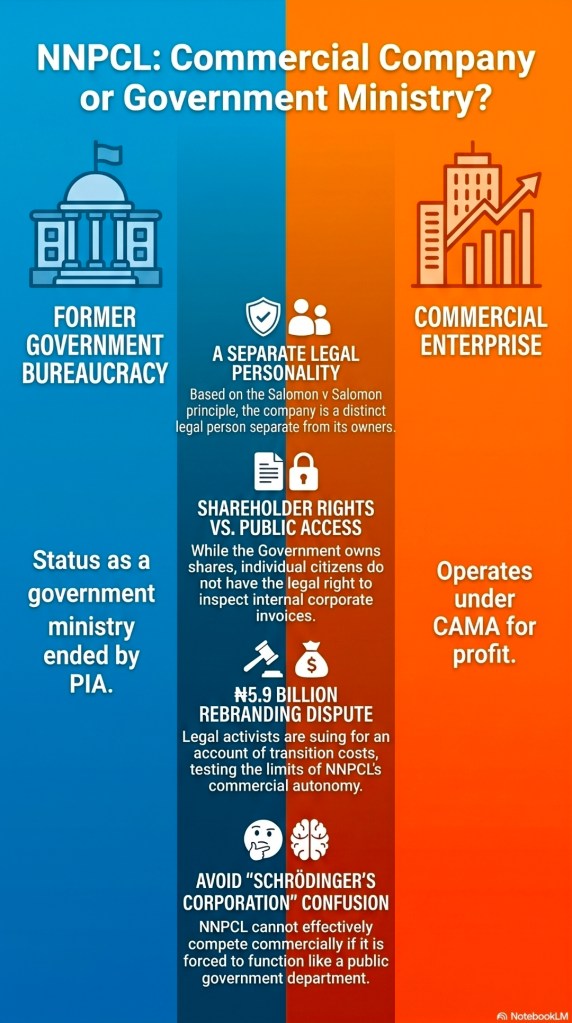
The solution was to transform NNPC into NNPCL, a company incorporated under the Companies and Allied Matters Act (CAMA), intended to operate as a commercial enterprise rather than a government department.
In simple language, the dog finally caught the car.
Now the question is whether Nigerians actually wanted the car after all.
The entire purpose of incorporation was to create a commercial entity with a separate legal personality from the government. Yet many of the same people who applauded the reform now argue that NNPCL should continue to be treated exactly like the old NNPC.
One begins to suspect that in Nigeria reform means changing everything so that nothing changes.
Who Owns the Company?
The Federal Government owns NNPCL through shareholding arrangements established by the PIA.
But company law has always distinguished between ownership of shares and ownership of corporate assets.
A shareholder does not own the company’s property.
A shareholder owns shares.
The distinction is important.
If I buy shares in a bank, I do not acquire the right to inspect every invoice, every contract and every internal expenditure of that bank.
Likewise, if the Federal Government owns shares in NNPCL, that does not automatically grant 230 million Nigerians the right to exercise shareholder powers.
The constitutional chain is straightforward:
Citizens elect government.
Government owns shares.
The company answers to its shareholders.
What many activists are proposing is something entirely different:
Citizens directly supervise the company.
That is not how company law ordinarily works.
The British Example
The problem is not unique to Nigeria.
Britain privatised numerous public utilities.
Telecommunications, railways, water and gas services all moved into corporate structures.
Many continued to perform functions that were essential to everyday life.
Yet British courts generally refused to treat them as government departments merely because they provided services used by millions of citizens.
The distinction became clear.
A company may perform a public service without becoming a public authority.
A company may supply water to an entire nation without becoming the Ministry of Water.
A company may operate railways without becoming the Department of Transport.
And a company may produce oil without becoming a ministry.
This distinction is one of the foundations of modern company law.
The Ghost of Salomon
The great principle established in the landmark case of Salomon v A Salomon & Co Ltd in 1897 remains alive and well.
A corporation is a separate legal person.
That principle has survived world wars, economic depressions and several generations of Nigerian politicians.
It may even survive social media.
If government ownership alone converted a company into a government agency, every state-owned enterprise would lose its separate corporate identity.
The entire rationale behind incorporation would collapse.
One might as well save legal fees and simply call the company a ministry.
SERAP’s Constitutional Argument
SERAP relies heavily on constitutional provisions relating to transparency, accountability and the management of public resources.
The argument has moral force.
The legal position is less straightforward.
The Constitution undoubtedly expects public institutions to act transparently.
The difficulty is determining whether NNPCL remains a public institution for these purposes after being transformed into a company under CAMA.
That question is not answered simply by asserting that oil belongs to Nigerians.
The issue is whether Parliament deliberately chose the corporate form and, having made that choice, whether the courts should ignore it.
Courts are generally reluctant to do so.
The Danger of Having It Both Ways
The strongest argument against SERAP’s position is practical.
The PIA was designed to commercialise NNPCL.
Commercial companies compete, negotiate contracts, raise finance and make business decisions.
If NNPCL is treated exactly like a government ministry whenever transparency is demanded, then much of the commercial autonomy promised by the PIA becomes an illusion.
One cannot simultaneously insist that NNPCL should operate like a private sector company and then demand that it function like a public agency whenever controversy arises.
That is like insisting that a football club should compete in the Premier League while demanding that its transfer negotiations be conducted at a town hall meeting.
The Real Accountability Question
None of this means NNPCL should operate in secrecy.
The question is who has the legal right to demand explanations.
The shareholder?
Certainly.
The board?
Of course.
Auditors?
Absolutely.
Regulators?
Without doubt.
The National Assembly?
Subject to the limits imposed by law.
But can every member of the public demand detailed corporate records simply because the Federal Government owns the shares?
That is the question before the courts.
And it is a far more difficult question than many commentators realise.
Conclusion
The debate surrounding NNPCL exposes a deeper Nigerian confusion.
We wanted a commercial company.
We passed a law creating a commercial company.
We incorporated a commercial company.
Then we immediately began demanding that the commercial company behave like the government agency we abolished.
The courts will eventually decide where the balance lies.
But one thing is certain.
If NNPCL is a company, then it must be treated as a company.
If it is a government department, then it should be called a government department.
What it cannot be is Schrödinger’s Corporation simultaneously a private company when profits are discussed and a government ministry whenever someone wants to inspect the books.

