

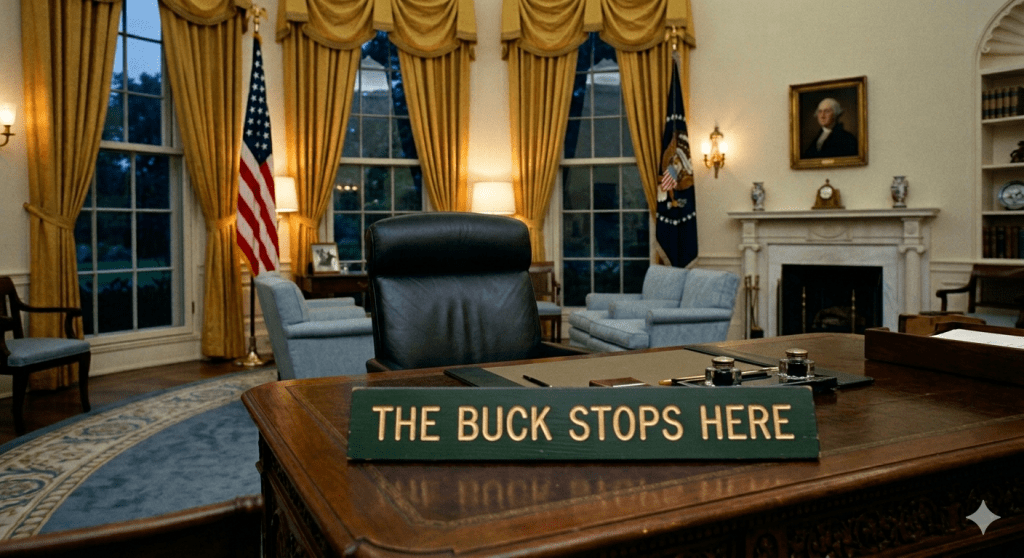
When Harry S. Truman placed that famous sign on his desk proclaiming “The buck stops here,” it was meant as a declaration of accountability. Truman understood the terrifying weight of executive power. The phrase did not mean the president personally knew everything. It meant that after experts argued, generals briefed, diplomats negotiated, economists calculated and civil servants exhausted themselves producing options, the president alone bore responsibility for the final decision.
Under Donald Trump, the phrase appears to have mutated into something far more dangerous: the buck starts here, ends here, and apparently no one else is allowed near it.
Trump has mistaken presidential accountability for presidential omniscience.
America’s national security architecture was not designed around one man’s instincts after midnight cable television and a social media binge. The entire structure exists precisely because no individual, however gifted, can possibly master military strategy, intelligence analysis, regional diplomacy, economic consequences, logistics, energy markets, nuclear doctrine and alliance management simultaneously.
The system was intentionally built as a chain. Intelligence agencies gather information. Diplomats assess political consequences. Military planners produce operational options. Civil servants evaluate risks. Allies are consulted. Congress is briefed. Arguments occur behind closed doors. Often ugly arguments. Then the president chooses.
That process is not weakness. It is the safety mechanism.
Trump has instead treated expertise like an inconvenience and consultation like a personal insult. The result is a presidency increasingly resembling a one-man WhatsApp group where every member agrees with him because every dissenting voice has either been fired, humiliated or transformed into a televised court jester applauding each new impulse as strategic genius.
The frightening part is not merely the impulsiveness. Democracies have survived impulsive leaders before. The frightening part is the collapse of restraint around the impulsiveness.
There appears to be nobody left willing to say: “Mr President, this is absurd.”
And so America lurches from declaration to declaration like a casino gambler convinced the next hand will reverse all previous disasters.
Trump marched toward conflict without meaningful consultation with allies and then seemed genuinely shocked that allies might object to being dragooned into enforcing policies they neither shaped nor supported. He demanded the opening of the Strait of Hormuz as though international geopolitics were a hotel concierge service where regional powers simply nod and reply, “Certainly sir, right away sir.”
Unfortunately for Washington, the Middle East is populated not by casino employees but sovereign states with their own interests, fears and domestic pressures. Regional allies were reportedly unwilling to have their territories casually transformed into launchpads for escalation merely because Trump had announced another muscular slogan at a podium.
This is the recurring flaw of the “only I can fix it” doctrine. It assumes reality itself will rearrange to accommodate personal willpower.
Reality rarely cooperates.
One suspects Trump still approaches diplomacy the way he approached Trump Entertainment Resorts: maximal bravado, theatrical leverage, endless declarations about “holding all the cards,” followed eventually by bankruptcy proceedings while somebody else cleans up the debris.
The irony is painful. The same man who bankrupted casinos, businesses mathematically designed to make money, now lectures nuclear powers and military alliances about strategic leverage. His supporters repeat every slogan with cultic enthusiasm, insisting adversaries are terrified because Trump supposedly possesses mysterious “cards” invisible to everyone else.
The Iranians supposedly hold no cards. Europe holds no cards. NATO holds no cards. Congress holds no cards. The Pentagon apparently exists merely to salute and nod.
Everyone else is bluffing.
Only Donald knows the game.
But governing is not poker. National security is not baccarat. Foreign policy is not a property licensing deal in Atlantic City.
The danger to America is not simply that Trump makes bad decisions. Presidents throughout history have made catastrophic mistakes. The deeper danger is that he has systematically weakened the mechanisms designed to prevent bad decisions from becoming national disasters.
A functioning republic depends upon friction. Upon argument. Upon institutional resistance. Upon experienced officials able to tell powerful men uncomfortable truths.
Instead America increasingly operates like an imperial court where ministers compete not to provide accurate analysis but to anticipate the emperor’s mood. Every statement must be praised as brilliant. Every contradiction reframed as strategy. Every reckless escalation described as strength.
Even the language has become detached from seriousness. Policies are discussed like wrestling promos. Diplomacy sounds like casino banter. War is marketed as branding.
Meanwhile the world watches nervously as the most heavily armed nation in human history appears to be governed by instinct, ego and applause metrics.
Truman’s sign represented humility before responsibility.
Trump’s interpretation appears closer to this: if the buck stops here, then nobody else is allowed to touch it, question it or even explain how currency works.
And that may be the most dangerous misunderstanding of presidential power in modern American history.

