


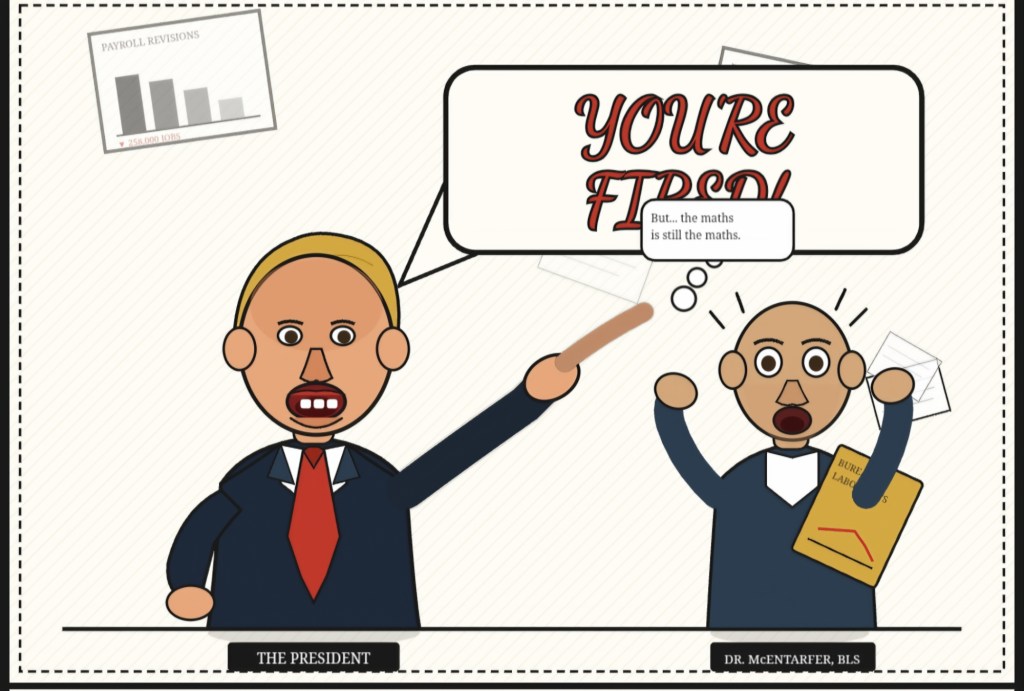
On Trump’s firing of Erika McEntarfer, and the peculiar belief that sacking a statistician changes arithmetic
There is a particular breed of authoritarian impulse, not the jackbooted kind, which at least has the virtue of being honest about its intentions, but the softer, more petulant variety, which believes that reality is a subordinate. That if the numbers displease you, the solution is not to interrogate what the numbers are saying, but to fire the person who said them.
On August 1, 2025, President Donald Trump demonstrated precisely this variety. On the same Friday that the Bureau of Labor Statistics released its July jobs report, Trump fired its Commissioner, Dr. Erika McEntarfer, posting on Truth Social that the numbers were “rigged in order to make the Republicans, and ME, look bad.” Economic Policy Institute The economy had added just 73,000 jobs in July, with monthly totals for May and June revised downward by a combined 258,000 jobs. CNN Trump’s diagnosis: fraud. The cure: dismissal. The result: a self-inflicted wound to the credibility of the world’s most important economic statistical apparatus.
There is, of course, a foundational problem with this theory. The BLS commissioner has no role in producing employment estimates and does not see them until shortly before their scheduled release. American Statistical Association McEntarfer did not conjure the numbers from a partisan imagination. She oversaw an agency of career civil servants who have been doing the same job, by the same method, for the better part of a century and a half. But inconvenient truths rarely survive contact with a leader who regards inconvenience as treachery.
Mark Twain, or Benjamin Disraeli, depending on which apocryphal source you prefer, is credited with observing that there are three kinds of falsehoods: lies, damned lies, and statistics. The remark has long served as a cynical shorthand for the manipulability of numbers. Trump appears to have taken it not as a warning but as a manifesto. If statistics can lie, the logic goes, then a loyal statistician should be willing to lie better. The firing was in response to large revisions to payroll job estimates, which the administration claimed were deliberately produced to embarrass the president. American Statistical Association That no evidence supported this claim, and that such revisions are a routine feature, indeed, a methodological virtue, of economic data, was beside the point. The accusation was the point.
What the president apparently did not consider, or considered and dismissed, is that economic credibility is not a renewable resource. It is not like a press secretary you can replace, or a Cabinet member whose loyalty you can buy. McEntarfer is the only BLS commissioner to be fired, explicitly for overseeing job numbers that did not support the president’s message. Urban Institute One hundred and fifty years of institutional independence, ended in a Truth Social post. The BLS has survived wars, recessions, depressions and the full carnival of American political dysfunction. What it had not previously been required to survive was a president who confused the messenger with the message.
The consequences are not abstract. BLS price data is used by the Federal Reserve to help set interest rates, influencing borrowing costs for both businesses and homeowners. Urban Institute The Fed does not respond warmly to the suggestion that the data underpinning its monetary policy decisions may now be subject to political vetting. An independent central bank cannot conduct monetary policy on numbers that carry the fingerprints of the executive. When the data supply chain is contaminated at source, the downstream effects are not merely academic, they are priced into bond markets, Treasury yields, and the borrowing costs of ordinary Americans who have never heard of the BLS and would strongly prefer to keep it that way.
McEntarfer herself, speaking at the Levy Economics Institute at Bard College, her alma mater, in what must have been the most surreal homecoming of her career, reached for a metaphor of commendable clarity. “Messing with economic data is like messing with the traffic lights and turning the sensors off. Cars don’t know where to go, traffic backs up at intersections.” The Hill She also pointed, with some precision, to the cautionary tale already written by others. Countries including Argentina, Greece and Turkey politicised their economic statistics, and the resulting loss of trust led to worsening economic crises, higher inflation and higher borrowing costs. The Hill These are not hypotheticals. These are countries that tried to govern by preferred arithmetic and discovered that mathematics, unlike people, cannot be fired.
The BLS’s monthly jobs report, particularly its non-farm payrolls figure, is widely regarded as the “gold standard” of economic indicators and a key input into Federal Reserve policy decisions, the pricing of Treasury Inflation Protected Securities, and countless investment strategies. evrimagaci “Gold standard” is not an idle phrase. It denotes trust accumulated over decades of rigorous, apolitical methodology. It is, in the world of sovereign economic data, the thing that separates the United States from banana republics, or used to. One strategist at TD Securities put it with the directness that markets favour over diplomatic evasion: there is “a broader worry in investors’ minds that the US may be becoming less investable.” evrimagaci
The broader tragedy, if tragedy is not too elevated a word for what is, at its core, a very small man’s tantrum at a very large institution, is that Trump did not change a single number. The 73,000 jobs figure stands. The 258,000 downward revision stands. The slowdown it describes stands. Mathematics, unlike civil servants, does not serve at the pleasure of the president. You cannot executive-order your way to a stronger labour market. You can only, if you try very hard, ensure that the agency measuring it is no longer trusted to tell you the truth, which leaves you governing by faith rather than facts, and markets pricing in the difference.
There is a passage in the old satirist’s handbook, unwritten but universally understood, which notes that power, when it feels most threatened, attacks the instruments of measurement rather than the underlying conditions. The thermometer is not the fever. The scale is not the weight. And the Bureau of Labor Statistics, with its 2,000 career statisticians and its century-and-a-half of institutional memory, is not responsible for the state of the American economy. It merely reports it. Accurately. Consistently. Without fear or favour, or so it did, until August 1, 2025, when the president decided that an agency doing its job was indistinguishable from an enemy doing him harm.
Dr. McEntarfer, for her part, found out she had been fired not through any official channel, but when a journalist rang for comment on a Truth Social post she had not yet seen. She checked her inbox and found a message from the White House informing her she was “terminated effective immediately.” The Hill Twenty minutes’ notice. A four-year Senate-confirmed term, ended by a social media post and a form letter. One assumes the White House considered this adequate.
It is a peculiar empire that fires its cartographers because it dislikes the shape of the territory. The map, unfortunately, remains the map. The numbers remain the numbers. And the credibility, once spent, does not refund.

