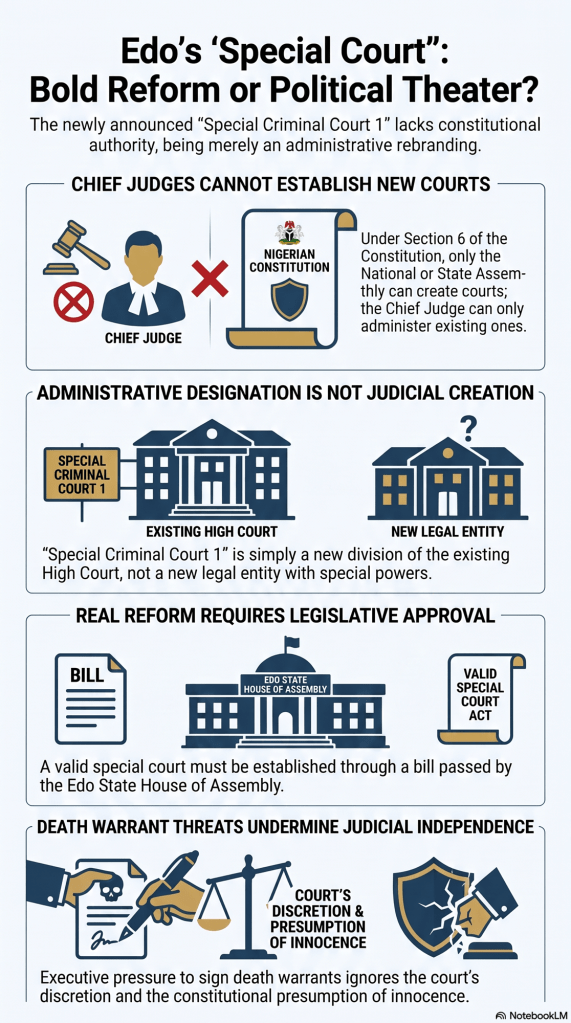

The recent move by Edo State Governor Monday Okpebholo and Chief Judge Justice Daniel Okungbowa to establish a “Special Criminal Court 1” for cultism and kidnapping cases has generated significant buzz . The Governor’s declaration that he would sign death warrants for convicted kidnappers, coupled with the Chief Judge’s administrative action, has been framed as a bold security intervention .
But is it? Or is this much ado about nothing, a gesture that fundamentally misunderstands the constitutional limits of judicial power?
What Actually Happened
On June 18, 2026, Governor Okpebholo announced plans for a special court to fast-track prosecution of cultism and kidnapping cases . The following day, he formally requested the Chief Judge to constitute such a court. On June 25, Justice Okungbowa responded by approving the creation of “Special Criminal Court 1,” set to begin operations July 1, 2026, in Benin City .
On its face, this appears decisive. But a closer look reveals a significant constitutional disconnect.
The Chief Judge Cannot “Establish” Courts
Here is the fundamental issue: Chief Judges do not have the constitutional power to establish courts. They can only administer existing ones.
Section 6 of the Nigerian Constitution vests judicial power in courts established by the Constitution or by law made by the National Assembly or State House of Assembly . The Edo State High Court already exists by constitutional mandate. What the Chief Judge actually did was create an additional division of that existing High Court—an administrative designation, not a judicial creation .
This distinction is crucial because it reveals the limits of what has actually been achieved.
The Governor Cannot Bypass Legislative Process
The Governor’s request was essentially an executive wish directed at the judiciary. But the judiciary operates independently, and its structure is constitutionally determined. The Chief Judge’s power under Section 274 of the Constitution is to make rules for regulating “practice and procedure”—and this power is explicitly “subject to the provisions of any law made by the House of Assembly of a State” .
In other words, the Chief Judge cannot unilaterally redesign criminal procedure. He cannot abrogate evidentiary rules. He cannot bypass the constitutional protections that define our criminal justice system.
The Governor’s “Death Warrant” Threat
Perhaps most troubling is the Governor’s statement that he would “sign the death warrant of any person convicted of kidnapping” . This plays well politically, but it misunderstands the constitutional reality:
- Death sentences are not automatic, they are at the discretion of the court after considering all circumstances.
- The Governor’s role is ministerial, he only signs warrants when all legal processes, including appeals, are exhausted.
- The threat undermines judicial independence, a Governor cannot pre-judge cases or pressure courts to convict .
Arrests Are Not Convictions
There is an unsettling subtext to this entire exercise. The Governor announced this special court during the parade of suspected kidnappers and cultists . This creates the impression that these suspects are already guilty, that the only missing piece is a court to rubber-stamp their convictions.
But our Constitution presumes innocence until proven guilty. Suspects have the right to fair hearing, legal representation, and the full protection of evidentiary rules. Any attempt to shortcut these processes whether through administrative fiat or political pressure, is unconstitutional .
You Cannot Correct Lawlessness with Lawlessness
This is the heart of the matter. The Governor is right that cultism and kidnapping are serious problems requiring urgent attention. He is right that delays in the justice system can undermine deterrence . And he is right that the state needs a more efficient criminal justice system.
But you cannot correct lawlessness with lawlessness.
If the Edo State Government genuinely wants to create a new court structure with expedited procedures, the proper path is legislative action, a bill passed by the Edo State House of Assembly creating a new court, defining its jurisdiction, and outlining its procedures, all within the framework of the Constitution and the Evidence Act .
What we have instead is smoke and mirrors: an administrative designation dressed up as a bold new initiative, and a Governor making threats that sound tough but have no constitutional basis.
What Would A Real Special Court Look Like?
A properly constituted special court would require:
- Legislative approval through the Edo State House of Assembly.
- Clear jurisdictional limits that do not violate constitutional rights.
- Compliance with the Evidence Act 2011, which governs all criminal proceedings .
- Proper constitutional safeguards for fair hearing, legal representation, and appeal rights.
Without these, “Special Criminal Court 1” is merely a rebranding exercise, an existing court with an impressive-sounding name, but no new powers, no expedited procedures, and no constitutional basis for doing anything the High Court could not already do.
The Bottom Line
The Governor and Chief Judge have engaged in political theater, not constitutional reform. They have created the appearance of action while avoiding the hard work of legislative change. And in the process, they have risked creating an impression that due process, fair hearing, and the rules of evidence are obstacles to justice, rather than its foundation.
Justice delayed is indeed justice denied. But justice short-circuited is not justice at all, it is something far more dangerous.
The Edo State Government should go back to the drawing board. If it wants special courts, it should go through the proper constitutional channels. If it wants expedited procedures, it should work with the judiciary to reform practices within constitutional bounds. And it should abandon the dangerous rhetoric of automatic convictions and guaranteed death sentences.
Because in a constitutional democracy, the rule of law applies to everyone, including those who seek to enforce it.