


The Sister Defence
In March 2023, a Lagos transport union chairman named Musiliu Akinsanya, better known as MC Oluomo, stood before a hall full of party faithful and delivered what history will remember as one of the more instructive freestyle performances in Nigerian electoral rhetoric. Addressing supporters ahead of the governorship poll, he singled out “Iya Chukwudi,” a stock name for the Igbo mother of the household, and told her plainly to sit down at home if she wasn’t voting APC. Not once. Repeatedly, for emphasis, in case Iya Chukwudi’s hearing was as poor as the security agencies’ subsequent memory.
What followed was a masterclass in Nigerian institutional choreography. The clip went viral. Ohanaeze Ndigbo condemned it. Journalists were roughed up at polling units. Igbo voters in Eti-Osa, Ojo, and Amuwo-Odofin were beaten and chased from the polls, precisely as advertised. The police, moved to action by the sheer volume of public outrage, invited Oluomo in for what can only be described as a restorative chat over tea. He emerged with an apology so threadbare it barely qualified as performance art: Iya Chukwudi, it turned out, was his actual sister, and he had never meant to threaten anyone, merely to greet his sibling on regional television during a live political rally. No charges. No prosecution. The file, along with several Igbo shopkeepers’ burnt-out stalls, was quietly closed.
This is the part of the story Nigerians know by heart, because we lived it. What deserves more attention is the part that came after: nothing. No law was tested. No precedent was set that electoral intimidation carries consequences. The matter wasn’t resolved, it was filed under Colourful Nigerian Politics and left to compost.
The Sequel Nobody Asked For, Except Everybody Who Wrote Act One
Fast forward to September 2026. Governor Francis Nwifuru of Ebonyi State, addressing the newly sworn-in chairmen of his state’s thirteen local government areas, delivers a directive with the crisp menace of a performance review: your continued occupation of that chair depends on delivering your council to the APC in 2027. Not a subtle suggestion. A transfer of pressure, downward, onto men who now understand their tenure is contingent not on governance but on electoral output.
One day later, Eze Paul Ituma, freshly installed as chairman of Ohaukwu LGA, translates the governor’s incentive structure into the vernacular of the street corner. Opposition parties and their supporters, he announces, should stay out of Ohaukwu unless they’re prepared to submit and be embraced. Anyone who tries otherwise “will be declared persona non grata.” He does not, mercifully, invoke Iya Chukwudi by name. But he does reach for a market metaphor with the unmistakable cadence of a threat: he has no shop to distract him, politics is his business, and nobody should come near Ohaukwu wanting to put sand in his garri.
Note the structure. The governor didn’t say the quiet part; he simply built the incentive that guarantees someone beneath him will. This is not a chorus of Oluomo copycats reciting the same script in unison, as the framing sometimes suggests; it’s something more efficient than that. It’s a delivery mechanism. The governor sets the terms, the local chairman does the shouting, and by the time anyone reaches for a microphone to ask what “persona non grata” means for a Nigerian citizen inside their own local government area, the deniability has already been pre-loaded. He was speaking politically. He didn’t mean it literally. He has a sister named Chukwudi somewhere, presumably.
A Brief, Unwelcome History Lesson
Rwanda did not begin with machetes. It began, as these things generally do, with language: radio broadcasts, casual dehumanisation, officials who found it useful to describe political opponents and ethnic others as pests, cockroaches, people who did not belong in a particular place. It began with a slow normalisation of speech that treated one’s neighbours as conditionally welcome, contingent on political compliance. The machetes came later, once enough people had been told often enough that violence against the designated outsider wasn’t really violence, just correction.
I raise this not because Nigeria in 2026 is Rwanda in 1994; it manifestly is not, and any columnist reaching for that equivalence wholesale is selling alarm, not analysis. I raise it because the mechanism, not the outcome, is the useful comparison. The mechanism is this: a political class discovers that threatening a rival’s supporters is cost-free, tests the boundary once, faces a manufactured apology and no legal consequence, and files the result away as a viable tool. The tool then gets reissued, refined, and handed down the chain of command, from party chieftain in Lagos to state governor to local council chairman, each iteration slightly more procedural, slightly more official-sounding, slightly less deniable as a joke. “Persona non grata” has the added menace of borrowed legal Latin: it sounds like law, dressed up for a council chairman with no jurisdiction to expel anyone from anywhere, and that veneer of officialdom is precisely what should worry a nation that has watched local strongmen turn suggestion into enforcement before.
Samson’s Miscalculation
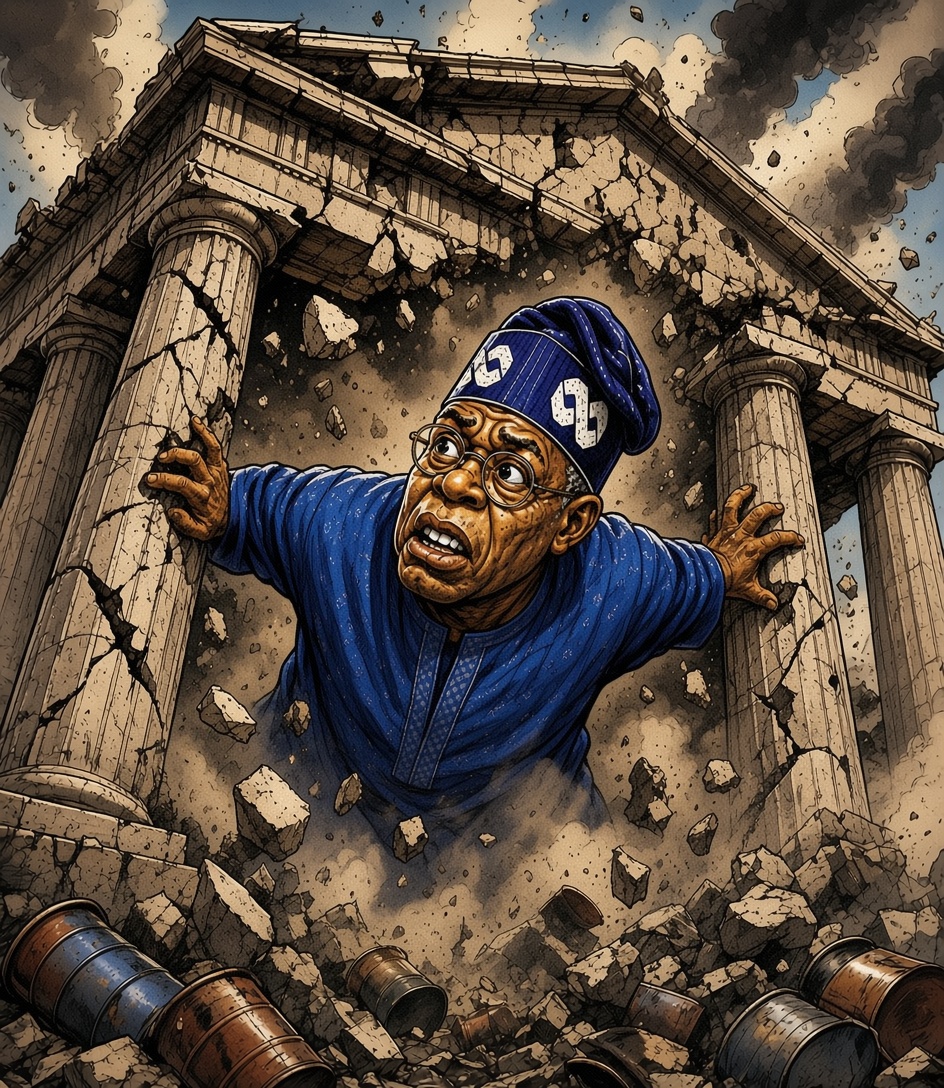
The biblical reference in the original complaint is worth taking seriously rather than as ornament. Samson pulled the temple down on the Philistines and, notably, on himself, having failed to notice that the building he was standing in and the one he intended to destroy were the same structure. Nigeria’s federal architecture works on a comparable principle: a Lagos threatened into silence today, an Ebonyi threatened tomorrow, becomes a precedent available to any successor government, of any party, against any constituency, including whichever one currently cheers loudest from the terraces of incumbency. The tool does not check party registration before it is used.
Tinubu’s supporters, and by extension Tinubu’s government, would do well to remember that the load-bearing walls of a federation are the same walls whether Yoruba, Igbo, or Ebonyi voters are standing under them. A precedent that says non-APC voters may be threatened out of participation with impunity is not a Lagos precedent or an Ebonyi precedent. It is a Nigerian one, and it will not politely restrict itself to inconveniencing the opposition. History, and Judges 16, are reasonably clear on how that story ends for the man holding the pillars.

