


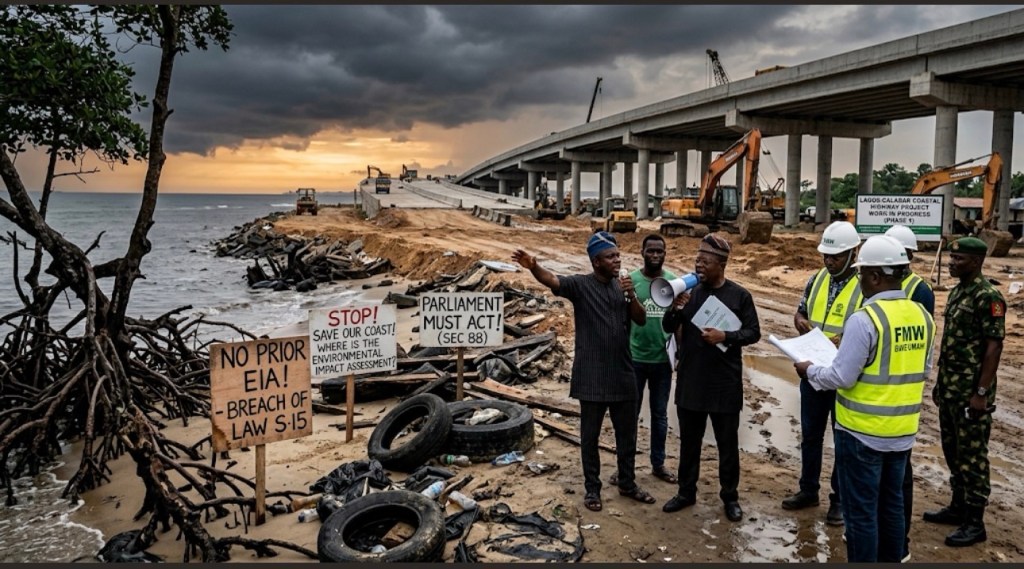
For centuries, Lagos has lived in a delicate, high-stakes relationship with water. Built on a sprawling network of lagoons, creeks, and barrier islands, the city exists at the absolute mercy of the Atlantic Ocean. But as unseasonal flooding continues to submerge communities, a burning question has surfaced over Nigeria’s most ambitious infrastructure project: Is the 700-kilometer Lagos–Calabar Coastal Highway paving the way for economic transformation, or is it simply washing away the rule of law?
The controversy isn’t just about the massive ecological disruption; it’s about a fundamental failure of governance. When Arise News reporter Laila Salami cornered the Minister of Works, Dave Umahi, asking if a final Environmental Impact Assessment (EIA) had been approved before the bulldozers roared to life, the response was a masterclass in bureaucratic evasion.
We were told “everything is in order” and that the government was “following due process.” Yet, the elusive EIA certificate was never produced. In Nigeria, public officials often treat a legitimate demand for public documents as an act of personal disrespect. But environmental approvals don’t belong to ministers; they belong to the public who will inevitably bear the brunt of any ecological fallout.
The Smoking Gun: What the BPP Revealed
While the Ministry of Works prefers to treat due process as a state of mind rather than a verifiable reality, another arm of government has already exposed the truth.
A procurement review document issued by the Bureau of Public Procurement (BPP) pulled back the curtain on the project’s frantic preparation. The BPP’s findings were devastating, noting that the Ministry had failed to forward engineering designs, tender author details, financial studies, or feasibility reports. Most indicting of all, the Bureau explicitly stated:
“No Environmental Impact Assessment (EIA) reports were forwarded along with this request. The FMW should note that EIA is part of project preparation.”
An EIA is not a bureaucratic hurdle to be cleared retroactively or bypassed with a wave of a hand. It is a vital risk-management tool. For a mega-project cutting through fragile wetlands, marine ecosystems, and gazetted reserves like Stubbs Creek in Akwa Ibom, failing to conduct a prior EIA is a dangerous gamble with nature.
The Illusion of “Exemptions”
Could the Executive branch argue that a project of this magnitude is legally exempt from prior scrutiny? Under Section 15(1) of the Environmental Impact Assessment Act, a project can only bypass a prior assessment under three exceptionally narrow, statutory exceptions:
- Minimal Environmental Impact: The project must be on an approved list deemed to have negligible or non-existent environmental effects.
- National Emergencies: The project must be an immediate response to a national crisis or disaster where temporary government measures are already active.
- Immediate Public Health and Safety: The project must be vital to preventing an imminent catastrophe or public health hazard.
The Lagos–Calabar Coastal Highway fails every single one of these tests. It is legally classified as a Mandatory Study Activity (Category 1), meaning it is structurally impossible to deem it a “minimal impact” initiative. It is a long-term developmental asset, not an emergency intervention for a natural disaster or a disease outbreak. Therefore, commencing site clearance without a fully completed and approved EIA is a flagrant breach of the law.Enter the Legislature: Can Parliament Pull the Reins?
When the Executive acts as both the developer (via the Ministry of Works) and the regulator (via the Ministry of Environment), a blatant conflict of interest emerges. Who watches the watchdog when the watchdog is building a highway?
This is precisely where the legislature’s constitutional oversight must kick in. Under Sections 88 and 89 of the 1999 Constitution of Nigeria, Parliament possesses absolute jurisdiction to pull up the Executive for breaching the EIA Act through three powerful constitutional levers:
- The Power to Investigate: The Senate and House Committees on Environment and Works have the structural mandate to summon both ministers, demand the immediate production of EIA draft reports, and question the legality of the project’s timeline.
- The Power of the Purse: Parliament holds the ultimate weapon. Under Section 88, no public funds can be drawn from the Consolidated Revenue Fund without legislative appropriation. If the Executive refuses to comply with environmental laws, Parliament has the authority to choke off capital allocations for the project in the next budget cycle.
- Quasi-Judicial Summons: Under Section 89, lawmakers can issue warrants to compel the attendance of any official or contractor, putting them under oath to explain why heavy machinery was deployed before scientific assessments were finalized.
The Cost of Guesswork
Lagos is not a city that can afford environmental guesswork. With rising sea levels, land subsidence, and rapid urbanization, every square meter of coastal development requires the highest level of scientific scrutiny.
When governments actually follow due process, they don’t ask citizens to rely on blind trust or performative assurances. They simply produce the documents. Until the missing EIA is laid bare for public inspection, the Lagos–Calabar Coastal Highway remains a monument to executive impatience—proving that in the rush to build the future, our leaders are completely undermining the legal foundations of the present.

