


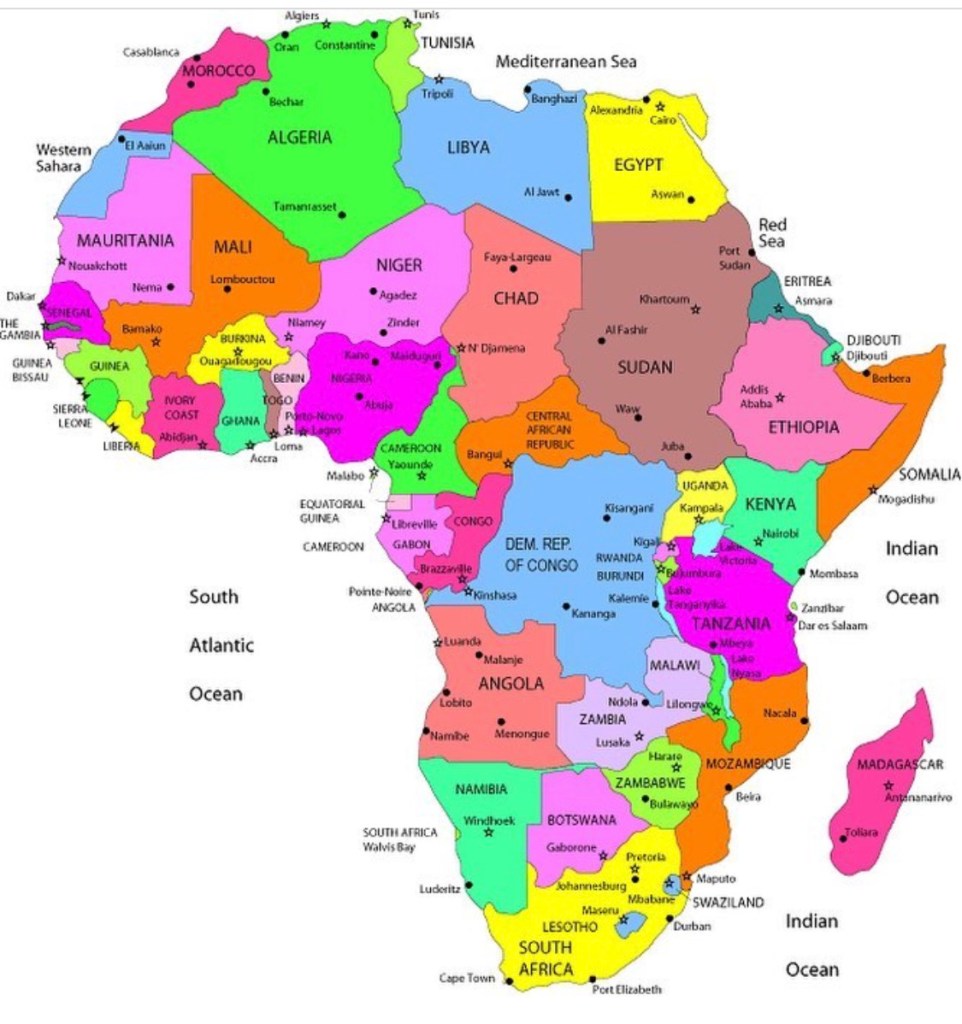
In his memoir The Lion Awakes, Ashish Thakkar recounts how, as a young entrepreneur flogging computer parts across Africa in the 1990s, he noticed that flights within the continent took suspiciously longer than the maps suggested. Were the planes slower? No. The Mercator projection had been quietly shrinking Africa for centuries, the cartographic equivalent of a colonial tailor insisting the continent could still fit into last season’s suit. China, India, the United States, Mexico and western Europe can all fit inside Africa’s borders with room left over for a decent argument about who left the light on.
That distortion never stayed on the map. Western journalists and academics have long specialised in reducing a continent of more than 1.4 billion people, 54 countries and over 2,000 languages into a single, digestible morality play. First came “the hopeless continent” (The Economist, 2000). Then, with the solemnity of a convert discovering avocado toast, “Africa rising” (same magazine, 2011). Both versions were elegant. Both were mostly wrong. The real place has always been messier, more contradictory, and far less interested in performing for external audiences.
Three books from that earlier decade tried to correct the caricature: Morten Jerven’s forensic demolition of the data, Thakkar’s entrepreneurial travelogue, and Jake Bright and Aubrey Hruby’s more cautious business brief. Taken together they offered a useful corrective. Africa was neither a charity case nor a seamless success story. It was energetic, inventive, and frequently exasperating. Yet even these accounts, valuable as they remain, still left the central question unanswered: how much are ordinary lives actually improving?
The Devil Remains in the Data (and the Devil Has Tenure)
Jerven’s central charge still holds. Economists spent decades asking why Africa failed instead of examining how it had actually performed. Growth after independence was often robust. The long stagnation of the 1970s–1990s had identifiable causes external shocks, policy disasters, debt. Recovery returned later. The data, however, remained a comedy of errors. Informal economies were largely invisible. Missing figures were filled by optimistic extrapolation from the neighbour. Corruption indices relied on the opinions of people who had never queued for anything more taxing than a conference coffee.
The result was policy advice built on foundations that would not pass a local government building inspection. Guinea could rank among the poorest or the relatively prosperous depending on which dataset one preferred. Mozambique performed the same statistical magic trick. Garbage in, policy papers out.
Nigeria’s 2014 GDP rebasing nearly doubling the official size of the economy overnight was the comic high point. The country did not suddenly become twice as rich; the statisticians had simply stopped using numbers from the era of VHS. Other countries followed. The “Africa rising” narrative received a statistical sugar rush while poverty, inequality and vulnerability remained stubbornly real. GDP still tells us very little about the informal sector that keeps most people alive, or about resilience when the next shock arrives.
The deeper problem persists. Correlation is still routinely sold as causation. Weak institutions are blamed for poverty; poverty may just as easily explain weak institutions. History, ethnicity, climate and geography are wheeled out as permanent alibis. The search for the single silver bullet continues, even as the continent politely declines to be reduced to one.
The Start-Up Continent, With the Occasional Power Cut
Thakkar’s account remains the more human corrective. His family’s expulsion from Uganda under Idi Amin, the return to a Rwanda in the midst of genocide, and the teenage computer-parts business that grew into the Mara Group form a classic African immigrant story of trauma, hustle and eventual scale. By the early 2000s the airports were slightly less chaotic, the potholes occasionally filled, and the customs officers occasionally smiled. Mobile phones arrived like a second independence. Technology hubs appeared. Nollywood industrialised entertainment. Diaspora talent began returning after the 2008 financial crisis made London and New York look less like permanent destinies.
Thakkar’s conclusion is brisk: business, not aid, is the answer. China, he notes, managed without the Western aid industry. The observation is only half true China received plenty of assistance but the broader point lands. Institutionalised aid has often been as distorting as the narratives it claimed to correct. Judging it project by project, country by country, remains the only serious method. Caricature helps no one.
Bright and Hruby offered a more measured version of the same optimism. Better (if still imperfect) governance, a demographic explosion, rapid urbanisation and a growing consumer class created real markets. M-Pesa turned phones into banks. BRCK and Jumia showed that African innovation could solve African problems and, occasionally, export the solutions. Yet they also catalogued the stubborn “less than 3 percent” problem: a continent with roughly 18 percent of the world’s population still accounting for a fraction of global trade, private equity, broadband and digital attention. Infrastructure gaps remain brutal. Electricity, roads, water and formal banking still lag. Youth unemployment is a political time bomb. Elite capture of growth continues. An external shock can still rearrange the furniture overnight.
The Real Africa Refuses to Sit Still for the Portrait
The intervening years have not simplified the picture. The Africa Continental Free Trade Area exists on paper and struggles in practice. Chinese financing has cooled. Commodity cycles continue their familiar cruelty. Debt distress has returned in several countries. At the same time, fintech, creative industries, renewable energy experiments and a restless young population keep generating possibilities that refuse to wait for perfect institutions.
Any aggregate portrait of “Africa” remains a statistical convenience that obscures more than it reveals. The average experience in Accra has little in common with the average experience in Khartoum. A Lagos billionaire and a malnourished farmer in the Sahel inhabit different planets that happen to share a continent. City-level data, when it finally improves, will be more useful than continental averages. Continental challenges energy, infrastructure, climate, pandemic risk, security still require cooperation that acknowledges difference rather than pretending it away.
No region’s fate is entirely self-determined. High commodity prices and Chinese demand once inflated expectations; their retreat deflated them. Diaspora remittances and skills matter. African innovations in mobile money and creative industries travel outward. The relationship is reciprocal, whether the old narrative admits it or not.
The deeper correction is conceptual. GDP and the usual Western yardsticks remain imperfect proxies at best and distractions at worst. Peace, health, the ability to plan beyond the next harvest or the next blackout, the distribution of opportunity, the resilience of communities these are harder to measure and more important. A truer accounting would start from lived experience rather than from models designed elsewhere, and would listen to entrepreneurs and labourers, farmers and urban traders, the young and the old, those who stayed and those who returned.
What emerges is not one Africa, rising or hopeless, but many Africas simultaneously dynamic and fragile, inventive and constrained, open for business and still waiting for the lights to stay on. The maps are still wrong. The data are still incomplete. The stories told from afar remain too tidy. The continent itself continues, as usual, to decline the invitation to be simple.

