


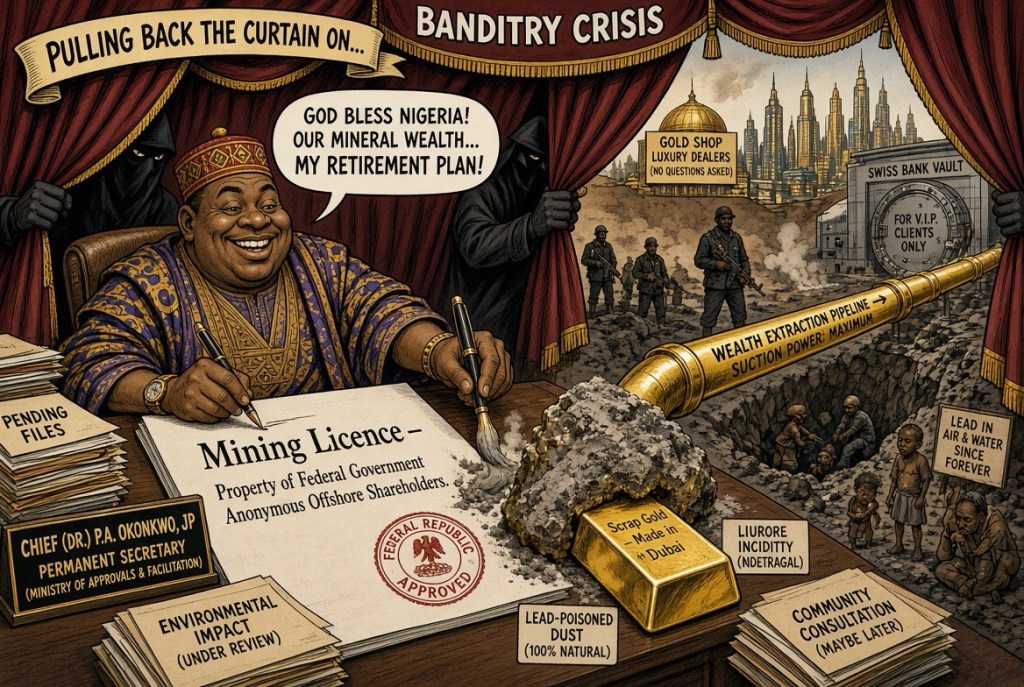
In 2010, while the rest of us were busy arguing about football or the latest political soap opera, over 400 children under five in Zamfara quietly died of lead poisoning. Not from some exotic virus. Not from famine. From the dust of the very gold that was supposed to lift their communities out of poverty. Mothers buried babies before they could finish naming them. Villages turned into mass graves. Médecins Sans Frontières later called it one of the worst mass child poisonings in modern history. The soil, the water, the air, all laced with lead from crude artisanal processing of gold-bearing rock right next to family compounds.
And the gold? It did not vanish into thin air like a politician’s campaign promise. It left. Quietly. Efficiently. Profitably.
This is the part the nightly news prefers to skip while it hyperventilates about “banditry.” Because “banditry” is a wonderfully useful word. It conjures images of wild men in the bush with rusty AK-47s and zero long-term planning. It lets everyone treat the violence as a pure security problem, more troops, more airstrikes, more solemn statements, while the underlying machinery keeps humming. The real story is less cinematic and far more Nigerian: a resource that was never truly stolen by force, but signed away, licensed away, and papered over until the communities standing on top of it owned nothing but graves and toxic dust.
The Paper Trick
Under Nigerian law, every mineral under the ground belongs to the Federal Government. Not the state. Not the village. Not the family whose children are crawling through the poisoned soil. A single licence from Abuja can hand the rights to people who have never set foot in Zamfara. Meanwhile, eight out of ten mines in the northwest operate illegally, no licence, no tax, no record. A parallel industry running in broad daylight, protected by silence and the occasional phone call from powerful godfathers.
The gold itself undergoes a miraculous transformation. Melting in a rough shed. Passing through local buyers and middlemen. Then, on paper, it becomes “scrap gold,” old jewellery, a modest gift, nothing worth inspecting too closely. That bureaucratic magic trick allows it to fly. Destination number one: Dubai. Hand luggage, private jets, false bottoms, creative paperwork. A city with dozens of refineries and thousands of dealers has perfected the art of looking the other way. Once melted and restamped, Zamfara’s blood-tinged dust becomes respectable “Dubai gold.” From there, much of it continues to Switzerland, where the last country of processing conveniently becomes the official origin. The children’s graves disappear in the paperwork.
Hundreds of tonnes of African gold leave the continent unrecorded every year. Billions of dollars. Nigeria’s share helps finance the very guns that keep the mining pits under armed control. Gold buys weapons. Weapons protect the gold. The cycle is elegant in its brutality.
The Costume Department
Enter the word “banditry.” It is not entirely false. Armed groups do control sites, impose levies, force locals to dig, and use the proceeds for arms and expansion. Figures like the late Halilu Sububu and his successors turned mining into a more reliable revenue stream than ransom or cattle rustling. But the label does useful work. It frames the crisis as chaotic criminality rather than a structured conflict over a highly lucrative, poorly regulated resource. It invites ethnic and religious explanations. It keeps the conversation focused on the men with guns in the bush instead of the men with licences, offshore structures, and quiet political protection.
When the federal government banned mining in Zamfara in 2019 citing the “nexus” between illegal miners and armed groups, the result was predictable. Legitimate operators withdrew. Armed groups filled the vacuum more thoroughly. Violence surged. The ban treated a symptom while leaving the ownership and licensing architecture untouched.
Local elites, traditional authorities, security elements, and foreign interests have all been implicated in various investigations as facilitators or beneficiaries. The gold does not survive on the muscle of the gangs alone. It survives on the silence of those who find the current arrangement convenient. The communities that dig and die remain poor. The value is extracted, rebranded, and realised far from the poisoned villages.
Signed Away, Not Stolen
The investigation’s sharpest point is this: the gold was never primarily “stolen” in the dramatic sense of a highway robbery. It was processed through a machine of legal loopholes, opaque licensing, paper reclassification, and institutional indifference. The children of Dareta and Yargalma paid the first price in blood and neurological damage. The rest of Zamfara continues to pay in insecurity, displacement, and the permanent conversion of a potential blessing into a curse.
Global markets receive clean bars. Dubai and Swiss refineries process the metal. Offshore shareholders remain anonymous. And back home, the news cycle returns to “bandit attacks” as if the guns appeared from nowhere and the gold was an afterthought.
Next time the headlines scream about banditry in the northwest, remember the costume. Look past the men with the guns. Follow the dust that killed the children. It leads, eventually, to very clean, very shiny gold behind glass in faraway cities, and to a system that has mastered the art of making extraction look like misfortune.
The villages remain poor. The paperwork remains tidy. And the gold, as always, finds its way.

