

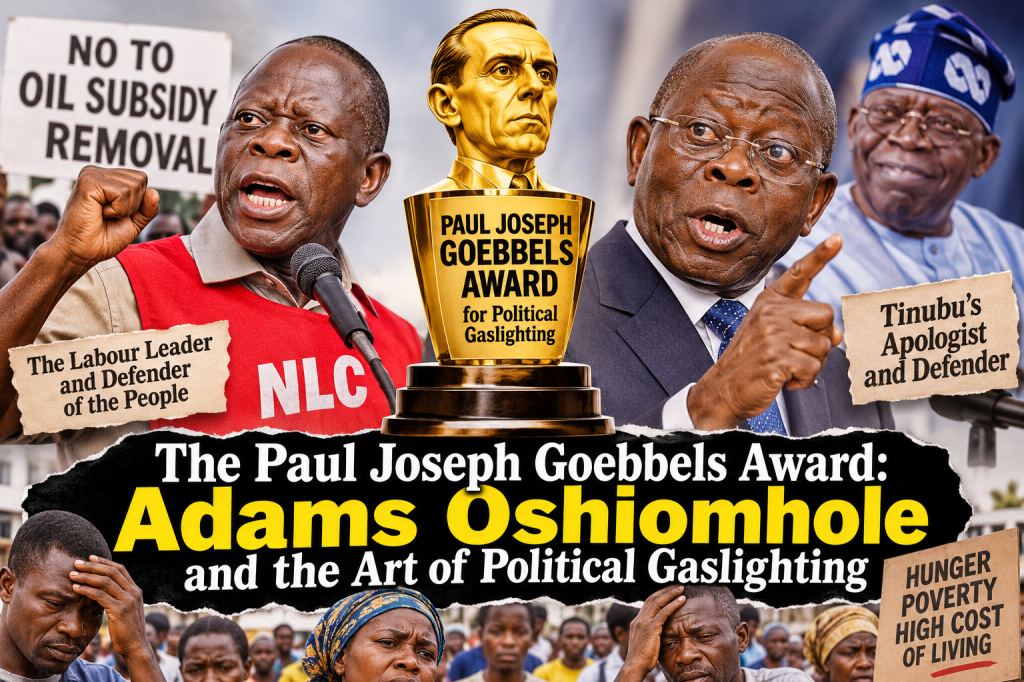
There is stiff competition for the Paul Joseph Goebbels Award for Propaganda, on behalf of the Tinubu administration. The competition is particularly interesting because the contenders are not necessarily people who have always lacked principles. Some once enjoyed considerable public standing, built reputations on political convictions and presented themselves as defenders of the Nigerian people. Today, however, they appear to have discovered a new political philosophy: whatever Tinubu says, whatever Tinubu does, and whatever the consequences for Nigerians, the mandate must be defended.
Their collective assignment is to gaslight the Nigerian people. They must explain away economic misery, dress up policy failures as courageous reforms, turn hardship into evidence of progress and persuade a suffering population that what it sees, feels and experiences is somehow different from reality.
It is a crowded field. But one contender is displaying such extraordinary enthusiasm that the judges may have to consider awarding him the prize without waiting for the closing ceremony. Senator Adams Oshiomhole.
Oshiomhole is an interesting political character. He is eloquent, theatrical, combative and thoroughly at home with the sound of his own voice. He has a remarkable ability to dominate a conversation, whether or not he has anything particularly illuminating to contribute. His confidence is rarely constrained by the inconvenience of self-examination.
His political journey makes the present spectacle even more remarkable.
He emerged from humble beginnings as a tailor and rose through the labour movement to become President of the Nigeria Labour Congress. He was not simply another trade union official. He became a recognisable national voice for working Nigerians, the ordinary people whose labour sustains the economy but whose interests are frequently ignored by those who govern it.
His strength was his ability to articulate the frustrations of the ordinary Nigerian. He challenged governments, confronted economic policies and fought against the removal of the petroleum subsidy. He understood, or at least appeared to understand, that the consequences of economic policy cannot be measured exclusively by government revenue figures. They must also be measured by what happens to the people who have to pay for those policies.
That was the Oshiomhole Nigerians came to know.
Then came political office.
He became Governor of Edo State, and somewhere between the labour movement and the Government House, the transformation began. The man who had spent years challenging the powerful appeared increasingly comfortable exercising power himself.
The transition was not without its memorable episodes. His infamous response to a widowed market woman who pleaded against the destruction of her means of livelihood, telling her to go and die, remains an enduring illustration of the distance between the language of political solidarity and the conduct of political authority.
The defender of the poor had become rather less sympathetic when the poor stood in the way of government action.
His political relationships also became casualties of his expanding political ambitions. Former associates and allies, including Ize-Iyamu and Captain Hosa Okunbo, became embroiled in the familiar cycle of political falling-outs and recriminations. The details of each relationship may differ, but the broader impression is of a politician whose friendships and loyalties have often proved vulnerable to the changing arithmetic of power.
He subsequently became National Chairman of the All Progressives Congress. That position, too, proved short-lived. His disagreements, political manoeuvring and personalised approach to political relationships eventually followed him from Edo State to the national stage. He was removed from the chairmanship, a reminder that the political machinery he helped operate could also turn against him.
He returned to elective politics and secured a seat in the Senate.
And now we have the present incarnation: Senator Oshiomhole, defender of the Tinubu administration and one of its most energetic interpreters.
There is something particularly striking about his present performance. The former labour leader who opposed petroleum subsidy removal now enthusiastically defends its removal under President Tinubu. The former champion of ordinary Nigerians now appears remarkably comfortable explaining why those same Nigerians must endure the consequences of policies that have pushed millions deeper into economic insecurity.
The policy has become acceptable, apparently, because the political address has changed.
This is the essence of political gaslighting. It is not merely defending a government. It is attempting to persuade people that their lived experience is an unreliable account of reality. When Nigerians complain about the cost of food, transport, electricity and basic necessities, they are invited to consider the grand economic narrative. When they speak of hunger and destitution, they are told about reforms. When they ask about the benefits, they are offered promises about a future that seems perpetually under construction.
Oshiomhole’s contribution is particularly remarkable because he knows better. He has occupied both sides of the political argument. He knows what it means to organise workers, mobilise protests and confront a government over the cost of living. He knows that economic policies have human consequences. His former position was not an academic abstraction. It was the foundation of his political identity.
Yet today, the same man appears to have discovered that the removal of subsidy is an entirely different proposition when undertaken by a government he supports.
His public interventions also reveal a curious absence of political self-awareness. He is quick to accuse others, quick to expose perceived inconsistencies and quick to pronounce moral judgments. Yet the same standards are not always applied to his own political journey.
There are persistent public controversies and allegations surrounding the scale of his wealth, his country home, projects associated with his community, his lifestyle and reports of private-jet travel for leisure. There has also been public commentary about an extravagant personal lifestyle, including an episode involving a South African socialite and a foot massage that attracted considerable ridicule.
These matters deserve proper scrutiny rather than automatic assumptions of wrongdoing. But a politician who readily throws stones at others should not be surprised when the public examines the windows of his own political mansion.
His personal life has also attracted public attention, including his marriage to a much younger foreign woman. There is nothing inherently improper about an adult choosing whom to marry. The point, however, is the apparent eagerness with which he sometimes assumes the position of moral examiner of other people’s lives while showing little appetite for equivalent scrutiny of his own conduct.
The problem with Oshiomhole is not that he speaks. It is that his political eloquence appears to have become detached from any consistent set of principles.
He is a gifted communicator. He can be entertaining, persuasive and occasionally devastating in debate. But eloquence without intellectual honesty is merely an instrument of persuasion. It can be used to illuminate the truth, or to obscure it. In his present political role, one increasingly wonders which purpose it serves.
The Tinubu administration has assembled an impressive collection of political defenders. Some have abandoned positions they once defended with considerable passion. Others have discovered that principles are flexible when political survival, appointments, influence and access to power are involved.
But Oshiomhole presents a particularly interesting case because his former public identity was built on challenging precisely the sort of political and economic arrangements he now appears eager to defend.
The man who once stood before Nigerians as the voice of the oppressed now stands before them explaining why their oppression, or at least their economic suffering, is a necessary price of progress.
There is a fundamental difference between defending a government and defending the indefensible. A politician is entitled to support a president, defend policies and argue against criticism. But that support should not require the abandonment of intellectual consistency or the denial of obvious social realities.
The Goebbels comparison is, of course, a satirical indictment of propaganda, not an assertion that contemporary Nigerian politicians are equivalent to the Nazi regime. The lesson of propaganda is that repetition, confidence and theatrical certainty can be deployed to manufacture an alternative political reality. The more extravagant the claim, the more insistently it may be repeated.
And this is where the competition for the award becomes interesting.
The Tinubu administration needs defenders who can turn every difficulty into a success story, every contradiction into political wisdom and every failure into an opportunity to blame the previous government. It needs people who can stand before Nigerians and insist that the economic disaster they experience is actually a reform dividend.
Senator Adams Oshiomhole appears to have embraced this assignment with extraordinary enthusiasm.
But perhaps the most important question is not whether he deserves the award. It is what happened to the man who once led Nigerian workers in the streets against the removal of petroleum subsidy.
Did he change his mind because the evidence changed? Did he discover some economic truth that had escaped him during his years in the labour movement? Or did the simple experience of political power alter the principles by which he once judged government?
History has a way of preserving these contradictions.
Oshiomhole should remember that political office is temporary, party loyalty is conditional and the applause of power is rarely a reliable measure of public esteem.
The White House does not create you; it reveals who you are. The same is true of Government House, the National Assembly and every other seat of political authority.
Perhaps the most revealing thing about Adams Oshiomhole is not what he says today, but how far he has travelled from what he once stood for.
The tailor became a labour leader. The labour leader became a governor. The governor became a party chairman. The party chairman became a senator.
And somewhere along that journey, the champion of the ordinary Nigerian appears to have become one of the most enthusiastic defenders of the political establishment.
The Goebbels Award committee may have a difficult decision to make. But Senator Oshiomhole has certainly made a compelling case for himself.
The former voice of the Nigerian worker is now competing to become the voice of the government’s propaganda machine. What a journey!

