

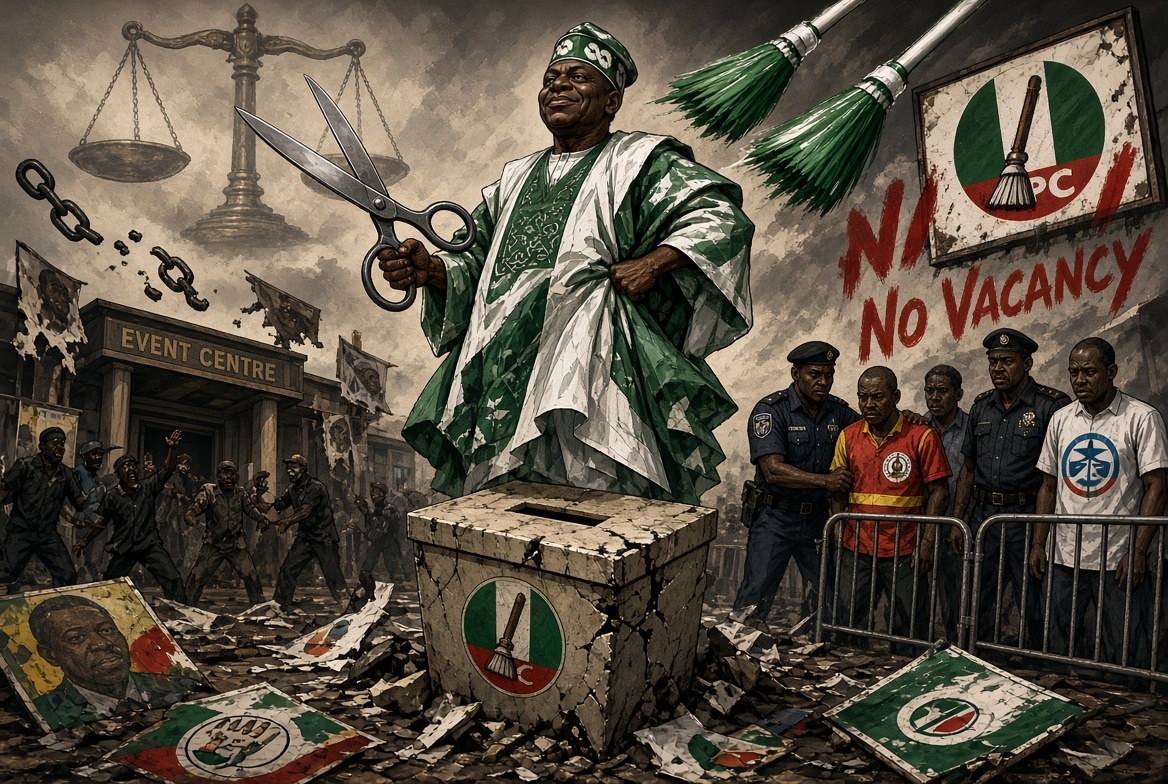

In the grand carnival of Nigerian governance, President Bola Ahmed Tinubu’s era has achieved something almost admirable in its consistency. The country has not merely suffered the usual infections of corruption and insecurity; it has thoughtfully integrated them into the operating system. What we are witnessing is less a failure of statecraft and more a successful hostile takeover—one in which illicit networks no longer lurk at the margins but sit comfortably in the boardroom, reviewing the minutes and approving the budget.
This is not the old story of a few bad apples. This is the orchard itself being managed by the pests.
Institutional Infiltration: The Art of Making the System Work for You
Rent-seekers in Tinubu’s Nigeria do not waste time with crude bribery alone. They have upgraded to a more elegant suite of tools: blackmail, strategic placement of allies, and the quiet understanding that certain institutions exist primarily to be managed rather than to manage. Police, judiciary, military, and political leadership become less guardians of the republic and more service providers for those who can pay the retainer.
The result is a peculiar form of efficiency. Operations that should be disrupted somehow find protection. Investigations that should accelerate mysteriously stall. High-profile cases develop the legal equivalent of chronic fatigue syndrome. One begins to suspect that the rule of law has been outsourced, and the successful bidder is not particularly interested in transparency.
Capturing the Guns and the Policy Pens
When the state’s coercive instruments—security forces and policy machinery—are effectively captured or subverted, the distinction between regulation and protection collapses. Routes for narcotics production, refining, and transit do not merely survive; they enjoy a form of unofficial licensing. The state’s monopoly on violence is not abolished; it is franchised.
Banditry and kidnapping cease to be purely criminal enterprises and begin to resemble alternative taxation systems. The official tax authority struggles to collect; the unofficial one rarely does. In some regions the parallel authority appears better resourced, better informed, and considerably more punctual in its demands. The citizen is left navigating two overlapping sovereignties, one of which at least has the decency to send clear invoices.
Economic Dependency: When the Illicit Economy Becomes the Real One
An economy that becomes heavily reliant on illicit revenues develops a strange allergy to legitimate commerce. Legitimate businesses face the usual obstacles—power, logistics, multiple taxation—while the parallel economy glides past with remarkable ease. Capital that should flow into productive enterprise is diverted into the more reliable returns of protection, extraction, and violence.
The national accounts begin to look increasingly fictional. Official GDP figures politely ignore the thriving shadow sector that actually keeps certain regions liquid. Crowding out is no longer a theoretical concept; it is visible in the empty factories and the thriving bush paths. One is left wondering whether the formal economy is still the main act or merely the opening act for the real show happening backstage.
The Rule of Law as Performance Art
Public safety collapses not with a bang but with a series of carefully targeted silences. High-profile violence, assassinations of officials or journalists, and the routine turf wars of bandits do not provoke institutional outrage so much as institutional fatigue. Legal authority weakens not because the law is absent, but because it is selectively present—energetic against the powerless, contemplative against the powerful.
The judiciary and security agencies perform their roles with the weary professionalism of actors who know the audience has already guessed the ending. Justice becomes a theatrical production in which the script is rewritten nightly according to the preferences of the most influential patrons. The citizen is invited to applaud the process while carefully avoiding the substance.
Porous Borders and the Architecture of Impunity
Weak border controls, underfunded police, and sparse institutional oversight are not bugs in the system; they are features that certain operators have learned to exploit with entrepreneurial flair. Bandits and kidnappers operate with an impunity that would be enviable if it were not so lethal. Geography and administrative neglect combine to create zones where the state’s writ runs only when convenient—or when the right intermediaries have been consulted.
These vulnerabilities are not accidental. They are maintained because they serve interests that have successfully embedded themselves within the formal structures of power. The result is a country that is simultaneously over-governed in the cities and under-governed in the spaces where the real extraction happens.
When the State Itself Becomes a Stakeholder
In the most advanced form of the phenomenon, elements of the regime or state apparatus move beyond complicity into direct management or protection of illicit activities. Banditry and kidnapping cease to be external threats and become, in certain circles, revenue streams that can fund political operations, secure loyalty, or simply enrich those positioned to collect. The line between the state and the underworld does not blur; it is deliberately erased and then redrawn to the advantage of those holding the pen.
This is the point at which satire struggles to keep up with reality. When the institutions charged with suppressing crime begin to regard certain forms of crime as strategic assets, the language of reform becomes almost comic. One does not reform a system that has already optimised itself for a different purpose.
The Larger Farce
Tinubu’s Nigeria did not invent these dynamics. It has, however, refined them with a certain managerial competence. The networks of rent-seeking, violence, and political protection that once operated as parasites have been invited inside and given desk space. The state still issues press releases about security and economic reform. The parallel state issues invoices and occasionally bodies.
The tragedy is not that Nigerians fail to notice. Most notice perfectly well. The tragedy is that noticing has become a spectator sport rather than a catalyst for institutional resistance. In a system where the core functions of government have been infiltrated to this degree, the usual tools of democratic accountability—elections, media scrutiny, judicial review—begin to feel like polite suggestions rather than binding constraints.
One is left with a final, bitter irony. A country that once prided itself on its capacity for resilience is discovering that resilience can be co-opted. The same ingenuity that once produced thriving informal markets and community self-help is now being applied, with equal creativity, to the business of state capture by other means.
The underworld did not storm the gates. It was given the keys, a budget line, and a polite request to keep the noise down during official functions. In Tinubu’s Nigeria, the political and economic entity has not been hijacked. It has simply been restructured—efficiently, profitably, and with remarkably little resistance from the formal owners of the brand.

