
There is a sacred rule among British estate agents, handed down from generation to generation like some holy grail of property snobbery: if you’re thinking of buying a house in a town, city or even a vaguely promising village, always check for a Costa Coffee on the high street. No Costa? Walk away. The place is clearly unfinished, unloved, and economically still in the Dark Ages. A Costa is not just a coffee shop. It is a signal. Civilisation has arrived. The middle classes can breathe. The area is safe for your equity.
This principle scales beautifully. Apply it to entire countries and the coffee shop becomes Uber. Or rather, the presence or absence of Uber.
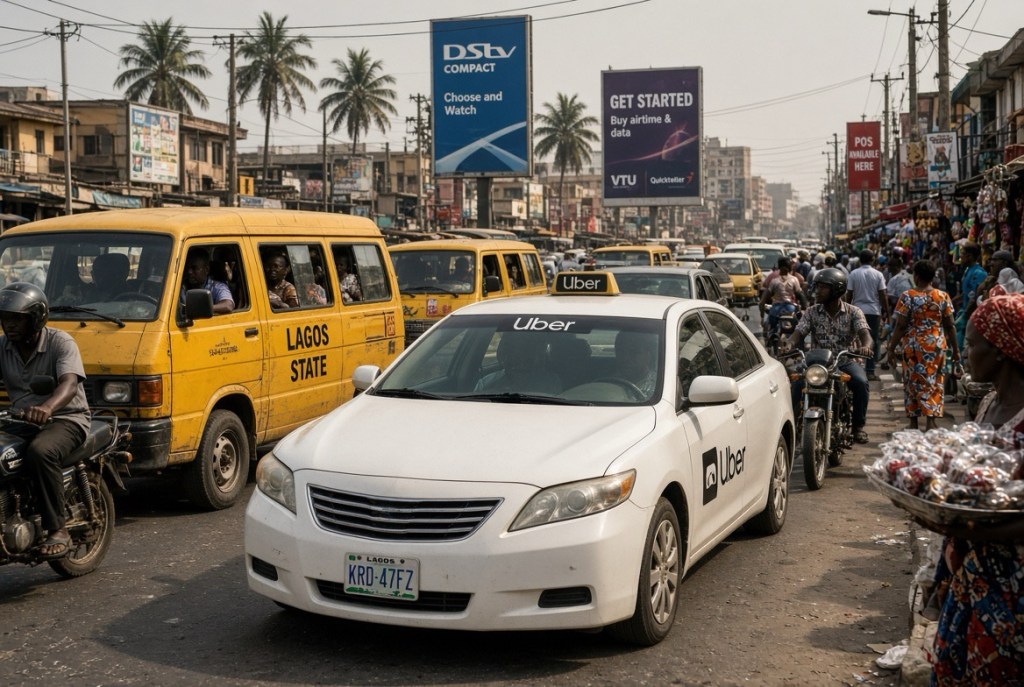
Uber has packed up its bags and left Nigeria. After twelve years of navigating Lagos traffic, Abuja politics and the general Nigerian special of “interesting times,” the global ride-hailing giant has decided the experiment is over. Effective immediately. Bolt, Faras and the usual suspects will no doubt rush to fill the gap, so the actual service of getting from A to B without bargaining with a danfo conductor will survive. The inconvenience is temporary. The optics are not.
Because this was never really about the app. It is about the message.
In the United Kingdom, the Bank of England measures inflation with a carefully curated basket of goods: milk, bread, a packet of crisps, the occasional avocado that somehow makes it into the middle-class version of the list. Economists and policymakers pore over the numbers as if they contain divine revelation. In the court of international perception, Uber sits in that same basket. Its presence says: this place works well enough for a sophisticated global company to make money, keep drivers on the road, and not spend half its life explaining itself to regulators who change the rules between breakfast and lunch.
Its departure says the opposite. Loudly.
Nigeria has just been quietly removed from the “viable emerging market” shelf and placed on the “too hard for now” pile. Uber did not leave because Nigerians stopped needing rides. It left after a “thorough review of our business.” That corporate phrase is the polite version of “the juice is no longer worth the squeeze.” Rising costs, regulatory friction, currency headaches, and the general tax of doing business in an environment where the rules can shift like the Lagos lagoon at high tide. The company is simultaneously cutting 10% of its global workforce and retreating from markets that no longer fit the new, leaner strategy. Nigeria made the cut. Or rather, it didn’t.
The tragedy is not that people will struggle to get home from the airport. Bolt will be there, ready to surge-price with the best of them. The tragedy is what the exit telegraphs to the next investor, the next tech company, the next serious capital looking for a place to plant a flag in Africa’s most populous market. When a brand as recognisable as Uber decides the Nigerian chapter is closed, the conversation in boardrooms from San Francisco to London becomes a little colder. “If they couldn’t make it work…”
Development indices are full of serious metrics: GDP growth, infrastructure scores, ease of doing business rankings, human development statistics. All useful. All incomplete. Sometimes the most honest indicator is simpler. Does a global consumer brand still want to be here? Can an app that works in dozens of other countries survive the local conditions without haemorrhaging money and patience?
Costa Coffee on the high street. Uber on the phone. Both are soft power in disposable-cup and smartphone form. Both whisper the same thing: this place has reached a certain threshold of predictability and middle-class demand.
Nigeria has just lost one of those whispers. The service will be replaced. The perception will linger. And in the ruthless marketplace of national branding, perception is not a side issue. It is the product.
The estate agents were right all along. Always check for the Costa. Or, in this case, the Uber. When it disappears, the neighbourhood has already begun to decline in the eyes of the only people who matter: the ones with the money and the options.

