
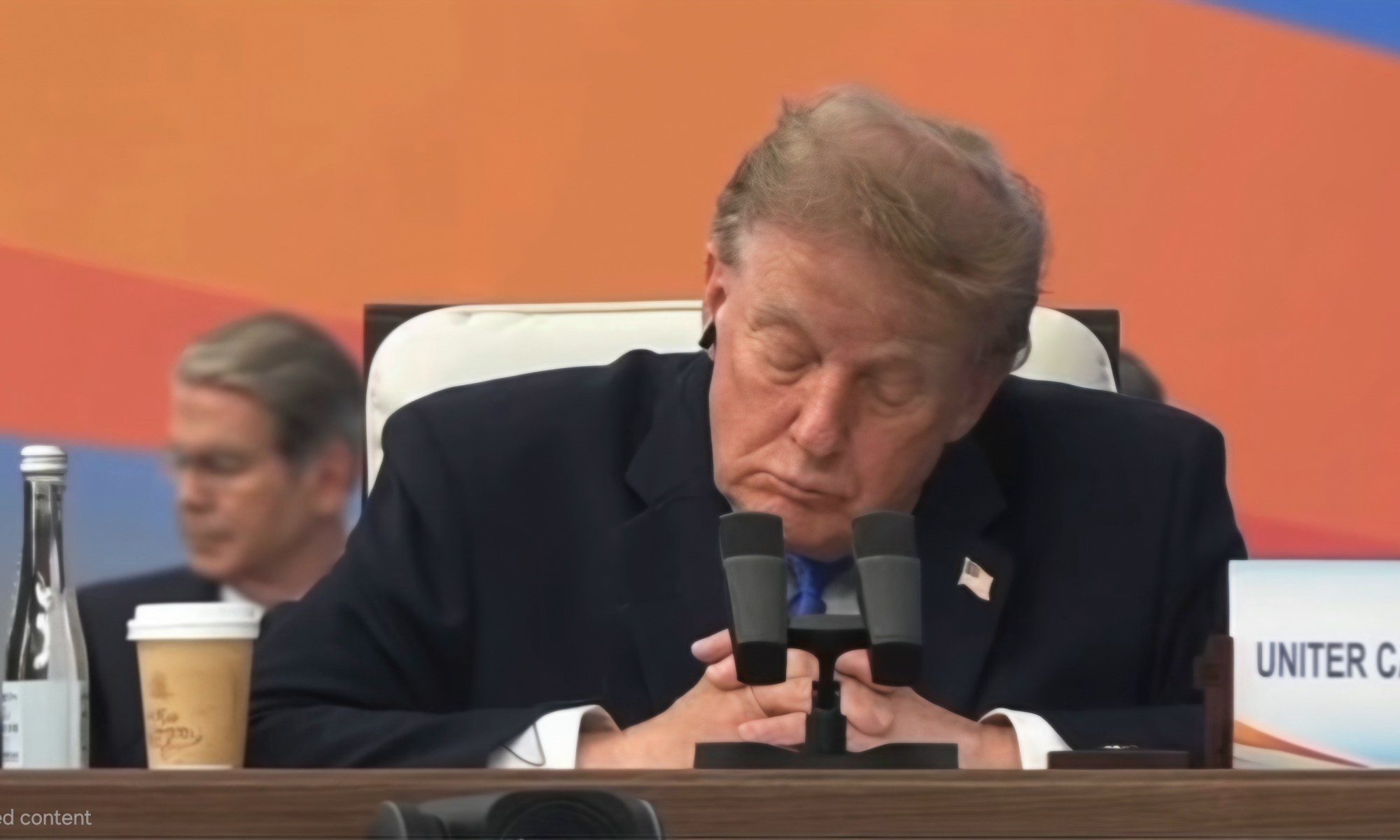
Fareed Zakaria: “I think he is a more mature, more disciplined version of himself than he was in his first term.” That’s what Jeff Bezos said about President Trump this week.
I’m puzzled by this statement from an obviously intelligent and accomplished businessman. I look at Trump’s second term, and I see the ham-handed efforts to annex Greenland and Canada, massive tariff hikes on most of the world, a cruel immigration crackdown that was both lawless and ineffective, and the sudden launching of a war without UN sanction, congressional consultation, or any clear strategy. If this is maturity, I would shudder to think what Trump’s immature phase would look like.
The opposite is actually closer to the truth. Trump’s first term was disciplined—more disciplined not because he was disciplined, but because he was constrained. He often deferred, however grudgingly, to the Republican establishment and national security elites. His early legislative agenda was shaped by Speaker Paul Ryan and executed by Chief of Staff Reince Priebus. Top economic adviser Gary Cohn repeatedly talked him out of the global tariff hikes he had long wanted. The generals whom he surrounded himself with urged caution on Iran, support for NATO, and arms for Ukraine.
The lesson Trump drew from that first term, however, was not that expertise mattered. It was that experts were not loyal enough. After the January 6th attack, you see, many of his senior officials distanced themselves from him; some denounced him. So this time, he has surrounded himself with people whose chief qualification is fealty. The less distinguished the resume, the better. Such people owe everything to him.
Process has given way to impulse, procedure to instinct, government to gut. But the starkest difference between Trump 1.0 and Trump 2.0 is not policy. It is enrichment: its scale, its brazenness, its open contempt for restraint.
The day before Bezos made his remarks, the acting Attorney General of the United States announced that the Justice Department would grant Trump, his family, and his businesses immunity from all audits and investigations for any past tax-related misconduct. And the announcement claimed it would last forever.
The week before, Trump disclosed that his stock portfolio had executed around 3,700 trades in the first quarter alone—a staggering number—many following a suspiciously convenient pattern: a stock bought shortly before a government action or statement that benefited it. On January 6th of this year, for example, the Trump portfolio bought half a million dollars of Nvidia stock. A week later, Nvidia received U.S. clearance to sell its H200 chips to China.
That was not all. The Commerce Department this week announced an investment in a quantum computing company in which a member of the Trump family holds interests. And don’t forget the $500 million UAE investment in a Trump family crypto venture, the $2 billion UAE investment using that company’s stablecoin, the flurry of new Trump Organization real estate deals, or the drone company in which the Trump family invested and that later miraculously received a Pentagon contract.
One number says it all: Reuters calculates that from the first half of 2024 to the first half of 2025, the Trump Organization’s income rose from $51 million to $864 million. This does suggest discipline—a relentless discipline devoted to monetizing the presidency. But somehow, I doubt that is what Jeff Bezos had in mind.
The Trump Organization has maintained that Trump himself, his family, and the organization don’t have any role in directing or influencing specific investments.
The deeper question is, why is this possible? And why has it produced so little resistance?
Scholars of corruption have long assumed that in advanced democracies, graft becomes subtle and institutional: campaign donations, lobbying networks, consulting contracts. Trump has taken the elaborate machinery of an advanced industrial state and used it to accelerate something far cruder: old-fashioned personal grift.
The public may be troubled, but his MAGA base doesn’t seem to be, and that is the only constituency that could restrain him. In a hyper-polarized country, corruption is no longer judged as an objective moral failing; it is filtered through tribe. If our side does it, it’s either fake news, clever politics, or totally justified revenge.
This reveals a deeper weakness in the American system. The Founding Fathers built a magnificent constitutional framework, but it rested on an assumption that they did not spell out: that public officials would retain some shared commitment to unwritten civic norms.
Madison’s design—”ambition must be made to counteract ambition”—assumed that Congress would jealously guard its powers against the executive. He did not imagine a political party that would surrender its institutional ambition to the personality cult of one man.
The legal guardrails are weaker than most Americans realize. The president is largely exempt from standard federal conflict-of-interest laws. Many of the actions I’ve described would expose even the seniormost Cabinet secretary to grave legal peril. For a president, the Supreme Court has decided that the only remedy for official acts is impeachment and two-thirds of the Senate voting for conviction, which, in our partisan age, requires a civic miracle.
The mature response to these travesties is not revenge, but a restoration of the rule of law. After Trump, the urgent task for the American republic will be to turn norms into statutes, curtail the ethical immunities of the presidency, and find legal ways to ensure that the highest public office in the world can never again become a platform for family business.

