


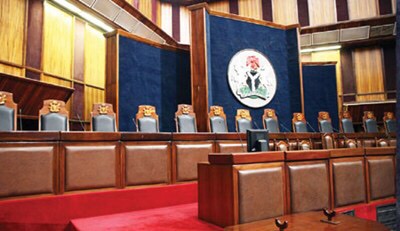
There is a question that has long occupied my thinking as a student of Nigerian jurisprudence — one that sits at the uncomfortable intersection of legal theory, political survival, and constitutional philosophy. How can a doctrine of necessity validly exist within a constitutional democracy? And more pointedly, how has Nigerian jurisprudence absorbed and applied a doctrine whose natural home is the uncodified, flexible constitutional tradition of the United Kingdom — a system without a supreme written text, without a Grundnorm in the Kelsenian sense — and transplanted it into a constitutional order built on the premise of constitutional supremacy?
This article is my attempt to think through that paradox carefully, and to ask the further question: does the United States — a constitutional democracy with a structural arrangement not entirely unlike Nigeria’s — have a comparable doctrine, and if so, how does it justify it?
The Paradox at the Heart of the Matter
Let me state the tension plainly. The doctrine of necessity, in its classical common law articulation, is a principle that validates acts which would otherwise be legally defective or unauthorised, on the ground that the alternative — constitutional paralysis, state collapse, or a greater injustice — would be worse. Its philosophical root is the ancient maxim necessitas non habet legem — necessity knows no law.
This doctrine finds its most comfortable home in a system like the United Kingdom’s, where the constitution is uncodified, where parliamentary sovereignty reigns supreme, and where there is no single supreme legal text against which an act can be measured and declared void. In such a system, the doctrine of necessity does not challenge any higher norm — because no such norm exists in the formal, hierarchical sense.
But Nigeria is not the United Kingdom. Nigeria operates under the Constitution of the Federal Republic of Nigeria 1999 (as amended) — a rigid, written, supreme instrument. Section 1(1) declares it supreme. Section 1(3) renders void any law or act inconsistent with its provisions. This is a constitutional order in which, to use Kelsen’s language, the constitution is the Grundnorm — the basic norm from which all legal validity flows. Within such a framework, how can a common law doctrine that essentially permits the bypassing of legal rules find legitimacy?
That is the central jurisprudential puzzle I want to explore.
How Nigerian Courts Have Absorbed the Doctrine
The Military Interregnum as Doctrinal Incubator
To understand how the doctrine of necessity took root in Nigerian constitutional law, one must first understand the peculiar constitutional history of the Nigerian state. Nigeria’s post-independence history has been punctuated by military interruptions — 1966, 1983, 1993 — each of which created a constitutional void that the ordinary rules of constitutional interpretation could not fill.
During these periods, Nigerian courts were confronted with a stark choice: either refuse to recognise military governments as legally valid (which would render virtually every act of governance void) or find some juridical basis for accommodating a reality that existed outside the four walls of any constitution. They chose the latter, drawing on two related doctrines — the Kelsenian theory of effectiveness and the common law doctrine of necessity — to validate governments and acts that had no constitutional warrant but were effective in fact.
This was the doctrine’s incubation period. In cases like Lakanmi v. Attorney-General (West) (1971), the courts initially showed resistance to executive overreach before political pressure eventually bent the law. The lesson of that era is that the doctrine of necessity in Nigeria was not, at its origin, a tool of constitutional democracy. It was a tool of constitutional rupture — a mechanism for bridging the gap between constitutional order and constitutional reality during periods of crisis.
The Civilian Constitutional Cases
What makes the Nigerian story more interesting — and more troubling — is what happened after the return to civilian governance. Rather than treating the doctrine as an emergency instrument relevant only during periods of constitutional breakdown, Nigerian courts began extending it into ordinary civilian constitutional disputes.
The high-water mark of this expansion is arguably Rotimi Amaechi v. INEC (2008), where the Supreme Court validated the substitution of Rotimi Amaechi as the PDP gubernatorial candidate — an act with no explicit constitutional warrant — drawing partly on reasoning that the alternative would produce a greater constitutional injustice. Here, the doctrine of necessity was being deployed not to prevent state collapse but to achieve what the court regarded as a just outcome. That is a fundamentally different — and far more controversial — use of the doctrine.
Similarly, in Attorney-General of the Federation v. Abubakar (2007), the court used necessity-adjacent reasoning to resolve questions of vice presidential succession, suggesting that where constitutional silence or ambiguity exists, necessity can fill the gap to preserve constitutional governance.
The Three Justifications Nigerian Courts Rely On
Across these cases, Nigerian courts have generally offered three overlapping justifications for importing the doctrine into a constitutional system:
The first is the ancient principle of salus populi suprema lex — the welfare of the people is the supreme law. On this reasoning, even a written constitution must yield, in extremis, to the overriding imperative of social order and national survival. The second is the idea of constitutional continuity — that the constitution itself implicitly demands its own survival, and that necessity, in service of that survival, is not contrary to the constitution but expressive of its deepest purpose. The third, and in my view the most intellectually defensible, is judicial gap-filling — the argument that Section 6 of the 1999 Constitution, which vests judicial power broadly in the courts, incorporates the power to apply common law principles not expressly excluded by the constitution.
Is There a Comparable Doctrine in the United States?
The United States presents a fascinatingly different but structurally analogous case. Like Nigeria, the USA has a written, supreme constitution — the text of which is the ultimate legal authority, protected by the doctrine of judicial review established in Marbury v. Madison (1803). Like Nigeria, the USA has no express textual basis for a doctrine of necessity.
And yet — functional necessity reasoning pervades American constitutional jurisprudence. It simply travels under different names.
Necessity in Disguise
In Youngstown Sheet & Tube Co. v. Sawyer (1952), the Supreme Court famously struck down President Truman’s seizure of the steel mills. But what is often more significant than the majority opinion is Justice Jackson’s celebrated tripartite concurrence, which implicitly acknowledges a constitutional grey zone — a space in which emergency conditions may alter the balance of constitutional power between the branches. This is necessity reasoning, dressed in the language of separation of powers.
The political question doctrine — through which American courts decline to adjudicate certain constitutional questions, particularly in the domains of foreign policy and military command — is another form of what I would call passive necessity. By abstaining, courts allow necessity-driven executive action to stand effectively unchallenged, without ever formally endorsing it.
Post-September 11 jurisprudence offers perhaps the most vivid contemporary illustration. In cases like Hamdi v. Rumsfeld (2004) and Boumediene v. Bush (2008), the Supreme Court was navigating the precise tension between constitutional guarantees and executive claims of necessity. The court never once used the phrase “doctrine of necessity.” But the functional reasoning — that some emergency flexibility exists, that strict constitutional application must accommodate the reality of armed conflict — is necessity reasoning in all but name.
The Critical Difference
The essential distinction between the American and Nigerian approaches is one of candour. American courts constitutionally sublimate necessity reasoning — they embed it within established doctrines of deference, implied powers, and political questions, never naming it directly. A United States court would never openly declare: “This act is unconstitutional, but we validate it by reason of necessity.” The constitutional culture, shaped by originalism, textualism, and the Marburian tradition of constitutional supremacy, makes such candour unthinkable.
Nigerian courts, shaped by their common law inheritance and the legitimating pressures of military history, have been willing — sometimes too willing — to name the doctrine openly and apply it directly. This candour is both the strength and the vulnerability of the Nigerian approach. It is more intellectually honest. But it is also more easily abused.
The Grand Normative Problem
I want to conclude by returning to the deepest theoretical difficulty — the one I regard as unresolved and perhaps unresolvable.
If a constitution is genuinely supreme — if it is, in Kelsen’s terms, the basic norm from which all legal validity flows — then there is no logical space for a doctrine of necessity as an independent legal source. The logic is airtight: acts consistent with the constitution are valid and need no necessity to save them. Acts inconsistent with it are void, and necessity cannot resuscitate them without hollowing out the very supremacy that gives the constitution its meaning. You cannot simultaneously affirm that the constitution is supreme and that some higher principle can override it. That is a contradiction.
The only theoretically coherent spaces for necessity in a constitutional democracy are, in my view, three: first, in the gaps — where the constitution is silent and courts must fill the lacuna using available legal tools, including common law principles; second, at the existential threshold — where the constitutional order itself faces destruction and necessity is invoked to preserve the constitutional framework rather than to subvert it; and third, as a transitional instrument — bridging pre-constitutional or extra-constitutional ruptures back toward constitutional normalcy.
What Nigerian courts have done, particularly in the post-1999 civilian era, is to expand the doctrine beyond these defensible limits into ordinary constitutional disputes. In doing so, they have handed themselves — and by extension, the political actors who appear before them — a roving licence to override constitutional text whenever a sufficiently compelling “necessity” can be constructed. That is doctrinally dangerous. It is the kind of reasoning that, if pushed to its logical conclusion, renders the written constitution an aspiration rather than a command.
Conclusion
The doctrine of necessity in Nigerian jurisprudence is a colonial common law inheritance that survived constitutional transformation — sustained by judicial creativity, by the legitimating pressure of military interruptions, and by the practical reality that every constitutional text has gaps that courts must fill. Its application within a functioning civilian constitutional democracy is theoretically strained, but it is now so deeply embedded in Nigerian case law that its existence cannot seriously be denied.
In the United States, the same underlying pressures exist but are managed through constitutional sublimation — necessity operates covertly, through other doctrines, rather than being openly invoked. Both systems are, in the end, grappling with the same permanent tension: constitutional supremacy and governmental necessity are irresolvable opposites, and every constitutional democracy must find some mechanism — honest or disguised — to manage the collision between them.
The question Nigerian jurisprudence must now confront is not whether the doctrine of necessity exists — it plainly does. The question is whether its boundaries can be disciplined sufficiently to prevent it from becoming a solvent that dissolves the very constitutional supremacy it claims to serve.
That, to my mind, remains the most important unfinished business of Nigerian constitutional scholarship.

