



There’s a difference between political ambition and political arithmetic. One inspires; the other must still add up. In Edo State, that distinction is currently being stretched to breaking point.
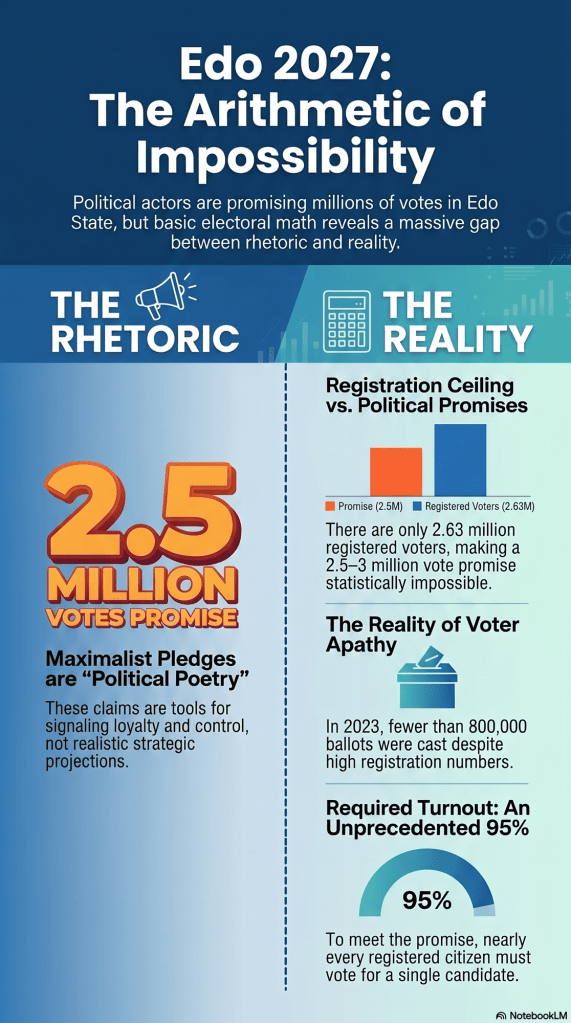
The baseline facts are not in dispute. According to Independent National Electoral Commission (INEC), Edo has 2,629,025 registered voters. Yet, in the 2023 presidential election, actual ballots cast were well under 800,000. That gap—between registered voters and real turnout—is not a clerical error; it is the enduring reality of Nigerian electoral participation: apathy, logistics, distrust, and sometimes outright suppression.
Against this backdrop, a political promise to “deliver” 2.5 million votes—and at times an even more ambitious 3 million—to a previously losing presidential candidate deserves scrutiny, not applause.
The Arithmetic Problem
Let’s strip away the rhetoric and deal with the numbers.
- Total registered voters: ~2.63 million
- Historical turnout (2023): <800,000
- Promised votes: 2.5–3 million
For such a promise to materialise, several improbable conditions must simultaneously hold:
- Near-Total Voter Turnout
You would need turnout approaching 95%+ of all registered voters. This is not just optimistic—it is unprecedented in modern Nigerian elections, where turnout often struggles to cross 30%. - Near-Unanimous Voting Behaviour
Even if turnout miraculously surged, the promise implies that almost every voter would choose the same candidate. That is not democracy; that is statistical fiction. - Perfect Electoral Logistics
Every polling unit functioning flawlessly, no delays, no disenfranchisement, no security disruptions. Anyone familiar with Nigerian elections knows this is aspirational at best. - Massive Voter Conversion Without Infrastructure
There is currently no evidence of:- A statewide voter mobilisation architecture
- Aggressive grassroots canvassing
- Data-driven voter targeting
- Civic education campaigns to convert non-voters into voters
In short, the inputs required to produce the promised output are missing.
Political Messaging vs Political Strategy
So what is really going on?
This is less about arithmetic and more about signalling.
Political actors often deploy “maximalist pledges” for three reasons:
- Demonstration of loyalty to a national figure or party hierarchy
- Projection of control over a state’s political machinery
- Psychological bandwagoning, creating an illusion of inevitability
But here lies the strategic misstep: credibility matters. A promise that defies basic electoral mathematics risks being discounted not just by opponents, but by allies and undecided voters.
A more politically prudent formulation would have been:
- “We will deliver a decisive majority”
- “We will outperform previous election results”
- “We will expand turnout and secure victory”
These are ambitious, yet defensible. They leave room for political manoeuvre. They respect the uncertainty inherent in elections.
The Missing Variable: Voter Behaviour
The real puzzle is not how to promise 2.5 million votes—it is how to move 1.8 million non-voters from apathy to action.
That requires:
- Trust-building in the electoral process
- Issue-based campaigning that resonates locally
- Operational capacity at ward and polling unit levels
- Coalition-building across ethnic, class, and party lines
Absent these, voter turnout does not magically triple because a microphone says so.
Is There a Hidden Formula?
If there is a “political arithmetic” unknown to ordinary observers, it would have to involve one of three things:
- A radical transformation in turnout dynamics (unlikely without visible groundwork)
- A misreading—or deliberate inflation—of political strength
- Purely rhetorical overreach designed for headlines rather than ballots
The most charitable interpretation is the third.
Conclusion: When Numbers Become Narrative
Politics thrives on bold claims, but elections are settled by counted votes, not declared intentions. The danger in overpromising is not just that it may fail—it is that it reframes the conversation from competence to credibility.
In Edo State, the real contest is not whether 2.5 million votes can be delivered. It is whether the political class can close the yawning gap between registered voters and actual voters.
Until that gap is addressed, promises of millions will remain what they currently are: not projections, but political poetry.
 Centre for Nigeria Progress