

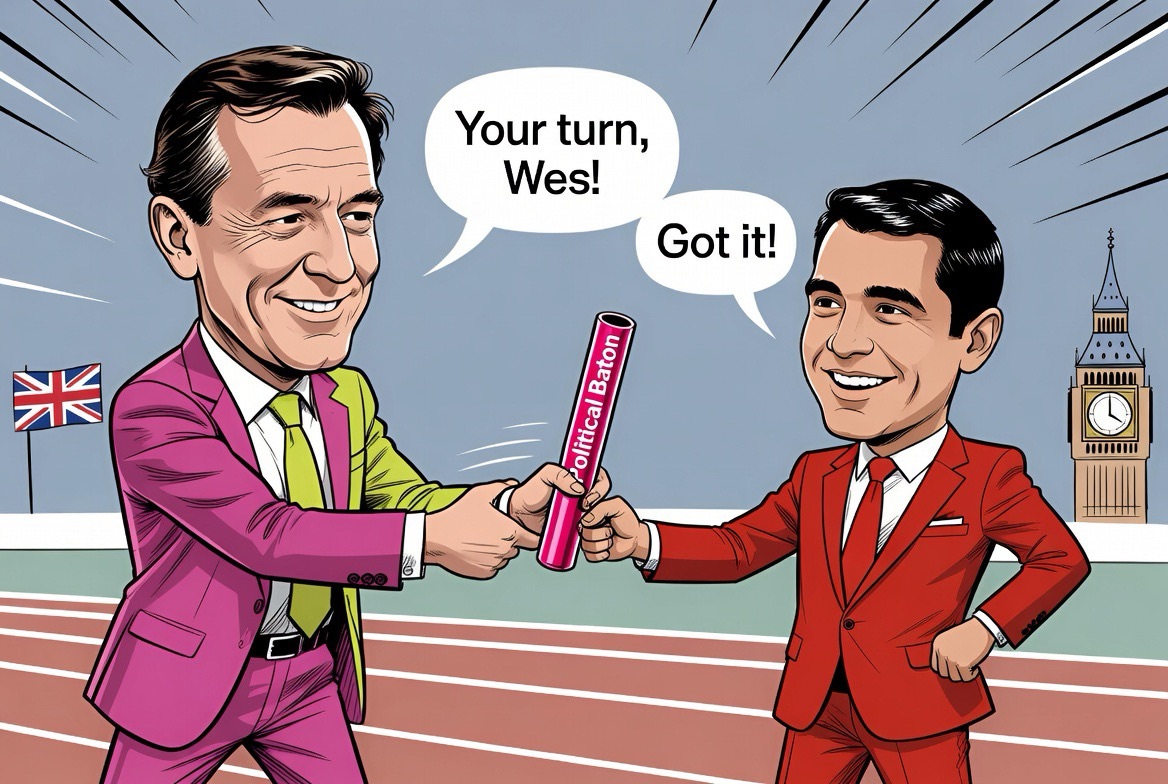

Or: A Short Political Typology of the Man Who Mistakes Applause for Destiny
Every generation of British politics produces one. A politician of middling seniority and considerable self-regard who delivers a conference speech, receives a standing ovation from six hundred party faithful in an airless hall in Birmingham or Brighton, and concludes, with the calm certainty of a man receiving divine instruction, that he is the future. Not a possible future. Not a candidate among several. The future. Singular, luminous, inevitable.
The Conservatives had Michael Portillo. Labour now has Wes Streeting. The script is identical. Only the rosettes have changed colour.
Act One: The Man With Nice Hair and a Phone Book
Michael Portillo was, by any reasonable measure, a serious politician. He was articulate, ideologically coherent in that particular Thatcherite way that involves believing the market has opinions and that they should be consulted, and he possessed cheekbones that his admirers treated as supplementary evidence of fitness for office. He served as Secretary of State for Defence, which is a job that requires gravitas, and he performed it with the sort of theatrical solemnity that you either find reassuring or deeply alarming depending on your temperament.
Then came the 1995 Conservative Party Conference. Portillo stood before the faithful and quoted the SAS motto — Who Dares Wins — with such barely-concealed personal application that the phrase might as well have been followed by: and I am the one who will dare, and I am the one who will win, and John Major should perhaps begin packing. The crowd erupted. Portillo basked. A thousand political commentators simultaneously reached for their “heir apparent” templates.
What followed was the political equivalent of measuring the curtains before you have been offered the house. Portillo arranged for British Telecom to install a bank of phone lines at a flat near Conservative Central Office, the infrastructure, it was understood, for a leadership campaign that existed only in his own expectations. He was, in effect, filing the planning application for an ambition that had not yet received planning permission.
John Major, that most tenacious of political survivors, did not oblige Portillo by immediately collapsing. And then, in 1997, the electorate intervened with the blunt efficiency of a historical correction. Portillo did not merely fail to become Prime Minister. He lost his own seat, Enfield Southgate, to a young Labour candidate named Stephen Twigg, who announced the result with the barely-suppressed joy of a man who could not quite believe what he had been permitted to do. The image of Portillo’s face in that moment entered the permanent visual lexicon of British political comeuppance. The phone lines, presumably, were disconnected.
He later became a television presenter. He wears brighter suits now. He seems happy. This is either a redemption narrative or a cautionary tale, depending entirely on how seriously you took the phone lines.
Act Two: The Man With Nice Ideas and a Newspaper Profile
Wes Streeting is, by any reasonable measure, a serious politician. He is articulate, ideologically coherent in that particular New Labour way that involves believing the NHS needs reform and that the people who work in it are the primary obstacle to that reform, and he possesses an ambition so unconcealed that political journalists have taken to describing it as “refreshing,” which is what you say about something when you have run out of polite ways to call it alarming.
As Health Secretary in Sir Keir Starmer’s government, Streeting inherited one of the most intractable briefs in British public life, a health service simultaneously beloved and underfunded, staffed by workers who had spent several years being variously clapped at, insulted, and paid in the moral currency of public gratitude rather than the legal currency of a living wage. He approached this brief with the energy of a man who has already written his own Wikipedia entry and knows that this paragraph will be crucial to it.
He has been bold. He has been outspoken. He has given interviews in which his leadership ambitions have been discussed with the discretion of a foghorn. He has made enemies in the trade unions with the efficiency of someone working to a deadline. He has, in the great tradition of the Portillo School, confused the act of being talked about with the act of being supported.
And so, in the manner of these things, his political obituary has already been written, not by his opponents, but by the peculiar British journalistic tradition of pre-emptive political burial, wherein a politician is declared finished approximately eighteen months before anyone has bothered to hold an election or a leadership contest. The obituary notes his talents, mourns his trajectory, and shakes its head with the gentle sorrow of someone watching a soufflé collapse.
The Syndrome, Defined
What afflicts these men, and it is, with notable exceptions, men, is a specific cognitive error: the confusion of momentum with mandate. A conference ovation is not an election. A newspaper profile titled “The Man Who Could Be Prime Minister” is not a parliamentary majority. The installation of BT phone lines is not, it turns out, a substitute for the vote of the Parliamentary Conservative Party.
Both Portillo and Streeting committed the same foundational mistake, separated by three decades and a change of government: they allowed the theatre of political ambition to outrun its constitutional requirements. In British politics, you do not announce that you are the future. You wait, patiently and preferably invisibly, for the future to arrive and find you there, looking surprised. The men who declare themselves wear a target that is visible from considerable distance.
There is also the question of enemies, which these ambitious men collect with the diligence of philatelists. John Major, for all his grey reputation, was an extraordinarily effective political survivor precisely because he understood that enemies are a depletable resource and allies are a renewable one. Portillo, in his conference hubris, spent both with reckless speed. Streeting, in his reform zeal and leadership-adjacent candour, has followed the same accounting model, spending political capital at a rate that would concern any prudent auditor.
A Note on the Phone Lines
The phone lines remain the most perfect image in this whole tradition. There is something almost poignant about them, the sheer practicality of the hubris. Portillo did not merely dream of leading his party. He procured telecommunications infrastructure. He filled in forms. He dealt with British Telecom, which in the 1990s required either extraordinary patience or extraordinary motivation, and Portillo’s motivation was not in question.
Wes Streeting’s equivalent is perhaps his media operation, which functions with the smoothness of a leadership campaign already in progress. The newspaper profiles, the think-piece interviews, the careful positioning as the sensible reformist alternative to whatever the Labour left is currently doing, all of it has the quality of infrastructure being quietly installed. Not phone lines this time. Broadband, perhaps. Something faster, and no less premature.
On the Matter of Political Obituaries
It would be too neat, and therefore too tempting, to say that Wes Streeting is finished. British politics has a long and inglorious history of pre-writing political obituaries for people who then survive to read them at breakfast. Gordon Brown was finished in 1994 and became Chancellor for a decade and Prime Minister after that. Boris Johnson was finished roughly fourteen times before he actually was. The obituary is a genre that politics treats with the same seriousness it treats opinion polls: useful, entertaining, and approximately as reliable as a weather forecast for the second Thursday of next month.
What can be said, with more confidence, is that Streeting has entered a particular zone of political vulnerability that the Portillo precedent illuminates with uncomfortable clarity. He is too visible to be ignored, too ambitious to be entirely trusted, too reform-minded to be loved by his base, and too associated with Starmer’s political fortunes to be entirely insulated from them. He is, in short, a man who has accumulated the profile of a future leader at precisely the moment when future leaders are most exposed.
Whether he ends up as Prime Minister or as a television presenter with brighter suits is a question that British politics will answer in its own time, with its own malice, and without consulting anyone’s infrastructure arrangements.
The phone lines, after all, are never a guarantee. They are merely evidence that the call was expected.
The Portillo Syndrome: n. A political condition in which a politician’s internal conviction of destiny develops approximately one general election ahead of the electorate’s willingness to confirm it. Symptoms include unsolicited telecommunications installations, premature newspaper profiles, and a conference speech that the afflicted individual will later watch on YouTube with complicated feelings.
 Centre for Nigeria Progress