


Nigerian politics has a curious relationship with the law. Politicians routinely ignore it until they need it. Courts routinely interpret it until they are accused of rewriting it. And regulators routinely exercise powers until someone asks where exactly those powers came from.
The recent decision of Justice Peter Odo Lifu of the Federal High Court, Abuja, directing INEC to deregister several registered political parties has raised constitutional, statutory and procedural questions that may ultimately determine not only the fate of the affected parties but also the shape of the political battlefield ahead of the 2027 general elections.
The decision has already generated allegations of “judicial rascality” from critics who contend that the Federal High Court proceeded despite a reported order of the Court of Appeal directing that proceedings be stayed pending the determination of an appeal.
As is often the case in Nigeria, the legal questions may prove more consequential than the political ones.
The Suit and the Court’s Decision
The action was instituted by the Incorporated Trustees of the National Forum of Former Legislators.
The claimants argued that several political parties had failed to satisfy the constitutional requirements necessary to retain their registration and therefore ought to be deregistered by the Independent National Electoral Commission (INEC).
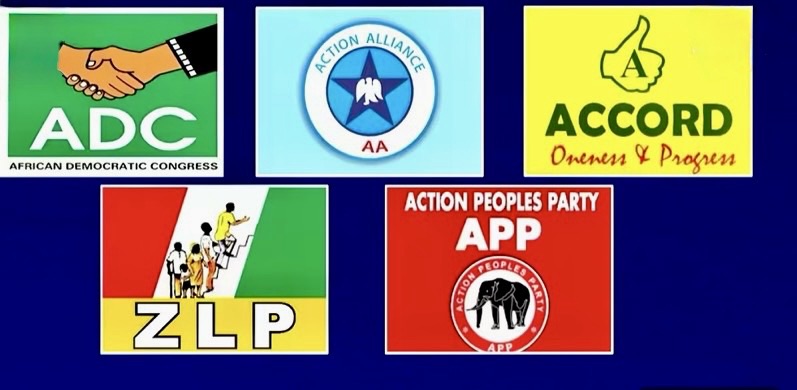
Justice Lifu reportedly agreed and ordered INEC to deregister parties including the African Democratic Congress (ADC), Accord Party (AP), All Progressives Grand Alliance (AA) and others.
The decision was founded principally on Section 225A of the Constitution of the Federal Republic of Nigeria 1999 (as amended), which empowers INEC to deregister political parties that fail to satisfy constitutional requirements relating to electoral performance.
The judgment immediately attracted attention because some of the affected parties are being discussed as potential political platforms for major political actors ahead of the 2027 elections.
Why the Case Matters Politically
Ordinarily, the deregistration of little-known political parties would barely generate public interest.
However, this case is different.
The African Democratic Congress (ADC), for example, has recently been mentioned as a possible platform for opposition realignments ahead of the 2027 elections. Political figures such as former Vice President Atiku Abubakar and others have been linked in media speculation to possible coalition arrangements involving smaller political parties.
If upheld, the judgment could significantly reduce the number of available political platforms for politicians seeking alternatives to the dominant parties.
In practical terms, the case is not merely about party registration.
It may influence the menu of political choices available in 2027.
That explains why the litigation has attracted attention far beyond the lawyers involved.
The Constitutional Basis for Deregistration
The constitutional argument rests upon Section 225A of the Constitution.
The provision was introduced to prevent the proliferation of political parties that exist largely on paper and contribute little to democratic competition.
The rationale is understandable.
Nigeria should not have political parties whose principal political activity consists of renewing office rent, printing posters and issuing annual press releases lamenting their exclusion from national affairs.
The Constitution seeks to ensure that registered parties demonstrate a minimum level of electoral relevance.
The question, however, is whether the constitutional requirements have been correctly interpreted and applied.
Does Decampment Count?
The most intriguing issue concerns parties that may not have won elections directly but subsequently acquired elected officials through political defections.
In Nigeria, politicians migrate between parties with such enthusiasm that one sometimes wonders whether party membership cards should come with return tickets.
Suppose a party wins no election.
A senator, member of the House of Representatives, state legislator or local government chairman later defects into that party.
Can it still be said that the party lacks elected representation?
One interpretation is that Section 225A focuses exclusively on electoral victories obtained under the party’s banner during the election itself.
Under this approach, subsequent defections are irrelevant because the party did not secure the original mandate.
Another interpretation is that the constitutional objective is political relevance. If a party has elected officials serving under its platform, regardless of how they arrived, the democratic purpose of maintaining viable political parties may already have been satisfied.
The issue is important because some of the affected parties may presently have elected officials who joined through lawful decampment.
If so, appellate courts may be called upon to determine whether representation acquired after an election satisfies the constitutional threshold.
The Jurisdictional Elephant in the Courtroom
Before reaching the merits of the case, there is an even more fundamental issue.
Reports indicate that the Court of Appeal had previously directed that proceedings be stayed pending the determination of an appeal arising from the dispute.
If that report is accurate and the order remained valid and subsisting, then the decision of the Federal High Court to proceed raises serious concerns regarding judicial hierarchy and compliance with appellate authority.
The relationship between superior and lower courts is not optional.
It is a constitutional necessity.
A trial court is ordinarily bound by the directives of an appellate court. Any departure from that principle risks creating uncertainty within the judicial system and undermining public confidence in the administration of justice.
This aspect of the case may become one of the central issues on appeal.
Who Has the Right to Sue?
Perhaps the most overlooked issue concerns the standing of the claimants.
The Incorporated Trustees of the National Forum of Former Legislators is not a registered political party.
It is not an electoral candidate.
It did not contest elections against the affected parties.
Nor does it appear to exercise any statutory functions under the Electoral Act or the Constitution in relation to party registration.
This raises the question of locus standi.
What legal injury did the claimants suffer as a result of the continued registration of these political parties?
Nigerian courts have gradually adopted a more liberal approach toward public-interest litigation. However, a claimant must ordinarily demonstrate sufficient interest in the subject matter of the suit.
The affected parties may therefore argue that the claimants lacked the legal standing necessary to invoke the court’s jurisdiction.
If that argument succeeds, the substantive constitutional issues may never be reached.
Is Deregistration an INEC Power or a Judicial Power?
Another constitutional question concerns institutional competence.
Section 225A confers the power of deregistration upon INEC.
This raises an important question.
Can a court directly order deregistration, or is the court limited to interpreting the law and directing INEC to consider whether constitutional conditions have been met?
The distinction is not merely academic.
The Constitution appears to designate INEC as the primary regulator responsible for assessing whether a party satisfies the requirements for continued registration.
Whether the court may effectively step into that role is likely to receive careful appellate consideration.
The Road to the Supreme Court
The affected parties are expected to challenge the judgment.
Given the constitutional questions involved, the litigation is likely to proceed through the Court of Appeal and may ultimately reach the Supreme Court.
The appellate courts will likely be asked to answer several critical questions:
- Did the Incorporated Trustees of the National Forum of Former Legislators possess the necessary locus standi to institute the action?
- Was the Federal High Court entitled to proceed despite the reported stay order issued by the Court of Appeal?
- Does political representation acquired through decampment satisfy the constitutional requirements for party survival?
- Is deregistration a power that belongs primarily to INEC or one that can be directly exercised through judicial orders?
- Was Section 225A correctly interpreted and applied to the affected political parties?
Conclusion
This litigation is about much more than the African Democratic Congress, Accord Party, All Progressives Grand Alliance and the other affected parties.
It raises fundamental questions about constitutional interpretation, judicial hierarchy, electoral regulation and access to the courts.
It also demonstrates the uniquely Nigerian reality that a political party may fail to win elections yet somehow remain attractive enough to receive defecting politicians from parties that did.
Whether such parties deserve to remain on the electoral register is a constitutional question.
Whether the Federal High Court was entitled to answer that question in the manner it did is a procedural question.
And in Nigerian law, procedural questions have a remarkable habit of becoming the main event.
As every lawyer eventually discovers, winning the argument is important.
Winning it in the right court, at the right time, and in the right way is often even more important.

