

Before reaching the constitutional merits of the case, there is a procedural issue that may ultimately overshadow every other question in the litigation.
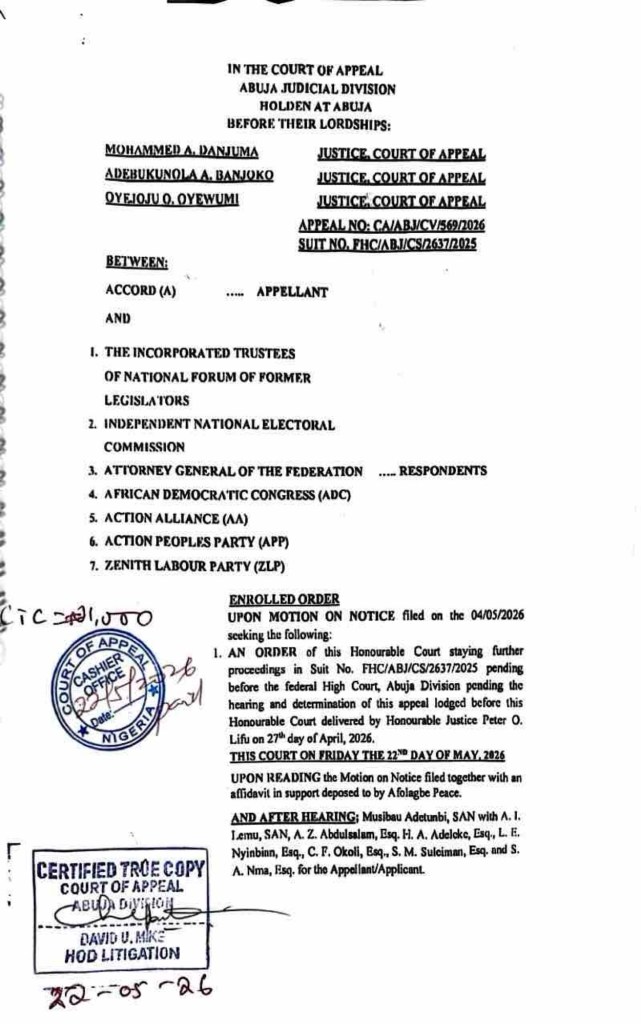
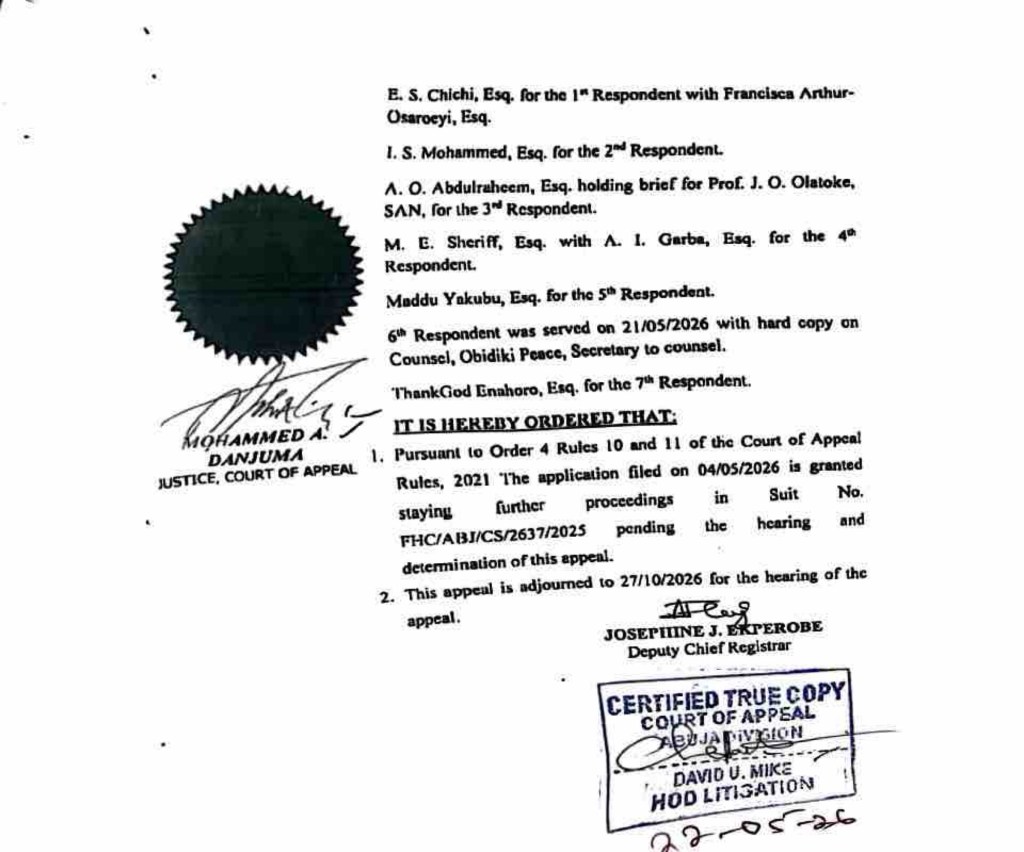
An enrolled order of the Court of Appeal, Abuja Division, dated 22 May 2026, shows that the appellate court granted an application staying further proceedings in Suit No. FHC/ABJ/CS/2637/2025 pending the hearing and determination of the appeal before it.
The order was not ambiguous.
The Court of Appeal expressly ordered that further proceedings in the Federal High Court be stayed until the appeal was determined.
This changes the nature of the controversy.
The issue is no longer whether reports of a stay order were accurate. The question now becomes whether the Federal High Court retained jurisdiction to proceed to judgment in the face of a subsisting order of the Court of Appeal directing otherwise.
The hierarchy of courts is one of the foundational principles of Nigeria’s judicial system. Trial courts do not sit in review of decisions of appellate courts. Nor do they possess a discretion to choose which appellate orders deserve obedience.
If a valid stay of proceedings existed and remained operative, any proceedings conducted thereafter may face serious questions regarding their validity.
Indeed, Nigerian appellate courts have consistently emphasised that orders of court, whether right or wrong, must be obeyed until set aside by a competent court.
The affected political parties are therefore likely to argue that the judgment itself is a nullity because the Federal High Court had been divested of authority to continue hearing the matter once the stay order was granted.
Should that argument succeed, the appellate courts may never need to reach the substantive constitutional questions concerning deregistration.
In that event, the litigation would become a classic example of a recurring lesson in Nigerian law: procedure often defeats substance.
A More Fundamental Question Than Deregistration
The public debate has largely focused on whether parties such as ADC, Accord Party, Action Alliance and others satisfied the requirements of Section 225A of the Constitution.
Those are important questions.
Yet the more immediate legal question may be whether the Federal High Court was entitled to determine those questions at all after the Court of Appeal intervened.
Lawyers sometimes describe procedure as the handmaid of justice.
In Nigeria, procedure occasionally behaves less like a handmaid and more like a bouncer at the entrance of a nightclub. It may never allow the substantive issues into the building.
Thus, while the headlines concern the deregistration of political parties and the possible consequences for the 2027 elections, the decisive battle may ultimately be fought on a narrower issue:
Can a judgment delivered after an appellate court has ordered a stay of proceedings survive appellate scrutiny?
If the answer is no, then the constitutional debate about electoral performance, decampment and party relevance may have to be fought all over again.
And if that happens, the biggest winner may not be any political party.
It may be the principle that no court, however well-intentioned, is above the judicial hierarchy established by the Constitution itself.

